
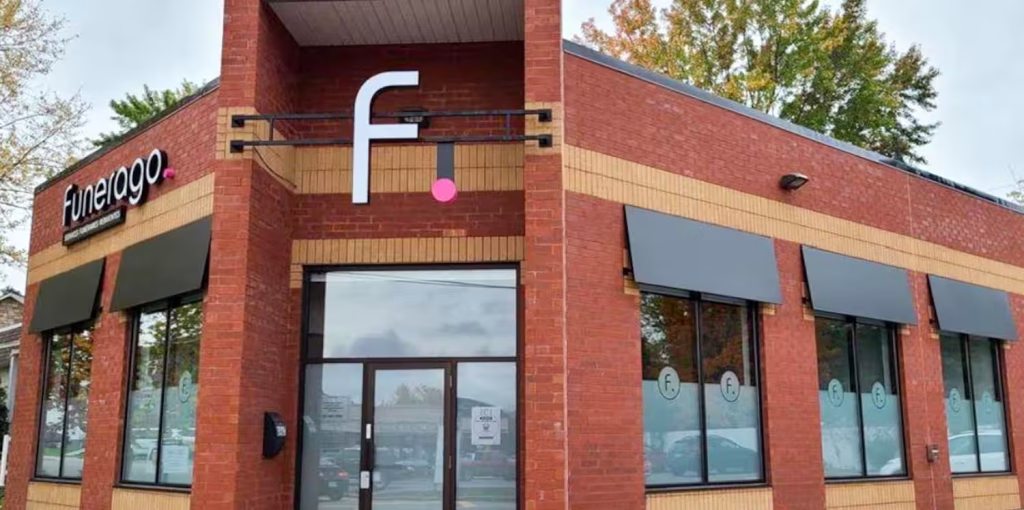
Image Credit: Le Journal de Montréal
I first wrote about obituary piracy back in 2019, and then more recently (here and here) about the online obituary company, Echovita which, to be clear, does not engage in copyright infringement. This is because it manages to stay just within the law by taking information from obituaries on funeral home websites and posting rewrites based on the basic, non-copyrightable facts regarding the deceased, even though the family or funeral home has not granted permission for them to do so. While full obituaries describing a person’s life can be protected by copyright law, basic facts are not protectable. Echovita takes full advantage of this, frequently to the anguish of bereaved family members and the annoyance of funeral homes. Not only does Echovita post the rewritten obituaries without seeking permission from either the family or the funeral home (which is legal), they also not infrequently get basic facts wrong. This is likely explained by use of AI in reviewing and rewriting thousands of obituaries a day. Predeceased relatives have been recorded as mourning the deceased. Pets have been identified as friends of the departed. And since Echovita’s business model is to monetize the obituaries by selling memorial items such as flowers, tree plantings etc. on their obituary site, they cut into a revenue source of the funeral homes who host the “authorized” obituaries. To date, no jurisdiction has enacted any law prohibiting the practice of monetizing obituaries without the consent of the family. Whether there should be such a law is another matter.
On its website (FAQ), Echovita explains how an incorrect obituary can be removed or edited. However, the bereaved family needs to initiate the remedy by completing an online form. Apart from this contact sheet on its website, there appears to be no other way to get in direct contact with Echovita. No doubt they prefer it that way. It’s easier to filter complaints, and you don’t have to deal with irate family members phoning to complain about mistakes in an unauthorized obituary of a loved one. I am not sure what Echovita’s error rate is. It may be quite small but given that it scrapes obituaries from websites all over North America, even a small error rate could be significant in absolute terms. And if it is the obituary of your loved one that has been mangled, it is very significant, and hurtful. All I know is that since I wrote my most recent blog posting on Echovita in July, I have started to receive phone calls from distressed family members from various parts of the US. Since I don’t answer phone calls that I don’t recognize, they usually leave a voice message, often very irate and threatening legal action if a particular obituary is not taken down forthwith.
At first, I was puzzled as to why I was getting these calls, but I attribute it to AI. People who feel victimized by Echovita want to take action quickly and to vent. This is understandable. Simply filling out a request on a website to have an unauthorized obituary corrected or removed (three days is the apparent standard) is not as satisfying as speaking to someone right now. You won’t find Echovita’s phone number anywhere but if you do a deep enough internet search on the company, my previous blog postings on Echovita will come up and, I surmise, AI will produce my phone number in response to a request for a “phone number associated with Echovita”. When I get called like this, I phone back, express my condolences and explain that unfortunately they are shooting the messenger. The first question is always, “how can I get in direct touch with Echovita?”. Here is what I know.
The company is run by someone called Pascal (aka Paco) Leclerc. I know this from various press articles, such as this one a few years ago in Wired and more recently in the Toronto Star. I also know this because after my most recent blog posting on Echovita, (Echovita is Still Going Strong: The Sleazy (but Apparently Legal) Business of Monetizing Obituaries Without Consent) I received an email apparently from him as CEO of Echovita requesting removal of my “inaccurate and misleading” blog post. It went on to say that; “Your article contains statements and implications that are factually inaccurate, misleading, and potentially damaging to our reputation. Echovita operates fully within the law, follows industry norms, and provides a free, valuable service to families by making obituaries more accessible and offering optional remembrance tools.”
This was (part of) my response;
“I publish a blog discussing copyright issues, often using current legal cases or media coverage to illustrate the topics under discussion, presenting my opinions on issues such as copyright piracy, use of copyrighted content by AI development companies and other copyright-related issues. My viewpoint is pro-creator and pro-copyright, as stated on the blog.
One topic on which I have written concerns piracy of obituaries, given that an obituary is usually a creative work that can be protected under copyright. In the case of Echovita, I have commented that Echovita’s business model of scraping obituary websites, extracting the basic unprotected facts concerning the death, and then republishing the basic information, is legal and avoids copyright infringement in contrast to the practices of another entity, Afterlife, that was found to have engaged in “obituary piracy”. I also noted that Echovita’s business practices are controversial and have upset many family members of the departed because the republished obituaries (more correctly, death notices), have been published without the consent or even in many cases the knowledge of those who may have originally published the obituary in a newspaper or on a mortuary website.
Because of the lack of consent or contact with the family, mistakes have been made in the death notices published by Echovita. While Echovita undertakes to correct any such mistakes, it is incumbent on the family to request the correction. I contrasted Echovita’s business with Legacy.com, which operates a similar website but does so on the basis of obituary content licensed from newspapers and with the consent of those placing the obituaries. Please indicate which parts of the above summary, or indeed information that I included in the blog post are inaccurate or misleading. I strive for accuracy and would be happy to correct any such misinformation on the blog.”
That was a couple of months ago. I have not heard back.
Echovita’s position is that it is providing a “service” to families (albeit one that they did not, in most instances, request). Its stated “mission” is to “make public information more easily accessible, free of charge”. While it has had plenty of complaints directed at it, one of Echovita’s responses is to encourage voluntary use of its site. For example, it advertises that users can add photos, personalize a text or authorize the original obituary for publication.
All for free! (whether you want it or not).
Here is an excerpt from one of its blurbs;
“Grief is universal and so is the need to remember. By centralizing obituaries online and making them easy to find and share, Echovita fills a critical gap between funeral homes, grieving communities, and the permanence of the internet. No family should lose a tribute because a newspaper shut down or because a paid notice couldn’t be afforded.”
Touching, n’est-ce pas? The problem is not the voluntary option. The problem (the moral problem, not the legal one) is the unauthorized republication and monetization of death notices of deceased family members without the consent, or in many cases, even knowledge of family members, compounded by making errors in republication. This business model is another offshoot of the internet where it costs very little to collect and digitally republish information, potentially reaching a market of millions to provide third party services on the platform. And it’s all perfectly legal.
But what if someone wants to actually talk to a real person at Echovita, say Paco Leclerc or one of his employees, to express some concerns? Well, good luck to that.
According to the website Zoominfo.com, Echovita is headquartered in Quebec City, Canada, at 8967 1ère Ave, Quebec, Quebec, G1G 4C5, Canada. If you go to that address on Google Street View, a building with name Funerago on it appears. Funerago.com has a website (and a phone number). It is an online platform offering basic cremation services and is associated with another entity called Funera which provides somewhat more expensive cremation services. Funera is located at the same addresss. Testimonials on Funera’s site thank Paco Leclerc for his help and understanding. The Wired article back in 2021 that I referenced above mentions that Leclerc intended to invest in a new business called Funerago so there is clearly some connection between Funerago and Echovita, including a common business address. So, of course I called Funerago and asked to speak to someone, anyone, about Echovita. All the person who answered would say was that someone would call me back. I left my phone number.
If they call, I will have a contact number for Echovita, one that I would be happy to share. But it’s been a couple of weeks and I am still waiting. The silence is deafening. I don’t expect to be called anytime soon.
© Hugh Stephens, 2025. All Rights Reserved.
