
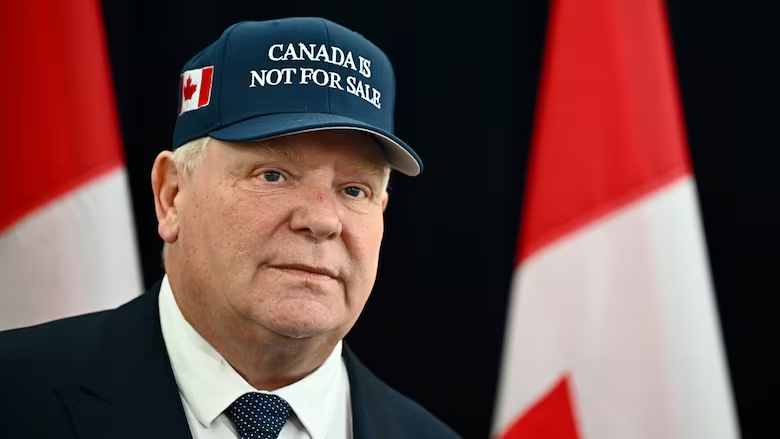
Ontario Premier Doug Ford wears his Captain Canada hat. Credit: CBC (Justin Tang/Canadian Press)
As Donald Trump continues his tariff threats against Canadian products, but more specifically doubles down on his “Canada should be the 51st state” nonsense, he has succeeded in doing what Prime Minister Trudeau has been unable to do over the past few years—uniting Canadians. Some Canadians are so incensed that they have taken to calling their favourite coffee beverage a “Canadiano” instead of an “Americano“. That’s extreme but hey, if Donald Trump can unilaterally change the name of the Gulf of Mexico to the Gulf of America, anything goes. While Trump apparently has spoken to some Canadians who are allegedly “interested” in the idea of annexation (did he find them on a golf course in West Palm Beach?), Canadian leaders and members of the public have made it plain that becoming part of the US is a non-starter.
In recent polls in Canada, opposition to Trump’s plan ranged from 90-94%. But of course that hasn’t stopped Donald Trump from publicly musing about the idea, although he seems to be just about the only person in the US who is actually interested in it, and he certainly didn’t campaign on it. Even if Canadians were interested, which they are not, the domestic political obstacles in the US to absorbing the world’s second largest country, with 42 million people, several million of whom have French as their first language, are insurmountable. It’s worth noting that Canada has more people than the most populous US state (California) and is 15 times geographically larger than the largest continental US state by size (Texas), and seven times bigger than the largest (Alaska).
However, the current issue is not whether or not Canada would ever become part of the US but rather what actions individual Canadians are taking to show their opposition to the idea. A recent public opinion poll from the respected pollster Leger reported that a large majority of those polled indicated they were prioritizing buying Canadian and consciously avoiding US products. More than half said they had cancelled trips to the US or would not travel there. The US Travel Association reported that in 2024 Canadians made more that 20.4 million visits to the US (the most from any foreign country), generating $20.5 billion in spending and supporting 140,000 US jobs. Thus a 10% reduction would mean $2.1 billion in lost spending and a loss of 14,000 jobs. The top states that Canadians visited were Florida, California, Nevada, New York and Texas. If your winter temperatures hit the minus 30s, as they do in many parts of Canada, Florida and California are understandable escapes, although there are alternatives. Mexico is a prime example.
When it comes to US products like alcohol it is also not that difficult to find good alternatives. California wine may be great, but there is Australia, Europe, Chile—even Canada itself as a source of supply. Some foodstuffs might be difficult to substitute, however, given the close integration of supply chains between the two countries. While people have started to boycott US brands, one has to ask what is a US brand, or a Canadian brand, these days? Canada Dry has long been a US product and is owned by Dr. Pepper. However, many US branded products are actually produced in Canada, so it takes some perspicacity to realize that Heinz ketchup is (once again) produced in Canada, at least for the Canadian market, as it loudly proclaims. (Canadians may remember that back in 2016 Heinz pulled out of Canada. After a widespread boycott of the product, the company rethought its policy and returned in 2020). The effectiveness of consumer boycotts is clearly illustrated when businesses such as A&W and Boston Pizza are sporting signs in Canada proclaiming that they are proudly Canadian owned and operated. Interestingly, that all-Canadian icon donut shop Tim Hortons is ultimately controlled by RBI, a US-Brazilian corporation, although most of its franchisees are Canadians and it is headquartered in Toronto.
These intricacies and nuances help explain why it is difficult for consumers to correctly identify the source of a product in order to accurately target their ire. And then there is the inconvenience of avoiding products you like, which can lead to all sorts of rationalizations. After all, most Americans don’t want to annex Canada and even if they voted for Trump, taking over Canada wasn’t part of the reason. So why try to punish them? The Province of BC took that a step further by announcing that it was going to pull all liquor products off the shelves of provincial liquor stores, but only if the products were from “red states”. We could still buy the Oregon pinot noir or that luscious California red blend with a clear conscience! (In the end, the wines have not yet been pulled because Trump postponed the tariffs on Canada for 30 days).
While Canadian consumers wrestle with whether they should cancel their trip to Disneyland or give up Florida orange juice for BC apple juice, the one thing they seem to be mostly united on is the need to leave their favourite US content streaming services out of the equation. According to the Leger survey, less than 30% said they would consider cancelling a US streaming service. (the recent price increases by Netflix might be a more compelling reason). Thus Netflix, Disney +, Prime, Apple TV and others seem safe. It’s easy to see why. Lack of real alternatives.
Bell Canada offers a domestic streaming service, Crave, but what is its prime attraction? Access to HBO. HBO does not operate a streaming service in Canada, at least not right now. It is more profitable, presumably, for the company to license its content to Bell for streaming on Crave. CBC offers an ad supported and an ad-free subscription streaming service, CBC Gem, but in the eyes of many consumers, it doesn’t stack up. Moreover, Netflix offers Canadian content if you want it. There is even a button highlighting how to access it. Besides, many of the most popular shows on Netflix are not US shows. There is Squid Game from Korea, many Nordic shows, Spanish, Italian, French and British productions abound, along of course with a range of US content. Netflix may be US owned but it has become an international platform to showcase content from around the world. It, and other US producers, also spend a lot of money producing content in Canada, some of it (a small minority) recognizably Canadian. As for the rest, it helps keep production in Canada growing. So, if you wanted to make a point, cutting off your US content nose to spite your Canadian entertainment face doesn’t seem like a very good idea. Most Canadians appear to have reached that sensible conclusion.
Will any of this stop the Trump tariffs? Consumer boycotts can have some impact, and retaliatory tariffs promised by Canada against imports of US products will hurt US exporters, such as the farming community, which is politically influential. US tariffs on imports of Canadian products, including imports that cannot be easily sourced elsewhere (think BC lumber to rebuild houses destroyed in the California fires) will increase costs to US consumers and drive up inflation in the US. That might be a more powerful reason why the Trump Administration in the end may back off somewhat. However, Donald Trump seems unlikely to stop spouting his disrespectful 51st state mantra, and the more he does, the more he will convince Canadians to come together and push back—but it seems that changing viewing habits is unlikely to be part of this.
Now if Trump really wanted to bring Canada to its knees, he would block all US streaming content, television and sports broadcasting. No Super Bowl, No NBA, No Netflix, No Disney.
We surrender!
© Hugh Stephens, 2025. All Rights Reserved.
This post has been updated to reflect the obvious fact that Alaska is the largest US state geographically, not Texas. Sorry Alaskans.