The Year That Was: Looking Back at Copyright Issues in 2025

A graphic featuring the text '2025 A Look Back' inside a magnifying glass on an orange background.

Image: Shutterstock.com

In last year’s annual retrospective, I commented that just about the only significant copyright story in town was the impact of AI on copyrighted content. There were three primary dimensions, unauthorized use of copyrighted content for AI training, copyright infringing outputs produced by AI platforms and whether works produced by or with AI qualify for copyright protection. The first two elements, especially the unauthorized use of copyrighted content for AI training, continues to be the big story in 2025. Little has changed in terms of the fundamental issues, although this year there were two key court rulings in the US that provided some legal guidance. These were the Bartz v Anthropic and Kadrey et al v META cases, both decided within hours in the same courthouse in San Francisco, but by different judges. As I noted in a blog post at the time, in July, the results were a very mixed bag. (Hold the Champagne: The Two AI Training/Copyright Decisions Released in the US Last Week Were a Mixed Bag for AI Developers). While both judges found the copying of copyrighted works to train AI algorithms “transformational”, and thus tending toward fair use, in the Anthropic case the AI developer was castigated for initially using two pirate data bases (Library Genesis, aka LibGen, and Pirate Library Mirror, aka PiLiMi), as source material. This use threatened to result in hundreds of millions of dollars in statutory damages for authors whose works were included in these databases (if they had registered their works with the US Copyright Office). Thus, it was with no great surprise that the world learned in September that Anthropic had agreed to a $1.5 billion settlement to bring an end to the case. (When the End Does Not Justify the Means: Anthropic’s $1.5 Billion Lesson). In the Kadrey case, the judge suggested the plaintiffs should have made a stronger market dilution argument, which might have overridden the transformation finding. (New AI works produced based on unauthorized inputs of copyrighted works will devalue and dilute the market for the original works). That theory has yet to be fully tested.

While the Anthropic settlement seemed large in absolute terms, many criticized it as just another cost of doing business that failed to protect authors. But that is what licensing is, a cost of doing business. The damages could have been larger than the settlement, so Anthropic made a strategic decision to settle. Given the precedent, META must be worried given the clear evidence that its top executives gave the green light to use LibGen for training purposes despite internal warnings about the risk of doing so. (Is it Ethical to Use Pirated Content for Commercial Purposes? META Thinks So). The Anthropic decision gave impetus to ongoing licensing discussions between AI developers and content owners, especially large corporate rightsholders, like news media, music labels and big studios, such as Disney. The list of companies striking significant licensing deals with AI developers, either for AI training or outputs containing derivative content, is rapidly growing. Meanwhile lawsuits, such as New York Times v OpenAI, continue in lieu of settlement agreements.

Outside the US where the “fair use” doctrine along with its transformation interpretation doesn’t apply, there are also lawsuits against AI developers (in Canada and India for example). However, in these “fair dealing” countries AI developers are in a potentially tighter spot. In many countries there is no statutory exception to allow unauthorized access to copyrighted content for AI training, commonly known as text and data mining (TDM). Where there is such an exception (as in the UK or EU), it is confined to very specific circumstances such as non-commercial research, or else it requires that rightsholders be provided with an opt-out mechanism. Given these inconvenient facts (and their inability to rely on fair use arguments outside the US), AI developers have been mounting a full-court press to have TDM exceptions introduced into national legislation using the pretexts that a) everyone is doing it (which is certainly not true) and b) if governments don’t create an exception allowing TDM for AI training, all those AI development funds will flow elsewhere. In other words, throw rightsholders and creative industries under the bus in order to chase some ephemeral AI research funds. Australia has just rejected this binary approach, announcing that a TDM exception will not be part of its review of copyright laws to help address the needs of the AI industry. A number of Asian countries are reviewing the need for a TDM exception, but are rightly being very cautious not wanting to sacrifice the vital cultural and economic interests their creative sectors represent. Canada is another country without a TDM exception, a situation that has made OpenAI jittery since they are being sued in Ontario Superior Court by a consortium of Canadian news publishers for copyright infringement, bypassing Technical Protection Measures (protected paywalls) and breach of contract. OpenAI has been trying to get the case moved to the US by challenging the jurisdiction of the Canadian court, so far unsuccessfully.

Just as lawsuits in the US are providing the impetus for settlement discussions between AI developers and rightsholders, lawsuits against the AI industry outside the US will potentially have the same effect. The big story of 2025 is how many licensing agreements have been already reached. Even META, which in Canada and more recently Australia insisted it doesn’t need news content and would not pay for it, has reached a news media licensing deal with a number of companies including USA Today, People, CNN, Fox News, The Daily Caller, Washington Examiner and Le Monde. Back in 2021 META agreed to license news content in Australia as a result of the introduction of the Australian News Media Bargaining Code, but when Canada enacted a similar provision, it refused to do so and evaded the obligation to pay for local news by blocking it on its Facebook and Instagram platforms. Subsequently, when the Australian Code came around for renewal this year, META balked. Australia is still contemplating its next steps and while it is treading carefully, indications are that it is prepared to move against META.

One reason why Australia is moving carefully is the Trump factor. Trump’s erratic behaviour including the tearing up of the established rules of international trade is the second big copyright theme of 2025, after AI’s predations and encroachments. Not that Donald Trump knows much about copyright or understands it, but in his broadsides against trading partners and the international trading system, copyright industries inevitably become caught up in his web. Whether it is threatening tariffs on movies filmed outside the US, regardless of the fact that the largest slice of the box office comes from non-US sources and many films are either co-financed by offshore producers or require non-US settings (Trump’s Threatened Tariffs on Hollywood Films Produced Outside the US: The Medicine Could be Worse than the Disease), or taking aim at the policies of other countries that may have a digital or content component, like the Digital Services Tax in Canada,and its Online News Act, Trump is unpredictable and often off-target. His initial tariff measures against Canada included everything from steel to autos, based on the specious “national security” argument that there was a flood of fentanyl coming into the US from north of the border (actually about 0.2% of the total in 2024), but so far he has not specifically targetted the cultural industries. That may all change as the negotiations for renewal of the CUSMA/USMCA begin in the new year and as Canada struggles to redefine “Canadian content”.

There are industry groups in the US that claim provisions of the Online Streaming Act violate the terms of the CUSMA/USMCA by discriminating against US content providers, and that the only way Canada can justify these provisions is to invoke the cultural exception clause of the CUSMA. This would allow the US to retaliate in any sector with equivalent commercial effect. I have questioned this interpretation but we will probably never know who is right because the Online Streaming measures are unlikely to be challenged by the US prior to the start of CUSMA/USMCA renegotiations in early 2026. In those negotiations, the US will almost certainly take aim at various elements of cultural legislation like Online News and Online Streaming, along with other issues like dairy supply management. These may or may not be subject to negotiation as part of the renewal of CUSMA, if indeed the US or Canada are prepared to renew it.

Even if Canadian actions are consistent with the terms of the Agreement, this is essentially meaningless given the way the Trump Administration operates, as demonstrated earlier this year when Trump overrode various tariff free commitments in the Agreement on the basis of unilaterally declared national security concerns. These included the specious fentanyl trafficking claim mentioned above. Not only did the miniscule numbers give the lie to this assertion but the US claim somehow made Canada responsible for ensuring the security of the US border. As professor Fen Hampson of Carleton University has eloquently pointed out, the fate of CUSMA/USMCA depends not so much on where the economic interests of the United States lie, but on the fickle and unpredictable whims of Donald Trump personally.

As we head into 2026, there will be more Donald Trump uncertainty affecting copyright industries, more AI disruption, more lawsuits, more settlements and more licensing agreements to avoid lawsuits and settlements. That’s a pretty safe prediction based on looking back on 2025.

© Hugh Stephens, 2025. All Rights Reserved.

US Retaliation Against the Online Streaming Act: How Real is the Threat?   

Illustration of the Canadian flag overlaid with yellow caution tape labeled 'TARIFFS', featuring American flags, symbolizing trade tensions between Canada and the USA.

Image: Shutterstock

As CRTC hearings on implementation of the Online Streaming Act (formerly Bill C-11) grind slowly forward as part of the Commission’s deliberations as to how foreign audiovisual and audio (music) streaming services may be required to meet Canadian content (Cancon) and discoverability requirements, while determining the extent of their financial contribution to various funds supporting Canadian content, affected US industry players are not sitting on their hands. As you would expect, they are deploying a range of tactics to fight back using their industry associations, the Motion Picture Association (MPA)-Canada, representing Netflix, Disney, Sony, Paramount, Universal, Amazon Prime and Warner Bros. Discovery, and the Computer & Communications Industry Association (CCIA), representing among others Amazon, Apple, Google and Meta, as their vehicles of choice.

MPA-Canada is currently appealing to the Federal Court the CRTC decision that its members must contribute 1.5% of annual revenues to the Independent Local News Fund, arguing that the studios do not produce news and should not be required to contribute to a line of business in which they are not active. Apple, Spotify and Amazon are also appealing the full 5% payment on the grounds it is a tax the CRTC is not mandated to apply. The 1.5% contribution to news is part of the CRTC’s initial decision that the streamers should, as a “downpayment”, contribute 5% of revenues to fund Canadian production.  The MPA has also undertaken a lobbying campaign to point out how much its members already contribute to production in Canada, (CAD$6.7 billion in 2023, more than the CBC, Canadian Media Fund and Telefilm Canada combined) even though much of that content does not count as CanCon under current rules.

To this “positive” argument, the CCIA by contrast has added a more hard line, “negative” approach, releasing a study that calculates the amount the CRTC’s compulsory contributions will purportedly cost the US industry. Assuming the levy stays at 5% of revenues (by no means an assured outcome as Canadian broadcasters are urging the CRTC to impose contributions of 20 to 30%, similar to the obligations they face), CCIA estimates this will cost US streamers between $2.19 billion and $6.96 billion (all figures USD) by 2030. The estimate of losses is bundled with CCIA’s claim that the financial obligations constitute a violation of the CUSMA (known as the USMCA in the US) because it creates a preferential regime for Canadian content “thereby discriminating against content classified as American or from a third country”. In the eyes of the CCIA, actions under the Online Streaming Act violate the principle of “national treatment” in which Party A agrees to treat the products and services of Party B “no less favourably” than its own products and services. In support of this claim, CCIA cites the Investment and Digital Trade Chapters of CUSMA/USMCA, Chapters 14 and 19 respectively. According to CCIA, the Online Streaming Act’s “inconsistency with core trade obligations is beyond dispute”. Given this “indisputable” fact, CCIA states thatif challenged, Canada can be expected to invoke its cultural industries exception (Article 32.6) as a basis for justifying the inevitable discrimination….

Article 32.6 is part of the General Exceptions Chapter of the CUSMA/USMCA. It states, in part, “This Agreement does not apply to a measure adopted or maintained by Canada with respect to a cultural industry…” The production, distribution, sale, or exhibition of film or video recordings as well as audio or video music recordings are included in the definition of a cultural industry. As I have written elsewhere (NAFTA and the Cultural Exception) Article 32.6, while in theory exempting defined cultural industries from the obligations of the Agreement (the NAFTA provision was essentially rolled over into the CUSMA), has a sting in its tail. If Canada applies any discriminatory measures that violate the agreement using the cultural exclusion as the pretext, the US is fully within its rights to retaliate with measures of “equivalent commercial effect”, in any sector. The CCIA’s $2.19 billion or $6.95 billion numbers need to be viewed in this context.

The first question, therefore, is would Canada need to resort to Article 32.6 to justify measures taken under the Online Streaming Act? I argued in an earlier paper I wrote for the School of Public Policy at the University of Calgary that given the current structure of the obligations, Article 32.6 would not be in play because the measures in question are not inconsistent with CUSMA, given the Agreement’s precise wording. You can read the detailed arguments in the paper, but essentially my position is that neither the Chapter 14 Investment reference nor the Chapter 19 Digital Trade provision cited by CCIA are relevant because content streaming is covered by a separate part of the Agreement, Chapter 15, Cross-border Trade in Services. The terms of the Online Streaming Act, as applied by the CRTC provide “national treatment” to foreign streaming services. In fact, they impose lesser requirements on foreign streamers with respect to carriage of Cancon than they do on Canadian streamers.

But this interpretation is only my personal view. I have no idea is this is the interpretation of the trade policy gurus at Global Affairs Canada (I haven’t spoken to them and even if I did, they would be unlikely to tell me what their position would be on a hypothetical trade case) and is almost certainly not the interpretation favoured by officials in the Office of the US Trade Representative (USTR). And certainly not by CCIA. CCIA’s position is that a show or track streamed in Canada is a digital product, (even though it describes its members as providing “streaming services”). The Agreement is clear that there should be no discrimination against digital products of the other Party i.e. they should be accorded “national treatment”, although domestic products can be subsidized. On the other hand, if streamed content is not considered a digital product (nor an investment, which according to CUSMA cannot be subject to “performance requirements” as a condition of allowing the investment) but rather a cross-border service, the conditions applicable to delivery of the service are what counts. National treatment needs to apply to service delivery, and insofar as the Online Streaming Act is concerned, it does.

Whether streamed content is a digital product or a cross-border service clearly matters. If the US brought a CUSMA trade complaint against Canada–and if the CCIA view were to prevail–Canada would either have to change the way it treats US digital products carried by streaming services or defend its actions on the basis of the cultural exception, Article 32.6. If it did the latter, it would be opening itself to trade retaliation by the US, at an equivalent commercial level. In my experience and judgement, Canada would be most unlikely to resort to the exception to justify its actions precisely because of the consequences. The US would retaliate not just against the cultural sector, but in other areas that would set one industry or part of the country against another. To avoid this, the government would instead find some other way to comply with the Agreement by modifying the offending provision (as little as possible but as much as necessary), but doing so in a way, if possible, that still met all or most of its policy objectives.

It is also just possible, however, that Canada would be prepared to absorb the retaliation, calculated by CCIA to be between $400 and $500 million annually if the CRTC mandated contribution remains at 5% of revenues. This sounds like a big number but the random way the Trump Administration has been imposing tariffs on a range of Canadian products such as steel and aluminum (50%), lumber (45%), and autos (25%), industries where Canadian exports total tens of billions of dollars annually, makes $400 million in possible retaliation seem relatively minor. In effect, Trump’s erratic punitive behaviour has normalized trade retaliation–and devalued its effectiveness as a threat. But whatever response the Canadian government took, the first step would be to determine whether Canada was in fact in violation of the Agreement. If one Party considers that “an actual or proposed measure of another Party is or would be inconsistent with an obligation of this Agreement”, it can resort to the dispute settlement process. In the first instance, this involves consultation and if no resolution is reached, sometimes the constitution of a panel to decide the issue. (CUSMA/Article 31).

The CCIA itself cannot charge Canada with non-compliance, although it can raise the spectre of retaliation as it is doing. Only the US Government can bring a complaint, and at this stage it is not clear if it would be willing to do so. Given the range of trade disputes between the two countries, including unilateral tariffs on Canadian exports imposed by the Trump Administration on the basis of specious claims that Canada is a major source of fentanyl exports to the US (last year 0.2% of all fentanyl seized at the US border came from Canada; over 90% was from Mexico), or equally questionable grounds that exports of Canadian products ranging from aluminum to kitchen cabinets pose a national security threat to the US, the bilateral trade relationship hardly needs more issues. It will depend on the extent to which the streamers in the US have the ear of the Trump Administration. Given Trump’s insistence that Canada drop its planned Digital Sales Tax if it wanted to keep the current bilateral trade talks going , it is certainly within the realm of possibility that USTR would take up the CCIA’s case.

There is one other wrinkle to the cultural exception clause. Even if Canada does not justify its actions on the basis of Article 32.6, potentially the US could unilaterally declare it considers Canadian measures to fall under that provision and move to initiate retaliatory measures. If it did so, Canada would then be entitled to demand a panel to determine whether Article 32.6 is applicable, and if so, whether the retaliation met the “equivalent commercial effect” test. However, the key issue would still be to determine whether Canada had violated its commitments under the Agreement. If there is no violation of CUSMA’s terms, the cultural exception is moot. If all this has your head spinning, welcome to the green eyeshade world of trade practitioners.

CCIA, in pushing back against the provisions of the Online Streaming Act, has resorted to the threat of trade retaliation as one more tool in its policy toolbox. That is to be expected. With this in mind, the CRTC will be carefully reviewing how much leeway it has in trade policy terms and needs to keep Canada’s CUSMA commitments in mind when implementing policy. In a following blog posting I will outline what I think Canada and the CRTC need to consider.

© Hugh Stephens 2025. All Rights Reserved.  

Policy Overboard! US Trade Talks Stabilized…For Now.

What’s the Next Policy to Walk the Plank? (The Canadian Content Industries Are Uneasy.)

A hand-drawn illustration of a boat labeled 'TRADE TALKS' with a small figure falling overboard next to the word 'POLICY'. The background features simple waves.

Image: Author

It used to be that when concessions were made during trade negotiations, they were announced as part of a final, balanced deal. That appears to be no longer the case, at least with respect to the dragged out Canada-US trade talks that are supposed to address the unilateral imposition of US tariffs on a range of Canadian products, such as steel, aluminum and copper along with many products manufactured from these commodities, and other Canadian products that do not qualify for CUSMA/USMCA tariff-free treatment. Last week, Prime Minister Mark Carney announced that effective September 1 Canada would lift retaliatory tariffs against a range US products that it had imposed back in March when the US imposed steep “fentanyl” tariffs on Canadian products. Since then, the US has confirmed that products falling under the CUSMA/USMCA Free Trade Agreement will be exempt (for now) from the 35% tariffs that the Trump Administration has imposed on non-CUSMA compliant goods. The tariffs that Canada is lifting cover only CUSMA/USMCA compliant goods, thus matching US policy.

Maybe this is a sensible and timely move to preserve the existing but tenuous CUSMA/USMCA zero tariff treatment enjoyed by qualified Canadian products. The fact that US compliance with a carefully negotiated trilateral treaty, personally signed by Donald Trump back in 2016, is considered tenuous speaks to the US President’s respect for international obligations, or rather lack of. If he doesn’t like what the US has agreed to through negotiations, he simply ignores treaty obligations by finding some specious excuse (like the accusations of Canada being a centre for fentanyl smuggling into the US) to renege on signed and Congressionally-ratified commitments. This process, by the way, is just a warmup for the upcoming renewal negotiations for CUSMA/USMCA in 2026. Trump already has Canada, and many other trading partners, on the back foot with his incessant imposition of new trade barriers on fabricated grounds. Soon he will be saying that imports of Canadian maple syrup are a security threat to the United States.

So far Canada has managed to weather the worst of the storm thanks, in part, to the existing CUSMA treaty. Negotiations with Washington to reset the relationship have been underway for some time but famously missed the August 1 deadline that Carney tried to pry out of Trump at the Kananaskis, Alberta, G7 summit earlier this year. As part of these negotiations, Canada has already made two significant concessions, one to dramatically increase defence spending immediately (probably a good idea for a host of reasons, but designed nonetheless to mollify the President), the other to withdraw its Digital Service Tax (DST) legislation. This latter move was required by the Trump Administration as a pre-condition for resuming the trade talks it had unilaterally suspended when Canada announced it was proceeding with its DST.

On the DST, while the US has dragged its feet on finding a multilateral solution to the problem of giant digital businesses engaging in tax avoidance through tax forum shopping, Canada compounded the problem by playing its hand badly. While there is plenty of justification for imposing a tax (DST) on the digital giants based on the level of revenue they generate in a given jurisdiction (since they manipulate their tax accounting to ensure that profits accrue only in offshore low tax regimes like Ireland), to actually implement a unilateral tax in the middle of trade negotiations was asking for trouble. Instead of putting the tax on pause and using it as a bargaining chip, the introduction of the DST–despite warnings of consequences–was a poorly timed move and led, almost overnight, to a hasty retreat and a humiliating climbdown on Canada’s part. And now we have the repeal of retaliatory tariffs that were instituted as part of the “elbows up” response to the unilateral imposition of US tariffs earlier this year. All just to keep the negotiations going. The only benefit Canada has received is a verbal assurance from Trump that lifting the tariffs will “kickstart” the negotiations. Not exactly a bankable document.

Trump’s strategy is to pick off one concession after another in return for just keeping the talks going. So far, he has been successful.  If you impose a DST, we’ll walk! Remove your retaliatory tariffs (remember, it was the US that started the tariff war, thus explaining why Canadian tariffs are “retaliatory”) or the negotiations will go nowhere. What’s next? Canadians have every right to worry. Trump smells weakness, and serial capitulations only encourage him. On the other hand, are there any good options?

The goal clearly must be to protect Canadian jobs. Maybe a little water in the wine at the right time is the way to do this, since the old model of how trade negotiations used to work is no longer on the table. Traditionally negotiating an agreement, a balance of concessions and advantages, was resorted to by smaller economic powers in order to have some guarantees of security and access to larger markets. The larger powers respected what they had negotiated as a means of promoting a more open trading system, to the benefit of all, while winning access for key sectors of their own. Trump has upended all that, using any excuse he can think of to renege on US obligations and impose unilateral tariffs, even if this is likely illegal and a usurpation of the role of Congress.

The end result will be the proof of whether Carney’s policies, which some equate with appeasement, are working. Using hockey analogies, which Carney employed so effectively in the election campaign, (Carney played on both the Harvard and Oxford varsity ice-hockey teams; it is not known whether his opponent, Pierre Polievre, can even skate) we have moved beyond “elbows up” defensive moves to focus instead on scoring goals. But if Trump continues to control the puck, neither elbows up or elbows down will have made much difference. One wonders where Carney will draw the line and how much longer the US can continue to slice the Canadian salami (before it’s all gone).

One can argue that lifting retaliatory tariffs is not a bad idea since they have hurt many Canadian businesses by increasing costs on the imported US goods they rely on (although there were many special exemptions created through duty remission orders). Canadian consumers have also taken a hit. On the flip side, while the Canadian tariffs hurt and caught the attention of some US exporters, the economic pressure was not sufficient to deter the Trump Administration. Over the longer term, Trump’s import tariffs are going to seriously damage the US economy, but Canada and Carney don’t have the luxury of waiting for that to happen. Nonetheless, unilateral concessions are a slippery slope. What’s the next Canadian policy at risk of being pushed overboard?

The content industries in Canada are concerned they might be the next ones to walk the plank. It’s no secret that some large US companies are not happy with Canadian cultural policies such as the Online News Act and the Online Streaming Act. In fact, the whole idea of an exemption from free trade agreement obligations for Canadian cultural industries has long been unpopular in the US although accepted as the part of the balance of give and take that was necessary to reach a mutually beneficial agreement. The “cultural exemption” was embedded in the first Canada-US bilateral agreement in 1987 and has been carried over to both NAFTA and the CUSMA/USMCA. However, the “Art of the Deal” style of negotiating does not put much stock in mutually beneficial win/win outcomes, instead viewing negotiations as a zero-sum game. With Trump generally holding the better cards owing to several decades of economic integration of the Canadian and US economies as a result of the bilateral FTA, NAFTA and CUSMA, Carney is playing against the odds. What is the ultimate price of a deal that Canadians can live with?

The unilateral concessions to date have led to some domestic unease and criticism, but if Carney scores a winning goal, or even achieves a tie, no doubt all will be forgiven. In the meantime, the cultural sector in Canada (and no doubt the supply management industry, especially dairy) are nervously watching the process of the on-again, off-again bilateral trade negotiations, hoping they won’t find themselves the next ones made to walk the plank just to keep the negotiating process going.

© Hugh Stephens, 2025. All Rights Reserved.

Celebrate Canadian Independent Bookstore Day

Photo: Author (one of my several overcrowded book cases)

Today, April 26, is Canadian Independent Bookstore Day (CIBD). Independent bookstores in all countries, especially in a country as geographically dispersed as Canada, form a community based network allowing readers of all ages to access the wonder of the written word, often beautifully illustrated. Whether you are Tofino, Whistler, or Victoria BC, Whitehorse in the Yukon, downtown Toronto, Calgary, Winnipeg or Montreal, Nova Scotia’s south shore or Tors Cove, NL, and everywhere else in between, there is an independent bookstore for you offering everything from novels, cookbooks, children’s stories, history, travel…and so on. Some even have copies of my book, In Defence of Copyright! Of course, there is also Amazon and, in Canada, Indigo, but the uniqueness of each independent bookstore is what I like. Wherever I go, I always seek one out. It can tell you a lot about the town you are visiting. If you want to find the closest independent bookstore, just type in the postal code of wherever you are in Canada (here), and you will get a full listing.

Indie bookstores are facing many challenges these days, not the least of which is the ongoing tariff war launched by the Trump Administration against the world, including islands populated exclusively by penguins. Given the close economic integration between Canada and the US, it is not surprising that Canadian bookstores import a fair amount of their stock from the US. In fact, even books by Canadian authors are often either printed, or stored and distributed from US locations because of economics. The major publishing houses have concentrated their North American distribution hubs in the US. More that 80% of books published in Canada are published by foreign-owned firms (not all American). For example, Penguin Random House is owned by Bertelsmann, a German conglomerate. Macmillan is also German owned; Harper Collins and Simon & Schuster are US owned.

Most Canadian publishers and printers operate on a small scale. Sutherland House, an Indie Canadian publisher, reports that in 2024, sales by Canadian owned publishers totalled $56 million, or just 5% of the Canadian market. However, in Quebec it is a different story as Canadian owned French language publishers have 54% of the market. Considering that Quebec has about a quarter of Canada’s population and economic activity, this suggests that the sales of Canadian published works in the rest of Canada must be well below five percent.

While Canadian authors and publishers (so called “CanLit”) are important to independent bookstores in Canada (and Indie bookstores play an important part in the promotion of local authors and CanLit), their bread and butter is still any book that customers are prepared to buy, regardless of the nationality of the author, the genre, or where it is published. When Donald Trump invoked the 1970s-era International Emergency Economic Powers Act (IEEPA) as the pretext to impose 25% tariffs on Canadian (and Mexican) products exported to the United States, regardless of commitments the US had made to both countries under the USMCA (the “new NAFTA”), Canadian publishers were delighted to find out that the IEEPA had a carve out for “information or informational materials”. This included “publications”, as I wrote about here. (Donald Trump’s Tariff Threats: Their Potential Impact on Canada’s Cultural Industries). Not that many Canadian publishers ship to the US, but some, including specialized printers, do so. As I noted above, it’s an integrated North American market.

But if the IEEPA exception provided a tariff respite with respect to the export of Canadian published materials to the US, it is the threat of Canadian counter-tariffs on US products coming into Canada that is of greatest concern to Canadian independent booksellers. The addition of a 25% counter-tariff on their book imports from the US would undermine profit margins and require a price increase, further threatening sales at an economically challenging time for most consumers. Happily, so far, the threat of Canadian counter tariffs has been suspended after Donald Trump blinked and allowed all Canadian (and Mexican) products that qualify for USMCA/CUSMA coverage to continue to be tariff exempt, as per the terms of the Agreement.

This exemption was supposed to end on April 2, but as is usual with Trump, he changed his mind at the last minute. The relief from US import duties (at least insofar as USMCA/CUSMA compliant products are concerned, except for steel and aluminum) has been extended without a fixed end date, but as with so much concerning Donald Trump it could be ended on a whim. If that happens, Canada will move to activate the counter tariffs it was preparing to impose on April 2. Books were on that list, although the Canadian Federation of Independent Booksellers and Indigo Books joined hands to lobby against the inclusion of books as part of Canada’s retaliation. It is not just bookstores that have warned against collateral damage to small, independent Canadian business from the imposition of counter tariffs on books imported from the US, but also librarians. The Ottawa Public Library estimated that the imposition of Canadian tariffs could result in it acquiring 33,000 fewer items for its collection.

The booksellers are from being out of the woods yet. They might get an exemption or a duty remission if Canada imposes tariffs. Then again, Canada might not impose tariffs, as it depends on what actions Donald Trump takes. Even if the book trade remains tariff free, the forecast recession in both Canada, the US, and elsewhere as a result of Trump’s unilateral tariff barriers is likely to hurt bookstores, as for most consumers buying a book is a discretionary purchase.

Let’s hope the worst doesn’t happen and that, at the end of the day, some reason and economic logic will prevail. In the meantime, if you haven’t seen it, I recommend a blog I wrote earlier this month on my visit to one of the most magical bookstores in the world, Livraria Lello, in Porto, Portugal.

(c) Hugh Stephens, 2025.

Here is the link to The Resilience of Independent Bookstores (My Visit to Livraria Lello, Porto)

The US National Trade Estimates (NTE), Trump’s “Reciprocal” Tariffs and IP/Cultural Industries

Image: Shutterstock

On so-called “Liberation Day”, April 2, a day that, to echo FDR, will live in infamy, (the day the world trading system was turned upside down and the US shot itself in the foot, or head) Donald Trump unveiled a limited list of “reciprocal” tariffs in a Rose Garden game show format. Like a magician revealing a secret, he unveiled a chart announcing imposition of minimum 10% “reciprocal” tariffs on a variety of transgressors, like the UK even though it buys more from the US than it sells to it, or Singapore which is an open port and has no tariff import barriers at all, or even the Heard and Macdonald Islands, a remote Antarctic territory of Australia populated exclusively by penguins. The penguins weren’t on the shorter Rose Garden chart but were included in the full list published by the White House on Truth Social (that authoritative channel). The Truth Social list included the Svalbard and Jan Mayen Islands near the Arctic Circle (population 2500, many of them scientists at research stations), the British Indian Ocean Territory, a jurisdiction populated entirely by the US military with some token Brits to maintain the fig-leaf of British sovereignty, and Norfolk Island, population 1500, a remote island between Australia and New Zealand. Some countries, like the small African kingdom of Lesotho or the French North Atlantic islands of St. Pierre et Miquelon (population 5000) didn’t get off so lightly, being assessed at 50%, half their supposed transgression rate of 99%. St. Pierre’s sin was that someone shipped some fish to the US whereas the French territory neglected to purchase the same volume of US goods. I guess they don’t need Dodge Ram or Chevy Silverado trucks there.

When the White House finally published the official list they cleaned up some of the ridiculous anomalies initially announced (the penguins were gone), but the only official response from the Office of the US Trade Representative (USTR) was to try to explain how the “reciprocal” tariffs were calculated. Prior to the announcement, trade observers assumed USTR would actually measure the level of tariffs imposed on US goods by other countries, possibly “tarrifying” other alleged non-tariff barriers, like Value Added Taxes, “currency manipulation”, cultural support policies, weak IP regimes, or any other perceived or real grievance from US industries. This list of “problematic” measures is released annually in the National Trade Estimates (NTE) document assembled and published by USTR. This year it was released on March 31, a couple of days before “Liberation Day” leading to speculation that it would provide the backstopping for the calculation of tariff reciprocity. However, no measures on the lengthy list of transgressions were actually included or used in making the “reciprocal” tariff calculations. Instead USTR published the following impressive looking formula to explain how the “reciprocal” tariffs were calculated. It makes Einstein’s E=mc² look simple.

What this actually means, however, is that the reciprocal punishment was based exclusively on whether the US ran a trade deficit with another country (except where there was no deficit, as in the case of the UK and Argentina, where countries got nailed with the minimum 10% tariff anyway.) The actual formula represents the 2024 US trade deficit in goods with a given country, divided by the total quantity of US imports from that country. So for example if Country X grows a lot of bananas very efficiently and exports them to the US, which doesn’t grow bananas (as far as I know), and if Country X doesn’t import the same value in US goods as it exports in bananas, it will get nailed with a “reciprocal” tariff of at least 10%, probably more, even if it doesn’t apply tariffs to US imports. Since Country X is a remote, relatively poor country, the likelihood of it being able to import substantial amounts of US goods is low. Never mind that its country is dominated by US service providers, such as delivery services, content streaming services and banks. Services don’t count in the Trump Administrations calculations.

As long as Country X or others like it can’t find a way to buy US products (the leading US exports are petroleum and gas, aircraft and aircraft parts, pharmaceuticals, autos, and chemicals, none of which a poor country like Country X has much need for), their banana exports to the US will be subjected to tariffs. This will increase the price of bananas for US consumers, and possibly lead to reduced imports, putting some banana farmers in Country X out of business thus making them even less likely to buy US products. Who thought this was a good idea? (You know who). As the US National Tax Foundation pointed out, the calculations are nonsense and will punish mutually beneficial trade. Indeed, the sloppiness and amateurish way in which they were calculated and announced seems to reflect the typical modus operandi of this Administration. Rush things to social media without fact checking or even applying a commonsense test, like checking for penguins. It makes USTR look downright foolish.

While some countries were dropped when the official list was published, a couple were never put on that list. Russia was one, since there is almost no bilateral trade post-sanctions; Canada and Mexico were two other significant exceptions. That is because they had already been the recipients of the Trump tariff treatment earlier, as I have written about here, with the imposition of 25% US tariffs (which were subsequently suspended for products that qualify for tariff-free treatment under the USMCA/CUSMA, except for steel and aluminum). Trump used the same loophole, the “national emergency” provisions of the International Emergency Economic Powers Act (IEEPA) to impose tariffs on Canada and Mexico as he used for the “reciprocal” tariffs on most of the rest of the world. This legislation allows the President to deal with “unusual and extraordinary threats” to the national security of the United States.

Trump invoked the supposed flow of fentanyl from Canada to the US as the pretext for his trade actions. Earlier reports had indicated that only 43 lbs of fentanyl had been seized in 2024 by US officials at the Canada-US border (over 21,000 lbs were seized at the Mexican border). Updated statistics winkled out by the Globe and Mail show that in fact 555 lbs were seized at the northern border, or inland having crossed the border, but of this amount, only 0.74 lbs (i.e. less than a lb.) was of Canadian origin, or 0.13 % of the total. The rest was sourced from Mexico, the US itself (almost 30%) or from unknown sources. Facts matter, but apparently not in this case. The use of the IEEPA to impose tariffs on the rest of the world is equally specious, and almost certainly a violation of the legislation, as argued here and in more detail here. Tariffs are the prerogative of Congress to impose except in emergency situations but given the supine, badly divided and highly partisan nature of the current Congress, legislators seem unwilling or afraid to assert their rights and jurisdiction vis a vis the President.

Coming back to the National Trade Estimates (NTE), which until “Liberation Day” many of us assumed would form the basis for the calculation of “reciprocal” tariffs, they are still worth examining to understand which measures get under the skin of US business and the US government. Not all countries hit by the Trump tariffs were listed in the NTEs (the penguin islands did not get a listing), but many were (58 in all) for one policy or another that some interest group in the US objected to.

In Canada’s case, the US not unreasonably complained about Canada’s antiquated supply management system that gives dairy, egg and poultry producers a set-price closed shop paid for by Canadian consumers, and keeps out almost all imports. It also complained about provincial control of liquor distribution and marketing, although 17 US states have similar systems, restrictions on US seed exports, where seeds have to be registered with the Canadian Food Inspection Agency before they can be sold in Canada, and several other issues ranging from plastic waste regulations to the proposed Digital Services Tax. The US also objected to Quebec’s Bill 96 where some US businesses are concerned about the impact of the language law on their federally registered trademarks. But it is in the intellectual property (IP) and cultural industries areas where the complaints pile up.

In the IP area, the NTE draws on last year’s Special 301 (Watch List) Report on Canada, an annual USTR exercise that compiles the IP related “transgressions” of countries into a report that highlights US concerns. Among these with respect to Canada are enforcement against counterfeit goods and online piracy, inspection of goods in-transit, transparency with respect to new geographical indications (GIs), and the broad interpretation of the fair dealing exception for the purpose of education. The notorious Pacific Mall in Markham, about which I wrote way back in 2019, still gets USTR attention. According to USTR’s report “Noticeably counterfeit luxury goods, apparel, electronics, and automobile parts are reportedly on display or hidden under tables or in back rooms but are available upon request.” I did not have that experience when I last visited the place pre-COVID but maybe I didn’t look like a likely buyer so was not invited to look under the table.

As for measures taken by Canada to support cultural industries, both the Online Streaming Act and the Online News Act got mentioned as areas the US will continue to monitor closely. The whole USTR “name and shame” exercise is a bit hypocritical in my view and certainly one-sided since the US itself has a number of shortcomings of its own with respect to policies that limit compensation to creators or fail to adequately provide responses to IP theft, such as establishment of site-blocking (disabling access to offshore pirate websites). Last year I wrote a tongue-in-cheek Special 301 Report assessing how the US is doing. (The USTR “Watch List” Designation You Will Never See).

All these transgressions, and more which the Trump Administration could dream up, like the existence of Goods and Sales Tax (GST) in Canada or a Value Added Tax (VAT) in Europe, could have been used to determine “reciprocal” tariffs. But they weren’t, as we have seen. In Canada’s case it was not assessed tariffs additional to those that had already been imposed on the improbable pretext of fentanyl trafficking, and in the case of other countries, the NTE Report was set aside in favour of USTR’s “innovative” trade calculation formula.

What will happen next? That is anyone’s guess. Since I started writing this blogpost a couple of days ago, global stock markets have gone up and down like a yo-yo. Global tariffs that were to have been imposed at midnight on April 9 were suddenly suspended for 90 days–as a result of an impending meltdown in US bond markets–just hours before the deadline (except for a 10% toll on everyone). There were exceptions, the penguins, Canada and Mexico because of the USMCA, and China, which found itself with a combined tariff of something like 145% imposed on all Chinese goods coming to the US because it had not simply rolled over and accepted the US calculation of “reciprocity”.

If the first 80 days of Donald Trump’s Administration is anything to go by, it is going to be a wild ride that could well end up crashing the vehicle in which we are all passengers . The National Trade Estimates and reports like the USTR Special 301 (IP Watch List) will continue to be prepared and released but will be either ignored or used depending on the current whim in the White House. Some in Congress may eventually be inclined to stand up for their rights to control tariffs. Some US citizens may even go to court to challenge what the Administration is doing in defiance of the law, but all this will take time. In the meantime, don’t look at your stock portfolio, tighten your seatbelt and be prepared for whiplash. It’s Show-Time at the White House. Or is it Amateur Hour?

© Hugh Stephens, 2025. All Rights Reserved.

Donald Trump’s Tariff Threats: Their Potential Impact on Canada’s Cultural Industries

Image: Shutterstock.com

With a general election in Canada now set for April 28, attention will be focussed south of the border to see what Donald Trump says and does next. Apart from his tiresome and insulting trope about Canada becoming the 51st US state, how best to deal with the economic fallout from the imposition of unilateral US tariffs on Canadian exports to the US will be the big election issue. Indeed, the drumbeat of tariff threats emanating from self-proclaimed “Tariff Man” is becoming overwhelming, both in terms of tariffs already applied, but also regarding potential future tariffs. As we have already seen, the uncertainty and almost daily changes, (government by tweet), are roiling markets and undermining investor confidence. With respect to Canada there have been repeated threats of what is to come while some tariffs, such as those on steel and aluminum that were applied globally, are already in force. Then there are the threatened 25% tariffs on all Canadian (and Mexican) imports, except for energy products which will be taxed at a 10% level, imposing additional costs on US consumers. (The example of potash, an essential product needed by American farmers is an interesting case study. It is basically only available from Canada, unless you import it from Russia, Belarus or China. The US does produce a small amount but 85% of US potash consumption comes from Canada. So much for President Trump’s mantra that Canada has nothing the US needs. When US farmers squealed loudly, the duties on potash were suddenly lowered from 25% to 10% and then suspended completely under an exemption for all products covered by CUSMA).

The 25% tariffs designed to hinder the export of automobiles and car parts (amongst other products) manufactured in Canada from being shipped to the US —a measure which incidentally contravenes the terms of the US-Canada-Mexico Agreement (USMCA/CUSMA)—are temporarily on suspension given the representations made by US auto manufacturers who had to explain to the White House how integrated North American supply chains work, but any products not covered by USMCA/CUSMA are still subject to the 25% tariff. The pretext for this violation of a ratified trilateral trade agreement is supposedly the “national emergency” created by the flow of fentanyl and illegal immigrants from Mexico and Canada. The only problem with this rationale is that, in the case of Canada,  there is a greater flow of illegals from the US to Canada than vice versa, and the seizures of fentanyl at the northern border by US officials in 2024 totalled less than 20 kilos, less than one percent of the amount seized on the southern border. Thirteen grams (that’s less than half an ounce) were seized in January. This year, US border officials have caught more people smuggling eggs from Canada into the US (where the price of eggs has shot up owing to avian influenza in US poultry flocks) than fentanyl. But the facts appear irrelevant to the Trump Administration; what is important is to create a pretext to violate the USMCA.

That pretext was used to trigger the International Emergency Economic Powers Act (IEEPA). This legislation allows the President “to deal with any unusual and extraordinary threat, which has its source in whole or substantial part outside the United States, to the national security, foreign policy, or economy of the United States”. It was first enacted in 1977 and is designed to deal with acts of terrorism or other threats to the security of the United States. It confers wide, albeit temporary, powers on the Executive Branch and has been used in situations like the Iran hostage crisis in 1979, the Soviet invasion of Afghanistan and to deal with various identified terrorist groups. Using it to punish Canada because under 20 kg (43 lbs). of fentanyl were seized in the course of a year at the Canada-US border is clearly an abuse of the intent of the Act. Notwithstanding, that is what Trump used to impose USMCA noncompliant tariffs on Canada.

The temporary suspension of the 25% tariffs on Canadian (and Mexican) imports will apparently end on April 2, when Trump plans to impose reciprocal tariffs on a global basis. How these will be calculated is anyone’s guess. The President has indicated that in addition to whatever tariff irritant he can find, he might also include other measures in US calculations that in his view discriminate against US goods and services. Thus, while most US products enter Canada tariff free (with the notable and unfortunate exception of most dairy products, which are subject to Canada’s outdated supply management system), Trump could take aim at other policies he doesn’t like. For example, while many US banks operate in Canada, none of them are full-service retail banks allowed to take deposits (but nor are they required to have the same capital requirements). Then there is the fact that Canada, like the EU, imposes a value-added tax (VAT) on most products (basic foodstuffs being the primary exception), called the GST (Goods and Services Tax). This is another potential target even though it is applied without discrimination to US, Canadian or products from any other country. Likewise, longstanding measures that provide protection and subsidies for Canadian cultural industries, like broadcasting (AV and music) content quotas or more recent mandatory financial contributions to Canadian content funds, along with funding obligations to support local journalism, could potentially become targets.

Would Google try to reopen the commitments it finally made to support Canadian journalism in order to avoid designation under the Online News Act? Will the mandatory “contributions” to Canadian content creation that the CRTC has imposed on foreign streamers become an issue? A prominent US trade association, the Computer and Communications Industry Association (CCIA), went so far as to claim that ”the CRTC’s structure of mandatory contributions contravenes Canada’s commitments to the United States under CUSMA”. While I think that claim is doubtful, if the Trump Administration regards the CUSMA as just a piece of paper to be ignored at will, US industries should think twice about using it as a lever against Canada. In any event, in my view the best approach is to continue to stress the value of cooperation and mutual benefit, as Canada has been trying to do by explaining to the Trump Administration why tariffs are self-defeating. In terms of AV production, the contribution that US content producers make to the Canadian production industry is significant even if there are disagreements about the extent to which US production in Canada helps or hinders creation and distribution of Canadian content.

It is important to note that all countries impose investment or trade restrictions of one sort or another, and the US is no exception. These restrictions are weighed in terms of the balance of reciprocal benefits when trade agreements are negotiated, including the current USMCA/CUSMA signed by Trump himself in his first term. But if you are not inclined to respect the commitments you have made, and intend to ignore carefully negotiated and signed treaties, then any domestic measure can become a target. Uncertainty as to what could happen next is a major concern. Two Canadian cultural industries that are keeping their heads down and hoping for the best are art dealers and book publishing.

Earlier this month, the Globe and Mail reported that art dealers and galleries are facing slowdowns in the face of the uncertainty brought about by the Trump tariff threats. Books, art and other informational materials were granted an exemption when Trump first imposed the tariffs on Canada, using the excuse of fentanyl trafficking. Buried within the legislation used to suspend USMCA/CUSMA obligations, (the IEEPA referred to in paragraph 3 above) is a provision that creates certain exceptions, amongst which is “any information or informational materials, including but not limited to, publications, films, posters, phonograph records, photographs, microfilms, microfiche, tapes, compact disks, CD ROMs, artworks, and news wire feeds”, unless controlled by some other authority. (Section 1702 (b)(3)). While US Customs noted the exception when publishing its Notice of Implementation, the on-again/off-again tariff implementation has created anxiety and uncertainty, not least of which is the possibility that any random Customs officer can hold up a shipment based on an individual (mis)interpretation of the regulations. Compounding the issue is the announcement by Canada of 25% retaliatory tariffs that include, among other things (the targets of the retaliation are wide covering everything from toilet paper to drones), “Paintings, drawings and pastels, executed entirely by hand”.

Book publishers are also exempted under the IEEPA and are keeping their heads down, as noted by another article in the Globe. Many Canadian publishers do not ship much to the US but some do, including companies that are exclusively printers rather than full service publishers. In the case of Friesens Corp, a printer in Manitoba, the bulk of their business is from US customers. However, now a new threat has risen for Canada’s independent book sellers. Books have been included on Canada’s retaliation list, and if books from the US are subjected to a 25% retaliatory tariff, the cost will be passed on to bookstores, and ultimately consumers. Independent bookstores already work on very thin margins and an additional charge will likely affect sales. Harm to Canadian business and consumers is the flipside of punishing US exporters, just as harm to US consumers will result from US tariffs on imports. Surely it would be best to leave a cultural product like books out of the trade war.

What happens next with regard to tariffs on exports to the US, from Canada or elsewhere, seems to depend on Donald Trump’s mood of the day. The expected announcement of “reciprocal tariffs” on April 2 will create further uncertainty and likely retaliation, further feeding the spiralling trade war. The fact that import tariffs are levied on the importer and are largely passed on to consumers seems not to have registered with the Trump Administration. They can certainly raise revenues, but if the end goal is to impede imports so that all production is reshored to the US, then presumably the revenue windfall (largely ultimately paid for by US consumers) will ultimately disappear. To depend on tariff revenues to fund more tax cuts in the US is ultimately a self-defeating strategy. In the meantime, the US economy will have suffered the impact of increased prices on all imported goods.

The Trump tariffs have had the effect of causing maximum disruption and chaos, and if that was the goal, then Donald Trump has succeeded. In the meantime, Canadians have until April 28 to figure out which political party and leader is best equipped to help navigate the treacherous waters ahead. Whatever happens, copyright and cultural industries are unlikely to escape getting wet.

© Hugh Stephens, 2025. All Rights Reserved.

This post has been updated to include reference to potential Canadian retaliatory tariffs on US book imports and the impact this will have on independent bookshops in Canada.

Canadians React to Donald Trump’s Tariff Threats and 51st State Nonsense by Boycotting American Goods and Services–But US Streamers Seem Immune

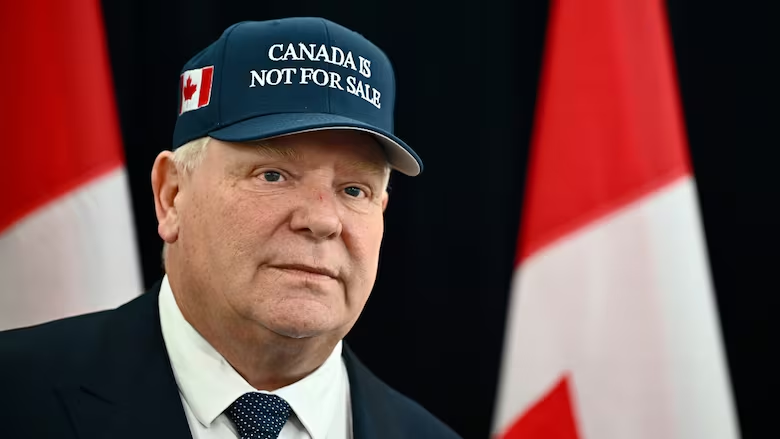
Ontario Premier Doug Ford wears his Captain Canada hat. Credit: CBC (Justin Tang/Canadian Press)

As Donald Trump continues his tariff threats against Canadian products, but more specifically doubles down on his “Canada should be the 51st state” nonsense, he has succeeded in doing what Prime Minister Trudeau has been unable to do over the past few years—uniting Canadians. Some Canadians are so incensed that they have taken to calling their favourite coffee beverage a “Canadiano” instead of an “Americano“. That’s extreme but hey, if Donald Trump can unilaterally change the name of the Gulf of Mexico to the Gulf of America, anything goes. While Trump apparently has spoken to some Canadians who are allegedly “interested” in the idea of annexation (did he find them on a golf course in West Palm Beach?), Canadian leaders and members of the public have made it plain that becoming part of the US is a non-starter.

In recent polls in Canada, opposition to Trump’s plan ranged from 90-94%. But of course that hasn’t stopped Donald Trump from publicly musing about the idea, although he seems to be just about the only person in the US who is actually interested in it, and he certainly didn’t campaign on it. Even if Canadians were interested, which they are not, the domestic political obstacles in the US to absorbing the world’s second largest country, with 42 million people, several million of whom have French as their first language, are insurmountable. It’s worth noting that Canada has more people than the most populous US state (California) and is 15 times geographically larger than the largest continental US state by size (Texas), and seven times bigger than the largest (Alaska).

However, the current issue is not whether or not Canada would ever become part of the US but rather what actions individual Canadians are taking to show their opposition to the idea. A recent public opinion poll from the respected pollster Leger reported that a large majority of those polled indicated they were prioritizing buying Canadian and consciously avoiding US products. More than half said they had cancelled trips to the US or would not travel there. The US Travel Association reported that in 2024 Canadians made more that 20.4 million visits to the US (the most from any foreign country), generating $20.5 billion in spending and supporting 140,000 US jobs. Thus a 10% reduction would mean $2.1 billion in lost spending and a loss of 14,000 jobs. The top states that Canadians visited were Florida, California, Nevada, New York and Texas. If your winter temperatures hit the minus 30s, as they do in many parts of Canada, Florida and California are understandable escapes, although there are alternatives. Mexico is a prime example.

When it comes to US products like alcohol it is also not that difficult to find good alternatives. California wine may be great, but there is Australia, Europe, Chile—even Canada itself as a source of supply. Some foodstuffs might be difficult to substitute, however, given the close integration of supply chains between the two countries. While people have started to boycott US brands, one has to ask what is a US brand, or a Canadian brand, these days? Canada Dry has long been a US product and is owned by Dr. Pepper. However, many US branded products are actually produced in Canada, so it takes some perspicacity to realize that Heinz ketchup is (once again) produced in Canada, at least for the Canadian market, as it loudly proclaims. (Canadians may remember that back in 2016 Heinz pulled out of Canada. After a widespread boycott of the product, the company rethought its policy and returned in 2020). The effectiveness of consumer boycotts is clearly illustrated when businesses such as A&W and Boston Pizza are sporting signs in Canada proclaiming that they are proudly Canadian owned and operated. Interestingly, that all-Canadian icon donut shop Tim Hortons is ultimately controlled by RBI, a US-Brazilian corporation, although most of its franchisees are Canadians and it is headquartered in Toronto.

These intricacies and nuances help explain why it is difficult for consumers to correctly identify the source of a product in order to accurately target their ire. And then there is the inconvenience of avoiding products you like, which can lead to all sorts of rationalizations. After all, most Americans don’t want to annex Canada and even if they voted for Trump, taking over Canada wasn’t part of the reason. So why try to punish them? The Province of BC took that a step further by announcing that it was going to pull all liquor products off the shelves of provincial liquor stores, but only if the products were from “red states”. We could still buy the Oregon pinot noir or that luscious California red blend with a clear conscience! (In the end, the wines have not yet been pulled because Trump postponed the tariffs on Canada for 30 days).

While Canadian consumers wrestle with whether they should cancel their trip to Disneyland or give up Florida orange juice for BC apple juice, the one thing they seem to be mostly united on is the need to leave their favourite US content streaming services out of the equation. According to the Leger survey, less than 30% said they would consider cancelling a US streaming service. (the recent price increases by Netflix might be a more compelling reason). Thus Netflix, Disney +, Prime, Apple TV and others seem safe. It’s easy to see why. Lack of real alternatives.

Bell Canada offers a domestic streaming service, Crave, but what is its prime attraction? Access to HBO. HBO does not operate a streaming service in Canada, at least not right now. It is more profitable, presumably, for the company to license its content to Bell for streaming on Crave. CBC offers an ad supported and an ad-free subscription streaming service, CBC Gem, but in the eyes of many consumers, it doesn’t stack up. Moreover, Netflix offers Canadian content if you want it. There is even a button highlighting how to access it. Besides, many of the most popular shows on Netflix are not US shows. There is Squid Game from Korea, many Nordic shows, Spanish, Italian, French and British productions abound, along of course with a range of US content. Netflix may be US owned but it has become an international platform to showcase content from around the world. It, and other US producers, also spend a lot of money producing content in Canada, some of it (a small minority) recognizably Canadian. As for the rest, it helps keep production in Canada growing. So, if you wanted to make a point, cutting off your US content nose to spite your Canadian entertainment face doesn’t seem like a very good idea. Most Canadians appear to have reached that sensible conclusion.

Will any of this stop the Trump tariffs? Consumer boycotts can have some impact, and retaliatory tariffs promised by Canada against imports of US products will hurt US exporters, such as the farming community, which is politically influential. US tariffs on imports of Canadian products, including imports that cannot be easily sourced elsewhere (think BC lumber to rebuild houses destroyed in the California fires) will increase costs to US consumers and drive up inflation in the US. That might be a more powerful reason why the Trump Administration in the end may back off somewhat. However, Donald Trump seems unlikely to stop spouting his disrespectful 51st state mantra, and the more he does, the more he will convince Canadians to come together and push back—but it seems that changing viewing habits is unlikely to be part of this.

Now if Trump really wanted to bring Canada to its knees, he would block all US streaming content, television and sports broadcasting. No Super Bowl, No NBA, No Netflix, No Disney.

We surrender!

© Hugh Stephens, 2025. All Rights Reserved.

This post has been updated to reflect the obvious fact that Alaska is the largest US state geographically, not Texas. Sorry Alaskans.

Donald Trump’s Punitive Tariffs on Canada: A Personal Commentary

Image: CBC

This blog post is an “extra”. It is tangentially copyright-related (after all, this is supposed to be a copyright blog) but I will admit it’s essentially a non-copyright personal opinion piece. I was incentivized to write it as a result of various conversations I have had with friends and colleagues during this past weekend about the impact and rationale behind Donald Trump’s punitive tariffs on Canada.

Do President Trump’s 25% tariffs on all imports from Canada (except for oil and gas which will be tariffed at 10%) have anything to do with copyright? The short answer is “probably not”, although judging from the vindictiveness of the President toward Canada, as well as an apparent inability to understand how international business is actually conducted, I wouldn’t rule out him finding some excuse to make life difficult for US studios that produce films in Canada, or for Canada to retaliate against US content providers as it desperately searches for a way to get the message through to anyone south of the border who may have Trump’s ear. In either case this would be a mistake. Hollywood is an unlikely source of influence on the President, although Silicon Valley might be a more likely prospect. Both Canada and the US film and TV industry have benefited from having the option of producing in Canada. It’s called win/win, a formula that seems alien to the current President.

So, there could be (but hopefully not) an impact on copyright industries from the fallout from the economic war Trump has declared on Canada, and the inevitable retaliation. (Canada’s initial retaliation list focussed primarily on foodstuffs, appliances and clothing, not affecting copyright industries). Economically, retaliation is a bad idea, inflicting pain on your trading partner but also causing a degree of self-harm. However, in the world of trade negotiations, it is inevitable and frankly is the only thing that Canada can do other than to turn the other cheek and say, “Hit me again”.

However, beyond the world of copyright that I usually write about lies another world, the world of international trade and security, a space in which alliances, cooperation, and mutual respect among trading partners are important. It is what is happening in this world that I want to talk about briefly today, from a personal perspective.

The announcement of the Trump tariffs on Canada has to be just about the most short-sighted policy announcement imaginable. As the Wall Street Journal put it, this is the “dumbest trade war in history”. Not only that, it is a blatant violation of US trade and treaty obligations under the USMCA/CUSMA. What is driving Trump to punish Canada, other than personal spite, is hard to fathom.

Forty years ago, Canada embarked on the path of economic cooperation and integration with the United States through the negotiation of the Canada-US Free Trade Agreement, overcoming decades of suspicion and various failed attempts to establish Canadian manufacturing in a small market behind high protective tariff walls. I was involved in a minor way, buried in the trade bureaucracy of the Department of Foreign Affairs and International Trade, and later the Trade Negotiations Office. It was a big roll of the dice for Canada, giving up quite a bit of economic sovereignty in exchange for agreed rules on market access. Both sides negotiated hard, but at the eleventh hour finally got to “yes”. It was a big step forward, promising greater prosperity on both sides of the border. We believed that when the US made commitments, it would respect them. Silly us.

There were economic advantages for Canada to develop an integrated market with the United States, but there were also important advantages for the US and US business. Production could be specialized where it was most economically and geographically advantageous to do so, supply chains could be integrated, tariffs would be (mostly) eliminated and the border would not impede business. Within the agreed rules, people and goods could move freely. US auto companies in particular, (Ford, GM and (then) Chrysler), were particular beneficiaries, but so were consumers in both countries. The rules around this grand bargain were ratified in the form of a treaty, later expanded to include Mexico. The objective was to minimize disruptions and where disagreements occurred, to settle them through a fair and impartial dispute settlement process in a timely way. This process was renewed under the USMCA/CUSMA, signed by Donald Trump in 2018. What Trump is doing now is effectively tearing up the commitments he made and which have been respected since the late 1980s, through both Republican and Democratic administrations.

The legal excuse being put forward for this trade war is the “national emergency” of fentanyl and illegal migrants. The USMCA does have provision for a national security override, Article 32.2.1.(b) which says;

Nothing in this Agreement shall be construed to..preclude a Party from applying measures that it considers necessary for the…protection of its own essential security interests.”

By invoking fentanyl and migration as “essential security interests” to justify his actions, Donald Trump is seeking to manufacture a pretext–at least insofar as Canada is concerned–allowing him to renege on US trade commitments enshrined in a Congressionally-ratified treaty that he signed. If there is a crisis, the problem does not lie with Canada. Last year exactly 19.5 kg of fentanyl (43 lbs) was seized at the Canadian border, less than 1% of the total seized at the Mexican border (21,148 lbs). In terms of illegal migration, US Customs and Border Patrol apprehended just under 24,000 illegal migrants coming into the US from Canada (Canada apprehended a greater number trying to sneak into Canada from the US, so the flow of illegals from Canada to the US was actually below zero). By contrast, on the Mexican border, about 1.5 million migrants were arrested by US authorities. Again, the Canadian border “problem” was about 1% of the total of migrants on the southern border. (I am not trying to trash Mexico but simply demonstrate how the rationale put forward to impose the tariffs on both countries is wildly disproportionate when it comes to Canada). How can Trump with a straight face use this “national emergency” as an excuse to try to cripple the economy of a friendly neighbour, an ally, and the largest customer for manufactured US goods globally? (Canada is the top export market for 34 states). Because he can, I guess.

It is apparent that facts have not been allowed to get in the way of what appears to be a personal vendetta. In fact, it appears that Trump is convinced in his own mind that Canada should not exist as a nation. His repetitive and insulting trolling of Prime Minister Trudeau as “Governor” Trudeau and the belief that Canada should become the 51st state is both tiresome and insulting. (Parenthetically, if Canadians ever agreed to become part of the US, why should Canadians settle for just two Senators? After all, the Province of Ontario has a larger population than 46 of the 50 US states, not to mention that Canada is the second largest country on the planet geographically). In reluctantly announcing retaliatory tariffs, which will hurt American workers and consumers, Justin Trudeau made a plea to Americans, recalling the famous words of John F. Kennedy;

“Geography has made us neighbours, history has made us friends, economics has made us partners and necessity has made us allies.”

These wise words are worth recalling. It is estimated that the tariffs, if sustained, will tip Canada into recession, increase the unemployment rate, shave several points off GDP and lead to a further drop in the Canadian dollar. As Ontario Premier Doug Ford put it, “he’s coming after our families and our jobs”. There will be negative impact on the US economy as well, but the unanswered question is “why would you want to deliberately destabilize your friend and ally, best customer and neighbour?”. Is it not in the interests of the US to have a prosperous, reliable, stable and friendly neighbour on its northern border? I would have thought so.

The current situation causes me both great sadness and repressed anger. Sadness because, like many Canadians, I have spent considerable time in the US and in the company of Americans. I grew up not too far from the border like many Canadians, so US television was part of my mispent youth. I attended grad school in the US. I have taken a number of holidays in various parts of the US. During my years on many foreign postings in Canada’s foreign service, I worked with and cooperated closely with my US colleagues in similarly located American embassies. Later I worked for a US company and had, and still have, many American friends and former colleagues. I have never detected any animosity toward Canada or Canadians. Thus I simply cannot believe that when he was elected, Donald Trump was given a mandate to go after Canada. But that is what he has done.

As I said at the beginning of this post, there is not much here related to copyright–but I needed to get this off my chest. I hope that saner heads will prevail, but much damage has already been done in Canada to the goodwill and trust that has long existed between Canadians and Americans. I wish it were otherwise. Maybe one day it will be again.

© Hugh Stephens, 2025.

Just before posting this, news reports indicated that President Trump had agreed to pause the imposition of tariffs on Canadian goods for 30 days after speaking with Prime Minister Trudeau. They were to have gone into effect tomorrow (February 4). Earlier he did the same for Mexico. While a temporary reprieve, this really doesn’t change much.