Australia Stands Up for its Creative Sector: A Useful Lesson for Canada and Others

Two coffee mugs side by side, one featuring the Australian flag and the other featuring the Canadian flag.

Image: Shutterstock

Australia just took an important stand in the tug-of-war being waged in many countries over whether, how and to what extent tech companies can use copyrighted content (text, music, images and so on) to train AI platforms by reproducing the content and extracting its essence without permission or compensation to rightsholders. Attorney-General Michelle Rowland has announced that while Australia will be undertaking consultations on revisions to its copyright laws to help address the needs of the AI industry, a Text and Data Mining (TDM) exception has been ruled out. Some countries, like the UK, have TDM exceptions for limited purposes (such as research and non-commercial use) in their laws while several other countries have TDM under review. Existing TDM exceptions allow reproduction of copyrighted content without the authorization of the rightsholder for research, data analysis, and in some cases for AI training purposes.

There is currently no TDM exception in Canadian law but as I noted in a recent blog post (“Canada’s Creative Sector Uneasily Awaits the Carney Government’s Next Steps on AI Training”), pressure is building from the AI sector to incorporate TDM into Canada’s Copyright Act. The government currently has yet another consultation paper on AI out for public comment and the Canadian cultural sector is organizing to protect creator’s rights, specifically calling on the Canadian government to “ensure that the Copyright Act is not modified through an exception permitting Text and Data Mining (TDM) or any other exception allowing technology developers or users to use protected works…to train generative AI systems without authorization or compensation…”. In doing so, it is taking a leaf from the book of Australian creators who mounted strong opposition to a proposal from the Productivity Commission, (PC) an independent research and advisory body created by an Act of Parliament some 25 years ago, that proposed in a report in August that Australia adopt a TDM exception. To say that this proposal put the cat amongst the pigeons would be an understatement.

The Commission has a reputation for denigrating the value of intellectual property and seeing it as an obstacle to industrial development rather than as an essential partner. In 2015 it proposed shortening the term of copyright protection from the current life of the author plus seventy years (“life plus 70”), a generally accepted international standard, to just “life plus 15”, (far lower than the Berne Convention minimum and a standard not adopted anywhere) while introducing a US-style fair use regime into Australia. There was strong pushback then, (it didn’t happen) and there was strong pushback this year (see here and here, for example) when the PC proposed introducing a TDM exception. It was particularly criticized for its lack of consultation with the creative industries in developing this proposal.

Now the Australian government has put its foot down, ruling out TDM but indicating that it will look at alternative solutions. These include examining whether to establish a new “paid collective licensing framework” under the Copyright Act for AI, or whether to maintain the status quo through voluntary licensing, clarifying how copyright law applies to material generated through the use of AI (i.e. whether there should be copyright protection for outputs produced by or with AI) and looking at the establishment of a new small claims forum to address lower-value copyright infringement matters.

It is generally accepted that AI is here to stay and will continue to need vast amounts of content for training. In most cases, copyrighted content is the kind of curated, high value work that AI developers need but until now, have preferred to appropriate without permission rather than pay for through licensing. In effect they have decided to ask for forgiveness after rather than permission beforehand. This has led to a plethora of lawsuits globally, including the recent $1.5 billion settlement that Anthropic has agreed to pay out to settle a class action suit brought by authors in the US. “Forgiveness” can be expensive. Inside the US, AI developers are arguing their copying is fair use, although at the same time they are beginning to hedge their bets by licensing content from a number of sources, ranging from media to music to image companies. Outside the US, AI companies have been beating the TDM drum, hoping that creation of wide TDM exceptions will obviate the need to negotiate with content owners. Nonetheless, voluntary licensing is growing globally. However, the surest way to kill a nascent licensing market is to give the tech industry a “get out of jail free” card by introducing a broad TDM exception. Australia has just rejected that option. Canada and others considering introducing new, or broadening existing, TDM loopholes should do the same.

It is not clear where Australia’s AI and Copyright review will end up, other than to note that it will not include TDM. As I have noted above, among other things it will be considering “collective licensing”. Collective licensing could help address the problem of remunerating individual rightsholders, in contrast to licence agreements signed between AI developers and corporate entities like media companies. However, Australia needs to steer clear of compulsory licensing which strips away the rights of copyright owners. Compulsory licences authorize use upon payment of a statutory or negotiated fee but remove the right of a copyright holder to withhold consent for use, or to impose specific limitations. A voluntary licence framework is fair to everyone. Compulsory licensing is not.

Canada and Australia have many things in common, (as well as a number of differences of course, beyond poutine vs vegemite). Among their commonalities is the desire to protect and foster a unique cultural identity in the face of global cultural homogenization. This is even more important in Canada given the realities of the struggle faced by 6 or 7 million Francophones to preserve their culture in a sea of 375 million Anglophones. Canada followed Australia’s lead (although less successfully) in requiring major online platforms to contribute financially to (i.e. pay for the use of) news media content. It should do the same by putting the idea of a TDM exception firmly to one side and instead focus on encouraging the development of voluntary licensing market for copyrighted content when used in AI training.

© Hugh Stephens, 2025. All Rights Reserved.

US Retaliation Against the Online Streaming Act: How Real is the Threat?   

Illustration of the Canadian flag overlaid with yellow caution tape labeled 'TARIFFS', featuring American flags, symbolizing trade tensions between Canada and the USA.

Image: Shutterstock

As CRTC hearings on implementation of the Online Streaming Act (formerly Bill C-11) grind slowly forward as part of the Commission’s deliberations as to how foreign audiovisual and audio (music) streaming services may be required to meet Canadian content (Cancon) and discoverability requirements, while determining the extent of their financial contribution to various funds supporting Canadian content, affected US industry players are not sitting on their hands. As you would expect, they are deploying a range of tactics to fight back using their industry associations, the Motion Picture Association (MPA)-Canada, representing Netflix, Disney, Sony, Paramount, Universal, Amazon Prime and Warner Bros. Discovery, and the Computer & Communications Industry Association (CCIA), representing among others Amazon, Apple, Google and Meta, as their vehicles of choice.

MPA-Canada is currently appealing to the Federal Court the CRTC decision that its members must contribute 1.5% of annual revenues to the Independent Local News Fund, arguing that the studios do not produce news and should not be required to contribute to a line of business in which they are not active. Apple, Spotify and Amazon are also appealing the full 5% payment on the grounds it is a tax the CRTC is not mandated to apply. The 1.5% contribution to news is part of the CRTC’s initial decision that the streamers should, as a “downpayment”, contribute 5% of revenues to fund Canadian production.  The MPA has also undertaken a lobbying campaign to point out how much its members already contribute to production in Canada, (CAD$6.7 billion in 2023, more than the CBC, Canadian Media Fund and Telefilm Canada combined) even though much of that content does not count as CanCon under current rules.

To this “positive” argument, the CCIA by contrast has added a more hard line, “negative” approach, releasing a study that calculates the amount the CRTC’s compulsory contributions will purportedly cost the US industry. Assuming the levy stays at 5% of revenues (by no means an assured outcome as Canadian broadcasters are urging the CRTC to impose contributions of 20 to 30%, similar to the obligations they face), CCIA estimates this will cost US streamers between $2.19 billion and $6.96 billion (all figures USD) by 2030. The estimate of losses is bundled with CCIA’s claim that the financial obligations constitute a violation of the CUSMA (known as the USMCA in the US) because it creates a preferential regime for Canadian content “thereby discriminating against content classified as American or from a third country”. In the eyes of the CCIA, actions under the Online Streaming Act violate the principle of “national treatment” in which Party A agrees to treat the products and services of Party B “no less favourably” than its own products and services. In support of this claim, CCIA cites the Investment and Digital Trade Chapters of CUSMA/USMCA, Chapters 14 and 19 respectively. According to CCIA, the Online Streaming Act’s “inconsistency with core trade obligations is beyond dispute”. Given this “indisputable” fact, CCIA states thatif challenged, Canada can be expected to invoke its cultural industries exception (Article 32.6) as a basis for justifying the inevitable discrimination….

Article 32.6 is part of the General Exceptions Chapter of the CUSMA/USMCA. It states, in part, “This Agreement does not apply to a measure adopted or maintained by Canada with respect to a cultural industry…” The production, distribution, sale, or exhibition of film or video recordings as well as audio or video music recordings are included in the definition of a cultural industry. As I have written elsewhere (NAFTA and the Cultural Exception) Article 32.6, while in theory exempting defined cultural industries from the obligations of the Agreement (the NAFTA provision was essentially rolled over into the CUSMA), has a sting in its tail. If Canada applies any discriminatory measures that violate the agreement using the cultural exclusion as the pretext, the US is fully within its rights to retaliate with measures of “equivalent commercial effect”, in any sector. The CCIA’s $2.19 billion or $6.95 billion numbers need to be viewed in this context.

The first question, therefore, is would Canada need to resort to Article 32.6 to justify measures taken under the Online Streaming Act? I argued in an earlier paper I wrote for the School of Public Policy at the University of Calgary that given the current structure of the obligations, Article 32.6 would not be in play because the measures in question are not inconsistent with CUSMA, given the Agreement’s precise wording. You can read the detailed arguments in the paper, but essentially my position is that neither the Chapter 14 Investment reference nor the Chapter 19 Digital Trade provision cited by CCIA are relevant because content streaming is covered by a separate part of the Agreement, Chapter 15, Cross-border Trade in Services. The terms of the Online Streaming Act, as applied by the CRTC provide “national treatment” to foreign streaming services. In fact, they impose lesser requirements on foreign streamers with respect to carriage of Cancon than they do on Canadian streamers.

But this interpretation is only my personal view. I have no idea is this is the interpretation of the trade policy gurus at Global Affairs Canada (I haven’t spoken to them and even if I did, they would be unlikely to tell me what their position would be on a hypothetical trade case) and is almost certainly not the interpretation favoured by officials in the Office of the US Trade Representative (USTR). And certainly not by CCIA. CCIA’s position is that a show or track streamed in Canada is a digital product, (even though it describes its members as providing “streaming services”). The Agreement is clear that there should be no discrimination against digital products of the other Party i.e. they should be accorded “national treatment”, although domestic products can be subsidized. On the other hand, if streamed content is not considered a digital product (nor an investment, which according to CUSMA cannot be subject to “performance requirements” as a condition of allowing the investment) but rather a cross-border service, the conditions applicable to delivery of the service are what counts. National treatment needs to apply to service delivery, and insofar as the Online Streaming Act is concerned, it does.

Whether streamed content is a digital product or a cross-border service clearly matters. If the US brought a CUSMA trade complaint against Canada–and if the CCIA view were to prevail–Canada would either have to change the way it treats US digital products carried by streaming services or defend its actions on the basis of the cultural exception, Article 32.6. If it did the latter, it would be opening itself to trade retaliation by the US, at an equivalent commercial level. In my experience and judgement, Canada would be most unlikely to resort to the exception to justify its actions precisely because of the consequences. The US would retaliate not just against the cultural sector, but in other areas that would set one industry or part of the country against another. To avoid this, the government would instead find some other way to comply with the Agreement by modifying the offending provision (as little as possible but as much as necessary), but doing so in a way, if possible, that still met all or most of its policy objectives.

It is also just possible, however, that Canada would be prepared to absorb the retaliation, calculated by CCIA to be between $400 and $500 million annually if the CRTC mandated contribution remains at 5% of revenues. This sounds like a big number but the random way the Trump Administration has been imposing tariffs on a range of Canadian products such as steel and aluminum (50%), lumber (45%), and autos (25%), industries where Canadian exports total tens of billions of dollars annually, makes $400 million in possible retaliation seem relatively minor. In effect, Trump’s erratic punitive behaviour has normalized trade retaliation–and devalued its effectiveness as a threat. But whatever response the Canadian government took, the first step would be to determine whether Canada was in fact in violation of the Agreement. If one Party considers that “an actual or proposed measure of another Party is or would be inconsistent with an obligation of this Agreement”, it can resort to the dispute settlement process. In the first instance, this involves consultation and if no resolution is reached, sometimes the constitution of a panel to decide the issue. (CUSMA/Article 31).

The CCIA itself cannot charge Canada with non-compliance, although it can raise the spectre of retaliation as it is doing. Only the US Government can bring a complaint, and at this stage it is not clear if it would be willing to do so. Given the range of trade disputes between the two countries, including unilateral tariffs on Canadian exports imposed by the Trump Administration on the basis of specious claims that Canada is a major source of fentanyl exports to the US (last year 0.2% of all fentanyl seized at the US border came from Canada; over 90% was from Mexico), or equally questionable grounds that exports of Canadian products ranging from aluminum to kitchen cabinets pose a national security threat to the US, the bilateral trade relationship hardly needs more issues. It will depend on the extent to which the streamers in the US have the ear of the Trump Administration. Given Trump’s insistence that Canada drop its planned Digital Sales Tax if it wanted to keep the current bilateral trade talks going , it is certainly within the realm of possibility that USTR would take up the CCIA’s case.

There is one other wrinkle to the cultural exception clause. Even if Canada does not justify its actions on the basis of Article 32.6, potentially the US could unilaterally declare it considers Canadian measures to fall under that provision and move to initiate retaliatory measures. If it did so, Canada would then be entitled to demand a panel to determine whether Article 32.6 is applicable, and if so, whether the retaliation met the “equivalent commercial effect” test. However, the key issue would still be to determine whether Canada had violated its commitments under the Agreement. If there is no violation of CUSMA’s terms, the cultural exception is moot. If all this has your head spinning, welcome to the green eyeshade world of trade practitioners.

CCIA, in pushing back against the provisions of the Online Streaming Act, has resorted to the threat of trade retaliation as one more tool in its policy toolbox. That is to be expected. With this in mind, the CRTC will be carefully reviewing how much leeway it has in trade policy terms and needs to keep Canada’s CUSMA commitments in mind when implementing policy. In a following blog posting I will outline what I think Canada and the CRTC need to consider.

© Hugh Stephens 2025. All Rights Reserved.  

Canada’s Creative Sector Uneasily Awaits the Carney Government’s Next Steps on AI Training

Blasting a Wide TDM Hole in the Structure of Copyright is Not the Answer

A cartoon-style illustration showing a fist breaking through a brick wall labeled 'COPYRIGHT', with the fist wearing a band labeled 'TDM', surrounded by explosive graphical effects.
Image: Author (via DALLE-E)

The ongoing wrestling match-cum-dance between the creative sector and AI developers over the uncompensated and unauthorized use of copyrighted content for AI training is being played out in different ways in different countries. In the US it is largely a legal play in the courts at the moment, with mixed results for both sides. However, President Trump has made concerning public comments siding with the AI industry, saying it is impractical for AI developers to pay copyright holders for AI training (and besides, China doesn’t do it). Congress is still considering its options. In Australia, the Productivity Commission, never a friend of intellectual property, has just issued an interim report recommending the adoption of a Text and Data Mining (TDM) exception in Australia to boost development of the AI industry locally. The Australian creative sector mobilized quickly and has pushed back hard against this proposal, with the government now saying that it has no plans to amend the Copyright Act. In the UK, where there is a TDM exception but only for non-commercial purposes, the Starmer government quickly adopted a pro-AI strategy, part of which was to propose an expansion of TDM to include commercial purposes, although subject to an opt-out for rights-holders. That ignited a major storm among leading British creatives from Paul McCartney and Elton John on down. Through a unified campaign, British creators were able to gain support in the Upper Chamber (House of Lords) to slow down the legislation. As a result, the TDM issue has now  been earmarked for further consultation and study. One thing is certain, the creation of a wide TDM exception is a sure way to stifle a nascent but rapidly developing licensing market for copyrighted content used for AI training.

It seems as if TDM, or more permissive TDM, is testing the boundaries of copyright just about everywhere. So, what about Canada? Canada has no TDM exception in its copyright law and, unlike the US, has clearly defined fair dealing exceptions that do not lend themselves to expansive court interpretation. Like other countries, it is trying to figure out how to not get left behind as the AI race accelerates. Canada initially had a first mover advantage in terms of AI research, given the work of Geoffrey Hinton, Yoshua Bengio and others, but recently it has been falling behind, notably lacking native startups. The cluster effect is not happening, with Canadian innovation going elsewhere for commercialization. To address these challenges, the new Carney government has appointed a dedicated Minister of Artificial Intelligence and Digital Innovation, former journalist Evan Solomon. This is the first time such a position has existed. One of Solomon’s first acts was to accelerate launch of an AI strategy beginning with a new consultation released on October 1 (closing at the end of this month), in the form of a survey to “help define the next chapter of Canada’s AI leadership”. This survey asks many relevant questions regarding AI and how it could be best developed in Canada but manages to mostly steer clear of the thorny question of AI training and copyright. The only question tangentially related to this issue is the following;

“Which infrastructure gaps (compute, data, connectivity) are holding back AI innovation in Canada, and what is stopping Canadian firms from building sovereign infrastructure to address them?”

Clearly this consultation is not going to turn over the TDM rock, at least not directly.

In the past couple of years, the government has issued two consultation papers on AI, one in 2021 and another last year as well as a “What We Heard” report. This report, issued earlier this year, summarizes the “great divide” between AI developers and the content industry. It’s first observation was that “Creators oppose the use of their content in AI without consent and compensation” but then goes on to say that “User groups support clarifications that TDM does not infringe copyright”.

After a couple of other observations about the centrality of human authorship and the need for transparency surrounding the use of copyright-protected works in the training of AI, the paper observed that there is “no consensus about whether existing legal tests and remedies are adequate”. That is the nub of the issue. There is no consensus, and while the courts are struggling with this issue (including in Canada, as I wrote about here and here), what Canadian creators fear is the introduction of a wide TDM exception in the name of maintaining “Canadian competitiveness”.

The launch of the new AI strategy and the evolution of the way in which copyrighted content is described in government consultation documents is indicative of the pressures on the government to shore up Canada’s AI strategy. It is interesting to note the shift in the definition of TDM from 2021 to today.

The definition provided in the 2021 consultation document described TDM as follows;

“The process of conducting TDM may require the making of reproductions of large quantities of works or other copyright subject matter to extract particular data and information from them. This process may be carried out using scientific or text-based data, as well as images, sounds, or other creative works.”

In the most recent consultative document, that definition has evolved;

“Text and data mining (TDM) consists of the reproduction and analysis of large quantities of data and information, including those extracted from copyright-protected content, to identify patterns and make predictions.”

Note the shift from “works” to “data”.[i]  It’s a subtle difference but is hugely significant because data and facts are not protectable under copyright whereas the creative elements of original works are. The cultural sector is rightly concerned.

The Coalition for the Diversity of Cultural Expressions (CDCE), a major arts and creatives lobby group, is currently pressing Ottawa on a number of cultural issues, including AI. Among its AI asks are to;

  1. Ensure that the Copyright Act is not modified through an exception permitting Text and Data Mining (TDM) or any other exception allowing technology developers or users to use protected works…to train generative AI systems without authorization or compensation;
  2. Adopt national legislation on generative AI that requires developers of generative AI systems to disclose the training data they use; and
  3. Adopt legislative provisions requiring public identification of content that is purely AI-generated.

Against these demands is the pressure coming from AI advocates who will argue that if the US loosens restrictions on use of copyrighted content for AI training, Canada will have no recourse but to follow. In other words, as goes the US, so goes Canada (or for that matter, the UK, Australia and others). Thus, what is happening in the US courts, and perhaps in Congress, is of critical importance for the creative sector everywhere including, in particular, Canada.

The issue of AI training on copyrighted content will need to be resolved sooner or later. Licensing solutions are developing quickly and if Canada can wait a bit longer it may be able to adopt licensing as the preferred solution (although the “What We Heard” report noted that “Some (intervenors) argued that licensing is an unnecessary burden because it may not be clear that copyright is engaged or that works used in TDM are being reproduced in the first place.”). There is pressure on the Carney government to take early action since AI industry developments are moving at lightning speed. With the TDM train gaining momentum in Canada and elsewhere, Canadian creators are understandably uneasy about what is likely to happen next.  

As the CDCE notes, culture is a major economic and social pillar in Canada. In 2023, it generated $63.2 billion in value added and employed 669,600 people. Throwing all that under the bus in the name of remaining competitive on AI is a flawed choice, a point also made by the creative sectors in the UK, Australia and elsewhere. However, with the AI horse well out of the barn, copyright cannot be seen as an obstacle to innovation, an accusation freely levelled at it by some in the AI industry. Rather, it must be seen as a partner in innovation, which is where licensing comes in.

Blasting a wide TDM hole in the protection and incentive structure that copyright provides the creative sector is not the answer. The creative sector is watching and waiting anxiously.

© Hugh Stephens, 2025. All Rights Reserved


[i] I am indebted to Erin Finlay, partner at Stohn Hay Cafazzo Heim Finlay LLP for drawing these changing definitions to my attention

When Will AI Developers Take Responsibility for the Products They Provide Their Subscribers?

What They are Doing Really Bugs Me

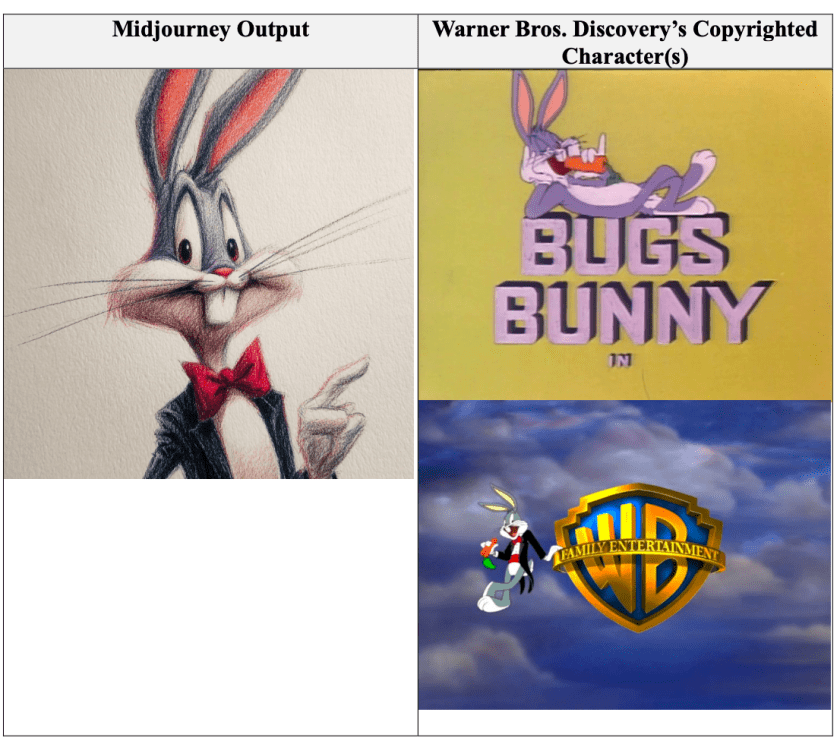
Illustration comparing a Midjourney-generated image of Bugs Bunny on the left with Warner Bros. copyrighted images of Bugs Bunny on the right, featuring different styles and settings.

Image: US District Court Filing

I confess to having been a lifetime fan of Bugs Bunny, that “Wascally Wabbit”, and not just because I worked for Time Warner at one point in my career. His insouciance, his ingenuity and his cultural achievements (have you seen Bugs perform opera or conduct a symphony orchestra?) are legend. Thus it was with some interest that I read the headline in my morning newspaper “Warner Bros. sues AI Company over Images of  Bugs Bunny and other characters”. It was based on a generic AP report that appeared in many journals across North America. The AI company in question is Midjourney. Hollywood Reporter has done a deeper dive comparing images produced with Midjourney’s AI program to copyrighted Warner Bros. (WB) images, drawn from the lawsuit submission. This is not the first confrontation between Hollywood and Midjourney. In June Disney and Universal brought a similar suit alleging that the AI company’s image generator produces near replicas of its copyrighted characters.

Just in case you forget what Bugs looks like, Warner Bros. (technically now known as Warner Bros. Discover) has a complete description in its lawsuit;

Many of the Looney Tunes characters are ubiquitous household names, and these characters have expressive conceptual and physical qualities that make them distinctive and immediately recognizable. Bugs Bunny, for example, is a playfully irreverent anthropomorphic gray and white rabbit, who has a star on the Hollywood Walk of Fame. Bugs Bunny has an overbite that showcases his two long front teeth, oversized feet with white fur, and is often depicted eating a carrot.

Does this description look anything like the image produced by Midjourney, as reproduced in the filing (see paragraphs 85 and 86), which I have pinched as the image for this blogpost. Scroll up or down to see the full range of characters at issue, ranging from Tweetie to Batman.

Midjourney’s response to the earlier lawsuit, and now to Warner Bros. is that they are not responsible for any copyright infringement that may occur. You see, it is the users of their service who are to blame. Not them. According to their court filing:

“The Midjourney platform is an instrument for user expression. It assists with the creation of images only at the direction of its users, guided by their instructions, in what is often an elaborate and time-consuming process of experimentation, iteration, and discovery.

Midjourney users are required by Midjourney’s Terms of Service to refrain from infringing the intellectual property rights of others, including Plaintiffs’ rights, Midjourney does not presuppose and cannot know whether any particular image is infringing absent notice from a copyright owner and information regarding how the image is used.”

Warner Bros. points out that Midjourney could easily control infringing outputs by (1) excluding WB content from training its AI system (2) rejecting prompts from users requesting WB characters and (3) using technical means to screen images. But instead, Midjourney has become a vending machine for WB content, selling a commercial service powered by AI that was developed using infringing copies of WB works and then allows users to reproduce or download infringing images or videos. These outputs directly compete with WB copyrighted content.

Midjourney’s defence strikes me as similar to arguments used by the manufacturers of guns. “Guns don’t kill people. People kill people.”  Except that there are a number of limitations on the kind of gun you can sell, and its capabilities. While the law varies from jurisdiction to jurisdiction, what is common are restrictions on selling automatic and semi-automatic weapons. The reasons are obvious. While there is a use for some kinds of guns (gun clubs, hunting etc.) there is no legitimate need for unlimited lethality. Not all gun purchasers (like AI software users) can be trusted so limitations are placed on what gun manufacturers are allowed to make available to the public. Similarly, while there are many uses for image-generating AI platforms, there are also legal limits to what is acceptable, such as when AI is used to create child porn. AI companies have agreed to set and enforce guardrails against this, and are clearly capable of doing so. Since, regrettably, not all users can be trusted, to simply to ask them to acknowledge and abide by Terms of Service is inadequate. So, if AI companies can stop some categories of use, they are equally capable of marketing a service that avoids copyright infringement. Enough of the “blame the user” nonsense. Design and market a service that conforms to the law.

Another good example of the “blame the user” excuse is META’s creation of “flirty chatbots” using virtual images of celebrities such as Taylor Swift, Scarlett Johanson, etc. According to Variety, quoting a report from Reuters who researched the issue, the celebrity AI chatbots  “routinely made sexual advances, often inviting a test user for meet-ups.” In some cases, when they were asked for “intimate pictures,” the chatbots “produced photorealstic images of their namesakes posing in bathtubs or dressed in lingerie with their legs spread.” Many of these chatbots, which clearly violate the right of publicity of the subjects, were user produced. But users could not produce these images, and cross the line into illegality, unless they were enabled to do so by the program produced by META. META claims that the production of such images violates its rules, which prohibit the direct impersonation of public figures. But of what use is a rule if it is not enforced?

If AI developers design products that are easily misused and then enable (even encourage) their users to do so, it is high time for them to accept responsibility. They are able to establish guardrails; they just don’t want to as it is easier to free ride, while attracting as many users as possible. Midjourney is a good case in point, but Warner Bros has just fired a shot across their bow. Just as Bugs did in Captain Hareblower.

© Hugh Stephens 2025. All Rights Reserved.

Confiscating Creator’s Rights: Australia’s Slippery Slope

A police officer in uniform is carefully holding a brown package marked with a copyright symbol.

Image: Author (via Dalle-E)

Confiscation is a strong word, but I can’t think of any more appropriate term to describe what has just happened in Australia regarding the copyright of film footage taken by two employees (Chris Delforce and Harley McDonald-Eckersall) of Farm Transparency International (FTI). FTI is an animal rights organization well known for its crusade against animal cruelty in Australia. The two illegally trespassed into the slaughterhouse facilities of Game Meats Company (GMC) and then installed pinhole cameras in the ceilings of the abattoirs. The resulting footage was to be used to further expose industry practices which FTI claims constitute animal abuse. It was sent to the Department of Agriculture, Food and Fisheries (DAFF) who forwarded the complaint to GMC, which triggered GMC’s lawsuit. It was also sent to Seven Network, who decided not to show it after the lawsuit was launched.

The Department (DAFF) declined to prosecute the company, although in court a GMC employee is reported as describing the alleged abuse as “a brief aberration … just a small glitch in a process”. The confrontation between FTI and the meat industry has been ongoing for a number of years, and the industry has employed various tactics to combat FTI’s use of film footage to expose slaughterhouse practices. Keeping the public’s eye away from how their lamb chop, hamburger or pork sausage got from farm to fork is one way of avoiding consumer pushback against the distasteful but necessary process of animal slaughtering. Such footage is not for the faint-hearted.

However, this blog post is not about the rights or wrongs of eating meat or animal slaughtering practices; it is about copyright. And, believe it or not, copyright is very relevant to this controversial topic.

Recall that copyright is established when an original work is created. There is no need for registration or validation, but the work must be fixed in some form (e.g. a book, image or film) and normally must have at least some element of creativity (although in Australia originality is not required for films). For films, holding copyright confers certain exclusive rights, such as the right to reproduce or make a copy, to have the film screened in public, and to communicate the film to the public through means such as broadcasting, streaming, or downloading. Once copyright is established, it lasts a long time (the life of the rights-holder(s) plus 70 years in Australia), and is impossible to renounce. Holders of copyright can issue various forms of Creative Commons licences authorizing use under various scenarios, but the copyright still exists. It is very “sticky”. In Australia, the copyright in films is normally held by the person who is the maker of the film, that is, the person who makes the arrangements for the film to be made. This could be the director, or the person who commissions the film. If a company commissions a film, the company could be the rights-holder. It could also be the person doing the filming, if it is a small-scale production and the person doing the filming is also the producer. The Australian Copyright Council has an excellent background paper outlining all the ins and outs of copyright ownership in films. In the case under discussion, the copyright owner was FTI. While the issue of who has copyright in a film can be complicated, one thing is very clear. The person being filmed does not own the copyright, any more than a person receiving a letter owns the copyright in that letter. It belongs to the author. But the Federal Court of Australia has just stood this principle on its head.

In August the full Federal Court upheld the appeal of Game Meats Company (GMC) against a lower court ruling. The lower court had concluded that while FTI had trespassed on GMC’s property (and was assessed significant damages for having done so), the filming that had taken place was not held in trust for the owner of the property, i.e. GMC. This somewhat convoluted wording meant that Game Meats did not own the copyright in the film and that the film was not made on its behalf. (This seems obvious since it was FTI doing the filming, but that was the wording of the decision). However, the Federal appeal court reversed this decision and awarded the copyright to GMC in the form of a “constructive trust”, to be maintained in force until such time as the copyright in the film was compulsorily assigned to it. As part of the decision, FTI was required to execute an assignment in writing of the copyright in the images and footage to Game Meats and permanently delete all copies of the images in its possession and control. In other words, FTI was required to turn over its copyright to the entity that it had filmed, thus ensuring that the new owner of the footage would ensure it never saw the light of day. In short, FTI’s copyright was confiscated.

As far as I am aware, this is the first time that the legal concept of “constructive trust” has ever been applied to a copyright case, in Australia or anywhere else. So, what is a constructive trust? There are many definitions, but here is one that seems to capture the essence quite well;

A constructive trust is imposed by law to remedy a situation in which someone has been unfairly deprived of property or wronged through misconduct such as fraud, misrepresentation, or a breach of fiduciary duty in relation to specific property or assets. This type of trust comes into existence to uphold equitable property interests, regardless of whether the parties intended to create a trust relationship.”

There are two key elements here, (1) there must have been some misconduct committed by the defendant and (2) restoration of “equity” demands that the property in question be transferred to the wronged party. It is often used in disputes over estates where one party argues they have been unjustly deprived of certain proceeds of the estate to which they had contributed for many years. It was not designed to deal with copyright disputes but that is how it has been used by Game Meats Company, now upheld by the full appeal court. This is an unfortunate precedent.

This case could lead to a very slippery slope regarding freedom of expression and freedom of the press. Hijacking copyright to stifle press coverage could easily result in unintended consequences. GMC, now the assignee of the copyright will, of course, not sanction any release of the footage. Any media outlet that does so could face severe legal consequences. Moreover, this decision sends a very threatening message to investigative journalists, photographers, film makers and others. Could the constructive trust ruling be expanded in future to impede researchers who were “virtually trespassing” by using drones or telephoto lenses? There are privacy and defamation laws to deal with this sort of situation, but what if the door is now open to seizing the copyright? What about surreptitious footage shot by documentary filmmakers or investigative TV reporters? The public interest demands that journalism be given some leeway to pursue investigations and shed light on contentious issues. It is self-evident that entities being investigated are not going to facilitate filming of their activities.

The Australian weekly, the Saturday Paper, quotes Macquarie University journalism professor, Peter Greste, who is also executive director of the Alliance for Journalists’ Freedom, saying the case “gives all sorts of subjects of media investigation an opportunity to threaten legal action and shut down otherwise important and legitimate journalistic investigations”. From a legal perspective, the appeal court’s ruling appears to be on shaky grounds. It is based on some non-binding opinion (obiter) in a 2001 case in which the Australian Broadcasting Corporation (ABC) successfully argued against an injunction sought by Lenah Game Meats, an opossum meat processer, that had sought to prevent ABC from showing footage the broadcaster had obtained from an anonymous source. ABC had subsequently learned its source had obtained the footage illegally. Apart from questionable legal precedence cited by the Federal Court in its current ruling, the decision itself constitutes a significant threat to responsible freedom of expression and freedom of the press at a time when both are under attack.

While privacy and prohibition against trespassing are important, there are other ways to deal with content obtained through illegal means such as legislation already used against FTI in New South Wales, the Surveillance Devices Act, or by seeking an injunction against publication because of “irreparable harm”. Undermining the Copyright Act and the fundamental principles of copyright is not the way to go. Australia has always had a strong tradition of journalistic freedom and a culture of encouraging creativity. The court’s FTI decision runs against that tradition and is a retrograde step. Let’s hope it is appealed–and subsequently overturned, reserving copyright law for the purposes for which it was intended.

© Hugh Stephens 2025. All Rights Reserved

Update: On December 4, 2025 the High Court of Australia granted leave for FTI to appeal the decision of the Federal Court of Australia.