Site Blocking is Back on the US Agenda: It’s Long Overdue


Image: Shutterstock

It seems as if I’ve been writing about site blocking (what I prefer to call “disabling access to offshore pirate content sites”, although this is a bit of a mouthful) forever, certainly since it was effectively pioneered by the UK, Australia and various EU countries a decade or more ago, followed later by Canada and others. The first blog post on the topic I wrote back in 2016 (Blocking Offshore Pirate Websites: It Can be Both Effective and Manageable) cited a study from Carnegie Mellon University that examined the effectiveness of internet site blocking to control copyright piracy in the UK. It showed that the measures caused a drop of 90% in visits to the blocked sites, leading to a 22% decrease in total piracy for all users affected by the blocks while increasing visits to paid legal streaming sites. Building on this research, the Information Technology and Innovation Foundation (ITIF), a Washington, DC, based industry think-tank, expanded on the study to extrapolate the UK example to the (then) 24 other countries that maintained some form of internet site blocking against offshore copyright infringers. Today more than 50 countries do so–but not the US. That may be about to change, and that change is long overdue.

The 2016 ITIF study (How Website Blocking Is Curbing Digital Piracy Without “Breaking the Internet) very effectively ran through and debunked the range of arguments that site blocking opponents put up to oppose instituting reasonable and transparent measures to protect copyrighted content on the internet, content being exploited by copyright infringing pirate offshore websites operating beyond the reach of domestic law. These objections included;

(1) too costly (for ISPs) to implement,
(2) technically difficult and might cause disruptions in the functioning of the internet
(3) can be easily bypassed,
(4) interferes with the free flow of information on the internet
(5) violates net neutrality…

And so on. All hogwash and horsefeathers.

A year later I was writing about site-blocking again, but in an Australian, EU and Asian context. (Disabling Access to Large-Scale Pirate Sites (Site Blocking)—It Works!“). Australia was one of the pioneers of site blocking, bringing in its first legislation in 2015. At first there was the usual opposition from ISPs, but as the regime began to work and costs kept nominal, the results started to speak for themselves. The opposition dropped away and the legal process around obtaining site blocking orders became routinized. Several European countries were also experimenting with site blocking models, notably Portugal, Italy and France. In Asia, Singapore, India, Indonesia, Malaysia and Thailand brought in site blocking mechanisms, either through court orders or administrative tribunals.

In Canada, the courts were reluctant to wade into the issue absent explicit authority to do so. In response, a coalition of content owners put together a proposal for an administrative agency to adjudicate and administer a site blocking regime, called Fair Play Canada. Predictably, the “usual suspects”, such as TechDirt in the US and Canada’s own anti-copyright crusader Michael Geist, came out in opposition. I rebutted these arguments at the time, as did others (probably more effectively). Regrettably, the telecoms regulator, the CRTC, whose authority was required to enable Fair Play to set up an administrative tribunal, ducked the issue, claiming it did not have the authority under the Telecommunications Act to make such a decision. Michael Geist claimed that the absence of a court order was a fatal flaw. And then, voilà, something unusual happened. The Federal Court of Canada (FCC) decided to exercise its authority. The so-called “fatal flaw” of a lack of a court order was remedied.

In its groundbreaking GoldTV case, the Federal Court issued an order requiring all of Canada’s major ISPs to undertake domain name server (DNS) and IP address blocking against the defendants, GoldTV.biz and GoldTV.ca, who naturally, being offshore pirate sites, failed to appear. The order was unopposed by all the ISPs with one exception–Teksavvy, a small reseller of internet access. (The appeal was joined by CIPPIC, the Samuelson-Glushko Canadian Internet Policy and Public Interest Clinic at the University of Ottawa, founded by Michael Geist). The appeal was dismissed, and the issuance of site blocking orders in Canada by the FCC has become as routinized as in Australia, the UK and elsewhere. The orders have proven effective as one tool amongst others to protect investment in content and fight online piracy, and have been expanded to include dynamic injunctions. Dynamic injunctions target the content rather than a specific Internet address, thus allowing the blocking order to shift to whatever address the pirated feed is coming from. So effective has the site blocking mechanism in Canada become that it was recently cited by the US based Digital Citizens Alliance as a model of what the US should adopt.

The US content industry has not been able to deploy the tool of site blocking ever since the PIPA/SOPA fiasco killed that option more than a decade ago. The “Stop Online Piracy Act” (SOPA) had wind in its sails and seemed likely to pass Congress without significant opposition until attacked by cyber-libertarians stoked up by Silicon Valley. The main argument to sow panic was the discredited argument that site blocking would “break the internet”. This has been shown time and again to be nonsense as highlighted in a fairly recent study released by ITIF, “A Decade After SOPA/PIPA, It’s Time to Revisit Website Blocking”. That was back in early 2022. Now something is finally happening in the US Congress.

At the end of January, Rep. Zoe Lofgren (D-CA) introduced the Foreign Anti Digital Piracy Act (FAPDA). Under this draft legislation, a blocking order would apply only to illegal content and would have to be issued by a US court, with due process and judicial oversight, supported by clear evidence of copyright infringement. Sounds reasonable to me, yet it has brought out the old arguments against it. (Lofgren herself opposed the original SOPA proposal but now believes the safeguards are adequate and the scope sufficiently targetted). One example of the opposition to FAPDA comes from Micheal O’Reilly, former FCC Commissioner, claiming that site blocking comes “with a host of problems”. ReCreate, “Innovators, Creators and Consumers United for Balanced Copyright” also opposes it.

FADPA and similar ‘site-blocking’ proposals would give Big Content the internet killswitch it has sought for decades. Copyright is hotly contested and infamously easy to use as a cudgel against free speech online.”

More offbase hyperbole.

In response, the Copyright Alliance published a detailed blog post written by Kevin Madigan, SVP for Policy and Government Affairs. Labelled “The Facts About Judicial Blocking of Foreign Piracy Sites”, Madigan goes through and carefully rebuts with facts the misleading arguments put forward by O’Reilly. (I note the term “site blocking” has been replaced with “judicial blocking”, which I think is a sound idea as site blocking is a misleading term, playing into the hands of extreme “internet freedom” advocates).

The facts, as outlined by Madigan are:

Judicial blocking is consistent with free speech
• ISPs face no legal risk for complying with judicial blocking orders
• Judicial site blocking is highly effective
• Judicial site blocking is entirely consistent with net neutrality

It is slightly amusing, but extremely frustrating, to see the necessity of having to rebut, yet again, the specious arguments put forward against a judicial blocking regime. The same tired old arguments were trotted out in Australia, Europe, and Canada to try to scare legislators and consumers, claiming that selective, judicially supervised and mandated blocking of access to illegal offshore websites would somehow violate free speech, lead to violations of privacy, would break the internet and be contrary to net neutrality–and would not work anyway. As Madigan puts it in his blog, this is “balderdash”.

Whether the term is hogwash, horsefeathers, balderdash or hyperbole (not to mention misinformation and disinformation), the opposition to judicial blocking of carefully selected offshore pirate websites is hard to understand—unless I guess you are a cyber-libertarian. But the internet is not a rule-of-law free zone. Illegal content, especially when hosted offshore beyond the reach of domestic courts, does not deserve special protection. The experience of countries around the world has shown that blocking access to offshore pirate sites works in terms of fighting piracy and encouraging take up of legitimate content, without breaking the internet or infringing on basic freedoms. It is time the US joined the club.

© Hugh Stephens, 2025. All Rights Reserved.
Canadians React to Donald Trump’s Tariff Threats and 51st State Nonsense by Boycotting American Goods and Services–But US Streamers Seem Immune

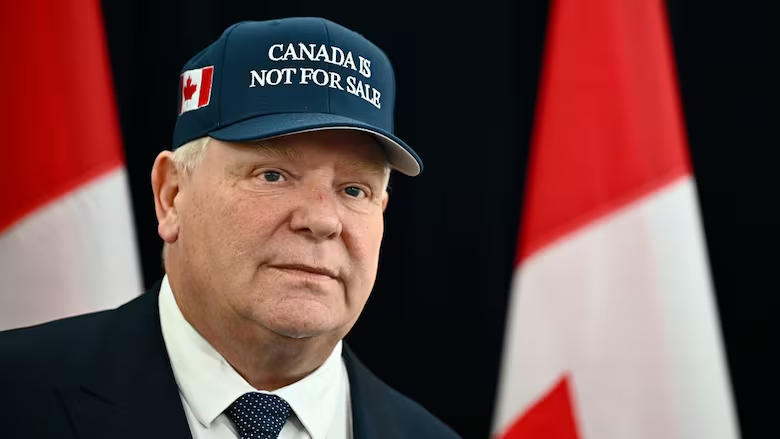
Ontario Premier Doug Ford wears his Captain Canada hat. Credit: CBC (Justin Tang/Canadian Press)

As Donald Trump continues his tariff threats against Canadian products, but more specifically doubles down on his “Canada should be the 51st state” nonsense, he has succeeded in doing what Prime Minister Trudeau has been unable to do over the past few years—uniting Canadians. Some Canadians are so incensed that they have taken to calling their favourite coffee beverage a “Canadiano” instead of an “Americano“. That’s extreme but hey, if Donald Trump can unilaterally change the name of the Gulf of Mexico to the Gulf of America, anything goes. While Trump apparently has spoken to some Canadians who are allegedly “interested” in the idea of annexation (did he find them on a golf course in West Palm Beach?), Canadian leaders and members of the public have made it plain that becoming part of the US is a non-starter.

In recent polls in Canada, opposition to Trump’s plan ranged from 90-94%. But of course that hasn’t stopped Donald Trump from publicly musing about the idea, although he seems to be just about the only person in the US who is actually interested in it, and he certainly didn’t campaign on it. Even if Canadians were interested, which they are not, the domestic political obstacles in the US to absorbing the world’s second largest country, with 42 million people, several million of whom have French as their first language, are insurmountable. It’s worth noting that Canada has more people than the most populous US state (California) and is 15 times geographically larger than the largest continental US state by size (Texas), and seven times bigger than the largest (Alaska).

However, the current issue is not whether or not Canada would ever become part of the US but rather what actions individual Canadians are taking to show their opposition to the idea. A recent public opinion poll from the respected pollster Leger reported that a large majority of those polled indicated they were prioritizing buying Canadian and consciously avoiding US products. More than half said they had cancelled trips to the US or would not travel there. The US Travel Association reported that in 2024 Canadians made more that 20.4 million visits to the US (the most from any foreign country), generating $20.5 billion in spending and supporting 140,000 US jobs. Thus a 10% reduction would mean $2.1 billion in lost spending and a loss of 14,000 jobs. The top states that Canadians visited were Florida, California, Nevada, New York and Texas. If your winter temperatures hit the minus 30s, as they do in many parts of Canada, Florida and California are understandable escapes, although there are alternatives. Mexico is a prime example.

When it comes to US products like alcohol it is also not that difficult to find good alternatives. California wine may be great, but there is Australia, Europe, Chile—even Canada itself as a source of supply. Some foodstuffs might be difficult to substitute, however, given the close integration of supply chains between the two countries. While people have started to boycott US brands, one has to ask what is a US brand, or a Canadian brand, these days? Canada Dry has long been a US product and is owned by Dr. Pepper. However, many US branded products are actually produced in Canada, so it takes some perspicacity to realize that Heinz ketchup is (once again) produced in Canada, at least for the Canadian market, as it loudly proclaims. (Canadians may remember that back in 2016 Heinz pulled out of Canada. After a widespread boycott of the product, the company rethought its policy and returned in 2020). The effectiveness of consumer boycotts is clearly illustrated when businesses such as A&W and Boston Pizza are sporting signs in Canada proclaiming that they are proudly Canadian owned and operated. Interestingly, that all-Canadian icon donut shop Tim Hortons is ultimately controlled by RBI, a US-Brazilian corporation, although most of its franchisees are Canadians and it is headquartered in Toronto.

These intricacies and nuances help explain why it is difficult for consumers to correctly identify the source of a product in order to accurately target their ire. And then there is the inconvenience of avoiding products you like, which can lead to all sorts of rationalizations. After all, most Americans don’t want to annex Canada and even if they voted for Trump, taking over Canada wasn’t part of the reason. So why try to punish them? The Province of BC took that a step further by announcing that it was going to pull all liquor products off the shelves of provincial liquor stores, but only if the products were from “red states”. We could still buy the Oregon pinot noir or that luscious California red blend with a clear conscience! (In the end, the wines have not yet been pulled because Trump postponed the tariffs on Canada for 30 days).

While Canadian consumers wrestle with whether they should cancel their trip to Disneyland or give up Florida orange juice for BC apple juice, the one thing they seem to be mostly united on is the need to leave their favourite US content streaming services out of the equation. According to the Leger survey, less than 30% said they would consider cancelling a US streaming service. (the recent price increases by Netflix might be a more compelling reason). Thus Netflix, Disney +, Prime, Apple TV and others seem safe. It’s easy to see why. Lack of real alternatives.

Bell Canada offers a domestic streaming service, Crave, but what is its prime attraction? Access to HBO. HBO does not operate a streaming service in Canada, at least not right now. It is more profitable, presumably, for the company to license its content to Bell for streaming on Crave. CBC offers an ad supported and an ad-free subscription streaming service, CBC Gem, but in the eyes of many consumers, it doesn’t stack up. Moreover, Netflix offers Canadian content if you want it. There is even a button highlighting how to access it. Besides, many of the most popular shows on Netflix are not US shows. There is Squid Game from Korea, many Nordic shows, Spanish, Italian, French and British productions abound, along of course with a range of US content. Netflix may be US owned but it has become an international platform to showcase content from around the world. It, and other US producers, also spend a lot of money producing content in Canada, some of it (a small minority) recognizably Canadian. As for the rest, it helps keep production in Canada growing. So, if you wanted to make a point, cutting off your US content nose to spite your Canadian entertainment face doesn’t seem like a very good idea. Most Canadians appear to have reached that sensible conclusion.

Will any of this stop the Trump tariffs? Consumer boycotts can have some impact, and retaliatory tariffs promised by Canada against imports of US products will hurt US exporters, such as the farming community, which is politically influential. US tariffs on imports of Canadian products, including imports that cannot be easily sourced elsewhere (think BC lumber to rebuild houses destroyed in the California fires) will increase costs to US consumers and drive up inflation in the US. That might be a more powerful reason why the Trump Administration in the end may back off somewhat. However, Donald Trump seems unlikely to stop spouting his disrespectful 51st state mantra, and the more he does, the more he will convince Canadians to come together and push back—but it seems that changing viewing habits is unlikely to be part of this.

Now if Trump really wanted to bring Canada to its knees, he would block all US streaming content, television and sports broadcasting. No Super Bowl, No NBA, No Netflix, No Disney.

We surrender!

© Hugh Stephens, 2025. All Rights Reserved.
This post has been updated to reflect the obvious fact that Alaska is the largest US state geographically, not Texas. Sorry Alaskans.

Donald Trump’s Punitive Tariffs on Canada: A Personal Commentary

Image: CBC

This blog post is an “extra”. It is tangentially copyright-related (after all, this is supposed to be a copyright blog) but I will admit it’s essentially a non-copyright personal opinion piece. I was incentivized to write it as a result of various conversations I have had with friends and colleagues during this past weekend about the impact and rationale behind Donald Trump’s punitive tariffs on Canada.

Do President Trump’s 25% tariffs on all imports from Canada (except for oil and gas which will be tariffed at 10%) have anything to do with copyright? The short answer is “probably not”, although judging from the vindictiveness of the President toward Canada, as well as an apparent inability to understand how international business is actually conducted, I wouldn’t rule out him finding some excuse to make life difficult for US studios that produce films in Canada, or for Canada to retaliate against US content providers as it desperately searches for a way to get the message through to anyone south of the border who may have Trump’s ear. In either case this would be a mistake. Hollywood is an unlikely source of influence on the President, although Silicon Valley might be a more likely prospect. Both Canada and the US film and TV industry have benefited from having the option of producing in Canada. It’s called win/win, a formula that seems alien to the current President.

So, there could be (but hopefully not) an impact on copyright industries from the fallout from the economic war Trump has declared on Canada, and the inevitable retaliation. (Canada’s initial retaliation list focussed primarily on foodstuffs, appliances and clothing, not affecting copyright industries). Economically, retaliation is a bad idea, inflicting pain on your trading partner but also causing a degree of self-harm. However, in the world of trade negotiations, it is inevitable and frankly is the only thing that Canada can do other than to turn the other cheek and say, “Hit me again”.

However, beyond the world of copyright that I usually write about lies another world, the world of international trade and security, a space in which alliances, cooperation, and mutual respect among trading partners are important. It is what is happening in this world that I want to talk about briefly today, from a personal perspective.

The announcement of the Trump tariffs on Canada has to be just about the most short-sighted policy announcement imaginable. As the Wall Street Journal put it, this is the “dumbest trade war in history”. Not only that, it is a blatant violation of US trade and treaty obligations under the USMCA/CUSMA. What is driving Trump to punish Canada, other than personal spite, is hard to fathom.

Forty years ago, Canada embarked on the path of economic cooperation and integration with the United States through the negotiation of the Canada-US Free Trade Agreement, overcoming decades of suspicion and various failed attempts to establish Canadian manufacturing in a small market behind high protective tariff walls. I was involved in a minor way, buried in the trade bureaucracy of the Department of Foreign Affairs and International Trade, and later the Trade Negotiations Office. It was a big roll of the dice for Canada, giving up quite a bit of economic sovereignty in exchange for agreed rules on market access. Both sides negotiated hard, but at the eleventh hour finally got to “yes”. It was a big step forward, promising greater prosperity on both sides of the border. We believed that when the US made commitments, it would respect them. Silly us.

There were economic advantages for Canada to develop an integrated market with the United States, but there were also important advantages for the US and US business. Production could be specialized where it was most economically and geographically advantageous to do so, supply chains could be integrated, tariffs would be (mostly) eliminated and the border would not impede business. Within the agreed rules, people and goods could move freely. US auto companies in particular, (Ford, GM and (then) Chrysler), were particular beneficiaries, but so were consumers in both countries. The rules around this grand bargain were ratified in the form of a treaty, later expanded to include Mexico. The objective was to minimize disruptions and where disagreements occurred, to settle them through a fair and impartial dispute settlement process in a timely way. This process was renewed under the USMCA/CUSMA, signed by Donald Trump in 2018. What Trump is doing now is effectively tearing up the commitments he made and which have been respected since the late 1980s, through both Republican and Democratic administrations.

The legal excuse being put forward for this trade war is the “national emergency” of fentanyl and illegal migrants. The USMCA does have provision for a national security override, Article 32.2.1.(b) which says;

Nothing in this Agreement shall be construed to..preclude a Party from applying measures that it considers necessary for the…protection of its own essential security interests.”

By invoking fentanyl and migration as “essential security interests” to justify his actions, Donald Trump is seeking to manufacture a pretext–at least insofar as Canada is concerned–allowing him to renege on US trade commitments enshrined in a Congressionally-ratified treaty that he signed. If there is a crisis, the problem does not lie with Canada. Last year exactly 19.5 kg of fentanyl (43 lbs) was seized at the Canadian border, less than 1% of the total seized at the Mexican border (21,148 lbs). In terms of illegal migration, US Customs and Border Patrol apprehended just under 24,000 illegal migrants coming into the US from Canada (Canada apprehended a greater number trying to sneak into Canada from the US, so the flow of illegals from Canada to the US was actually below zero). By contrast, on the Mexican border, about 1.5 million migrants were arrested by US authorities. Again, the Canadian border “problem” was about 1% of the total of migrants on the southern border. (I am not trying to trash Mexico but simply demonstrate how the rationale put forward to impose the tariffs on both countries is wildly disproportionate when it comes to Canada). How can Trump with a straight face use this “national emergency” as an excuse to try to cripple the economy of a friendly neighbour, an ally, and the largest customer for manufactured US goods globally? (Canada is the top export market for 34 states). Because he can, I guess.

It is apparent that facts have not been allowed to get in the way of what appears to be a personal vendetta. In fact, it appears that Trump is convinced in his own mind that Canada should not exist as a nation. His repetitive and insulting trolling of Prime Minister Trudeau as “Governor” Trudeau and the belief that Canada should become the 51st state is both tiresome and insulting. (Parenthetically, if Canadians ever agreed to become part of the US, why should Canadians settle for just two Senators? After all, the Province of Ontario has a larger population than 46 of the 50 US states, not to mention that Canada is the second largest country on the planet geographically). In reluctantly announcing retaliatory tariffs, which will hurt American workers and consumers, Justin Trudeau made a plea to Americans, recalling the famous words of John F. Kennedy;

“Geography has made us neighbours, history has made us friends, economics has made us partners and necessity has made us allies.”

These wise words are worth recalling. It is estimated that the tariffs, if sustained, will tip Canada into recession, increase the unemployment rate, shave several points off GDP and lead to a further drop in the Canadian dollar. As Ontario Premier Doug Ford put it, “he’s coming after our families and our jobs”. There will be negative impact on the US economy as well, but the unanswered question is “why would you want to deliberately destabilize your friend and ally, best customer and neighbour?”. Is it not in the interests of the US to have a prosperous, reliable, stable and friendly neighbour on its northern border? I would have thought so.

The current situation causes me both great sadness and repressed anger. Sadness because, like many Canadians, I have spent considerable time in the US and in the company of Americans. I grew up not too far from the border like many Canadians, so US television was part of my mispent youth. I attended grad school in the US. I have taken a number of holidays in various parts of the US. During my years on many foreign postings in Canada’s foreign service, I worked with and cooperated closely with my US colleagues in similarly located American embassies. Later I worked for a US company and had, and still have, many American friends and former colleagues. I have never detected any animosity toward Canada or Canadians. Thus I simply cannot believe that when he was elected, Donald Trump was given a mandate to go after Canada. But that is what he has done.

As I said at the beginning of this post, there is not much here related to copyright–but I needed to get this off my chest. I hope that saner heads will prevail, but much damage has already been done in Canada to the goodwill and trust that has long existed between Canadians and Americans. I wish it were otherwise. Maybe one day it will be again.

© Hugh Stephens, 2025.

Just before posting this, news reports indicated that President Trump had agreed to pause the imposition of tariffs on Canadian goods for 30 days after speaking with Prime Minister Trudeau. They were to have gone into effect tomorrow (February 4). Earlier he did the same for Mexico. While a temporary reprieve, this really doesn’t change much.

The Height of Hypocrisy! OpenAI Accuses DeepSeek of Stealing its Content


Image: Shutterstock (edited)

Am I the only one, or did anyone else have just a touch of schadenfreude when they read the story in the New York Times that OpenAI is claiming the Chinese start-up DeepSeek may have “improperly harvested” its data. What irony! DeepSeek caught everyone’s attention earlier this week when it announced a new AI application that appears to outperform or at least match OpenAI’s ChatGPT. Not only that, it is also open source and completely free to download and use. More important, its alleged development costs were but a fraction of the development cost of US models, reported to be in the hundreds of millions whereas DeepSeek claims that it produced its results with an investment of as little as $6 million. (This clearly does not include the value of earlier R&D, but the question is whether or not DeepSeek covered these costs).

We saw the shock this caused on the NASDAQ especially with respect to chip-designer Nvidia’s share price, with over $600 billion in value wiped off its valuation in one day. As often happens, there was a rebound the following day as saner heads digested the news and found a silver lining in the fact that AI development costs could be greatly reduced yet spending would continue. Of course, the spectre of “unfair” Chinese competition was raised, while others wondered how DeepSeek did it in the face of US high-tech embargos on the sale of advanced Nvidia chips to China. “They must have cheated” was the mantra.

It appears that part of DeepSeek’s success is based on what is called “distillation” in the AI industry. As explained in this tech article, distillation is a technique that “focuses on creating efficient models by transferring knowledge from large, complex models to smaller, deployable ones”. The earlier models do the heavy-lifting with respect to research and as they produce results, those results are incorporated into newer training models that take advantage of the earlier work. To my untrained mind, this sounds like building on knowledge created by others, as happens all the time or, to look at it negatively, by free riding on the investment of others. The question is, what knowledge is protectable and proprietary? This dichotomy is at the heart of the debate over copyright. You can’t copyright an idea, but the specific expression of an idea is protectable. Likewise, the functionality of software code cannot be copyrighted although a specific software program is considered a “literary work” and is protected.

There is also the issue of open source. Release of code as open source enables further advancements, pushing the boundaries of knowledge. This is a common feature of the digital revolution and one reason for rapid advancements in Silicon Valley. However, not all content is fully open source. In the case of OpenAI it would seem it considers its content to be proprietary to the extent that it can control the use to which it is put. The accusation is that DeepSeek took and distilled OpenAI’s results to create a competing application without permission. In effect, DeepSeek used ChatGPT to improve its own model.

OpenAI’s position that it can dictate the uses to which ChatGPT can be put is, in my view, contradictory, hypocritical and in the end morally if not legally indefensible. OpenAI has no problem enabling and encouraging people to use ChatGPT to “improve on” or create works in any field, from AI written novels to AI created art or music, resulting in works that directly compete with authors, artists and musicians. Remember that OpenAI has used their original copyrighted works without permission to build the AI machine that now threatens their livelihood and ability to create. Yet when that same AI application, ChatGPT, is used to improve on or create a new and better AI platform, this is declared to be infringement.

While distillation is common across the AI field, OpenAI claims its terms of service prohibit any use of data generated by its systems to build technologies that compete in the same market. This caveat would be similar to that which is applied to copyrighted content made publicly available on websites, with a disclaimer that it is copyright protected and potential users should contact the rightsholder. Did that stop OpenAI from helping itself without permission to this protected content to train its AI algorithm? Absolutely not. In fact, while it justified its activities by saying that all it was doing was taking “publicly available” content, not even paywalls and terms of service were allowed to get in their way. This was clearly demonstrated in the case brought against it by the New York Times. (When Giants Wrestle, the Earth Moves (NYT v OpenAI/Microsoft).

It seems that from OpenAI’s perspective, use of other people’s content without permission is okay, but when it’s their content, not so much. OpenAI is partially owned by Microsoft which is itself engaged in rolling out its own AI application, Copilot, trained in part through the unwitting contribution of hundreds of millions of users of Microsoft software, like MS-Word, as I wrote about last month. (Writers! Do You Know your Drafts on MS Word are being Scooped by Microsoft to Build its AI Algorithm? But You Can Stop This From Happening (Read On).

Given all that has transpired, and the struggle that authors and rightsholders are facing to protect and get paid for the use of their works in AI training, it is hard to have much, if any, sympathy for OpenAI. I certainly don’t. Poetic justice.

© Hugh Stephens, 2025. All Rights Reserved.