Canadians React to Donald Trump’s Tariff Threats and 51st State Nonsense by Boycotting American Goods and Services–But US Streamers Seem Immune

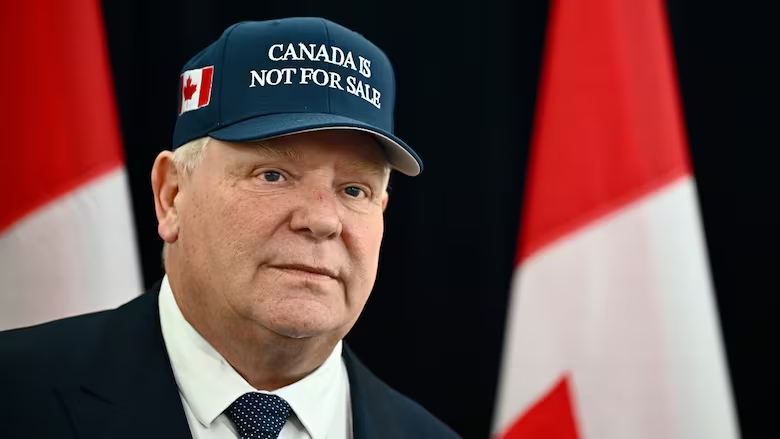
Ontario Premier Doug Ford wears his Captain Canada hat. Credit: CBC (Justin Tang/Canadian Press)

As Donald Trump continues his tariff threats against Canadian products, but more specifically doubles down on his “Canada should be the 51st state” nonsense, he has succeeded in doing what Prime Minister Trudeau has been unable to do over the past few years—uniting Canadians. Some Canadians are so incensed that they have taken to calling their favourite coffee beverage a “Canadiano” instead of an “Americano“. That’s extreme but hey, if Donald Trump can unilaterally change the name of the Gulf of Mexico to the Gulf of America, anything goes. While Trump apparently has spoken to some Canadians who are allegedly “interested” in the idea of annexation (did he find them on a golf course in West Palm Beach?), Canadian leaders and members of the public have made it plain that becoming part of the US is a non-starter.

In recent polls in Canada, opposition to Trump’s plan ranged from 90-94%. But of course that hasn’t stopped Donald Trump from publicly musing about the idea, although he seems to be just about the only person in the US who is actually interested in it, and he certainly didn’t campaign on it. Even if Canadians were interested, which they are not, the domestic political obstacles in the US to absorbing the world’s second largest country, with 42 million people, several million of whom have French as their first language, are insurmountable. It’s worth noting that Canada has more people than the most populous US state (California) and is 15 times geographically larger than the largest continental US state by size (Texas), and seven times bigger than the largest (Alaska).

However, the current issue is not whether or not Canada would ever become part of the US but rather what actions individual Canadians are taking to show their opposition to the idea. A recent public opinion poll from the respected pollster Leger reported that a large majority of those polled indicated they were prioritizing buying Canadian and consciously avoiding US products. More than half said they had cancelled trips to the US or would not travel there. The US Travel Association reported that in 2024 Canadians made more that 20.4 million visits to the US (the most from any foreign country), generating $20.5 billion in spending and supporting 140,000 US jobs. Thus a 10% reduction would mean $2.1 billion in lost spending and a loss of 14,000 jobs. The top states that Canadians visited were Florida, California, Nevada, New York and Texas. If your winter temperatures hit the minus 30s, as they do in many parts of Canada, Florida and California are understandable escapes, although there are alternatives. Mexico is a prime example.

When it comes to US products like alcohol it is also not that difficult to find good alternatives. California wine may be great, but there is Australia, Europe, Chile—even Canada itself as a source of supply. Some foodstuffs might be difficult to substitute, however, given the close integration of supply chains between the two countries. While people have started to boycott US brands, one has to ask what is a US brand, or a Canadian brand, these days? Canada Dry has long been a US product and is owned by Dr. Pepper. However, many US branded products are actually produced in Canada, so it takes some perspicacity to realize that Heinz ketchup is (once again) produced in Canada, at least for the Canadian market, as it loudly proclaims. (Canadians may remember that back in 2016 Heinz pulled out of Canada. After a widespread boycott of the product, the company rethought its policy and returned in 2020). The effectiveness of consumer boycotts is clearly illustrated when businesses such as A&W and Boston Pizza are sporting signs in Canada proclaiming that they are proudly Canadian owned and operated. Interestingly, that all-Canadian icon donut shop Tim Hortons is ultimately controlled by RBI, a US-Brazilian corporation, although most of its franchisees are Canadians and it is headquartered in Toronto.

These intricacies and nuances help explain why it is difficult for consumers to correctly identify the source of a product in order to accurately target their ire. And then there is the inconvenience of avoiding products you like, which can lead to all sorts of rationalizations. After all, most Americans don’t want to annex Canada and even if they voted for Trump, taking over Canada wasn’t part of the reason. So why try to punish them? The Province of BC took that a step further by announcing that it was going to pull all liquor products off the shelves of provincial liquor stores, but only if the products were from “red states”. We could still buy the Oregon pinot noir or that luscious California red blend with a clear conscience! (In the end, the wines have not yet been pulled because Trump postponed the tariffs on Canada for 30 days).

While Canadian consumers wrestle with whether they should cancel their trip to Disneyland or give up Florida orange juice for BC apple juice, the one thing they seem to be mostly united on is the need to leave their favourite US content streaming services out of the equation. According to the Leger survey, less than 30% said they would consider cancelling a US streaming service. (the recent price increases by Netflix might be a more compelling reason). Thus Netflix, Disney +, Prime, Apple TV and others seem safe. It’s easy to see why. Lack of real alternatives.

Bell Canada offers a domestic streaming service, Crave, but what is its prime attraction? Access to HBO. HBO does not operate a streaming service in Canada, at least not right now. It is more profitable, presumably, for the company to license its content to Bell for streaming on Crave. CBC offers an ad supported and an ad-free subscription streaming service, CBC Gem, but in the eyes of many consumers, it doesn’t stack up. Moreover, Netflix offers Canadian content if you want it. There is even a button highlighting how to access it. Besides, many of the most popular shows on Netflix are not US shows. There is Squid Game from Korea, many Nordic shows, Spanish, Italian, French and British productions abound, along of course with a range of US content. Netflix may be US owned but it has become an international platform to showcase content from around the world. It, and other US producers, also spend a lot of money producing content in Canada, some of it (a small minority) recognizably Canadian. As for the rest, it helps keep production in Canada growing. So, if you wanted to make a point, cutting off your US content nose to spite your Canadian entertainment face doesn’t seem like a very good idea. Most Canadians appear to have reached that sensible conclusion.

Will any of this stop the Trump tariffs? Consumer boycotts can have some impact, and retaliatory tariffs promised by Canada against imports of US products will hurt US exporters, such as the farming community, which is politically influential. US tariffs on imports of Canadian products, including imports that cannot be easily sourced elsewhere (think BC lumber to rebuild houses destroyed in the California fires) will increase costs to US consumers and drive up inflation in the US. That might be a more powerful reason why the Trump Administration in the end may back off somewhat. However, Donald Trump seems unlikely to stop spouting his disrespectful 51st state mantra, and the more he does, the more he will convince Canadians to come together and push back—but it seems that changing viewing habits is unlikely to be part of this.

Now if Trump really wanted to bring Canada to its knees, he would block all US streaming content, television and sports broadcasting. No Super Bowl, No NBA, No Netflix, No Disney.

We surrender!

© Hugh Stephens, 2025. All Rights Reserved.

This post has been updated to reflect the obvious fact that Alaska is the largest US state geographically, not Texas. Sorry Alaskans.
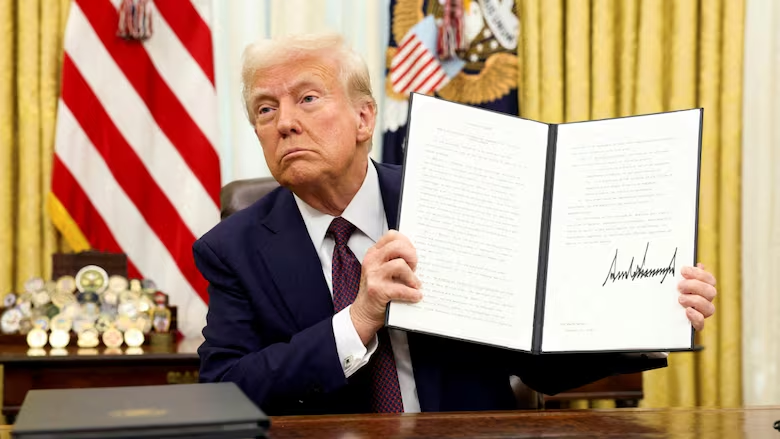
Donald Trump’s Punitive Tariffs on Canada: A Personal Commentary

Image: CBC

This blog post is an “extra”. It is tangentially copyright-related (after all, this is supposed to be a copyright blog) but I will admit it’s essentially a non-copyright personal opinion piece. I was incentivized to write it as a result of various conversations I have had with friends and colleagues during this past weekend about the impact and rationale behind Donald Trump’s punitive tariffs on Canada.

Do President Trump’s 25% tariffs on all imports from Canada (except for oil and gas which will be tariffed at 10%) have anything to do with copyright? The short answer is “probably not”, although judging from the vindictiveness of the President toward Canada, as well as an apparent inability to understand how international business is actually conducted, I wouldn’t rule out him finding some excuse to make life difficult for US studios that produce films in Canada, or for Canada to retaliate against US content providers as it desperately searches for a way to get the message through to anyone south of the border who may have Trump’s ear. In either case this would be a mistake. Hollywood is an unlikely source of influence on the President, although Silicon Valley might be a more likely prospect. Both Canada and the US film and TV industry have benefited from having the option of producing in Canada. It’s called win/win, a formula that seems alien to the current President.

So, there could be (but hopefully not) an impact on copyright industries from the fallout from the economic war Trump has declared on Canada, and the inevitable retaliation. (Canada’s initial retaliation list focussed primarily on foodstuffs, appliances and clothing, not affecting copyright industries). Economically, retaliation is a bad idea, inflicting pain on your trading partner but also causing a degree of self-harm. However, in the world of trade negotiations, it is inevitable and frankly is the only thing that Canada can do other than to turn the other cheek and say, “Hit me again”.

However, beyond the world of copyright that I usually write about lies another world, the world of international trade and security, a space in which alliances, cooperation, and mutual respect among trading partners are important. It is what is happening in this world that I want to talk about briefly today, from a personal perspective.

The announcement of the Trump tariffs on Canada has to be just about the most short-sighted policy announcement imaginable. As the Wall Street Journal put it, this is the “dumbest trade war in history”. Not only that, it is a blatant violation of US trade and treaty obligations under the USMCA/CUSMA. What is driving Trump to punish Canada, other than personal spite, is hard to fathom.

Forty years ago, Canada embarked on the path of economic cooperation and integration with the United States through the negotiation of the Canada-US Free Trade Agreement, overcoming decades of suspicion and various failed attempts to establish Canadian manufacturing in a small market behind high protective tariff walls. I was involved in a minor way, buried in the trade bureaucracy of the Department of Foreign Affairs and International Trade, and later the Trade Negotiations Office. It was a big roll of the dice for Canada, giving up quite a bit of economic sovereignty in exchange for agreed rules on market access. Both sides negotiated hard, but at the eleventh hour finally got to “yes”. It was a big step forward, promising greater prosperity on both sides of the border. We believed that when the US made commitments, it would respect them. Silly us.

There were economic advantages for Canada to develop an integrated market with the United States, but there were also important advantages for the US and US business. Production could be specialized where it was most economically and geographically advantageous to do so, supply chains could be integrated, tariffs would be (mostly) eliminated and the border would not impede business. Within the agreed rules, people and goods could move freely. US auto companies in particular, (Ford, GM and (then) Chrysler), were particular beneficiaries, but so were consumers in both countries. The rules around this grand bargain were ratified in the form of a treaty, later expanded to include Mexico. The objective was to minimize disruptions and where disagreements occurred, to settle them through a fair and impartial dispute settlement process in a timely way. This process was renewed under the USMCA/CUSMA, signed by Donald Trump in 2018. What Trump is doing now is effectively tearing up the commitments he made and which have been respected since the late 1980s, through both Republican and Democratic administrations.

The legal excuse being put forward for this trade war is the “national emergency” of fentanyl and illegal migrants. The USMCA does have provision for a national security override, Article 32.2.1.(b) which says;

Nothing in this Agreement shall be construed to..preclude a Party from applying measures that it considers necessary for the…protection of its own essential security interests.”

By invoking fentanyl and migration as “essential security interests” to justify his actions, Donald Trump is seeking to manufacture a pretext–at least insofar as Canada is concerned–allowing him to renege on US trade commitments enshrined in a Congressionally-ratified treaty that he signed. If there is a crisis, the problem does not lie with Canada. Last year exactly 19.5 kg of fentanyl (43 lbs) was seized at the Canadian border, less than 1% of the total seized at the Mexican border (21,148 lbs). In terms of illegal migration, US Customs and Border Patrol apprehended just under 24,000 illegal migrants coming into the US from Canada (Canada apprehended a greater number trying to sneak into Canada from the US, so the flow of illegals from Canada to the US was actually below zero). By contrast, on the Mexican border, about 1.5 million migrants were arrested by US authorities. Again, the Canadian border “problem” was about 1% of the total of migrants on the southern border. (I am not trying to trash Mexico but simply demonstrate how the rationale put forward to impose the tariffs on both countries is wildly disproportionate when it comes to Canada). How can Trump with a straight face use this “national emergency” as an excuse to try to cripple the economy of a friendly neighbour, an ally, and the largest customer for manufactured US goods globally? (Canada is the top export market for 34 states). Because he can, I guess.

It is apparent that facts have not been allowed to get in the way of what appears to be a personal vendetta. In fact, it appears that Trump is convinced in his own mind that Canada should not exist as a nation. His repetitive and insulting trolling of Prime Minister Trudeau as “Governor” Trudeau and the belief that Canada should become the 51st state is both tiresome and insulting. (Parenthetically, if Canadians ever agreed to become part of the US, why should Canadians settle for just two Senators? After all, the Province of Ontario has a larger population than 46 of the 50 US states, not to mention that Canada is the second largest country on the planet geographically). In reluctantly announcing retaliatory tariffs, which will hurt American workers and consumers, Justin Trudeau made a plea to Americans, recalling the famous words of John F. Kennedy;

“Geography has made us neighbours, history has made us friends, economics has made us partners and necessity has made us allies.”

These wise words are worth recalling. It is estimated that the tariffs, if sustained, will tip Canada into recession, increase the unemployment rate, shave several points off GDP and lead to a further drop in the Canadian dollar. As Ontario Premier Doug Ford put it, “he’s coming after our families and our jobs”. There will be negative impact on the US economy as well, but the unanswered question is “why would you want to deliberately destabilize your friend and ally, best customer and neighbour?”. Is it not in the interests of the US to have a prosperous, reliable, stable and friendly neighbour on its northern border? I would have thought so.

The current situation causes me both great sadness and repressed anger. Sadness because, like many Canadians, I have spent considerable time in the US and in the company of Americans. I grew up not too far from the border like many Canadians, so US television was part of my mispent youth. I attended grad school in the US. I have taken a number of holidays in various parts of the US. During my years on many foreign postings in Canada’s foreign service, I worked with and cooperated closely with my US colleagues in similarly located American embassies. Later I worked for a US company and had, and still have, many American friends and former colleagues. I have never detected any animosity toward Canada or Canadians. Thus I simply cannot believe that when he was elected, Donald Trump was given a mandate to go after Canada. But that is what he has done.

As I said at the beginning of this post, there is not much here related to copyright–but I needed to get this off my chest. I hope that saner heads will prevail, but much damage has already been done in Canada to the goodwill and trust that has long existed between Canadians and Americans. I wish it were otherwise. Maybe one day it will be again.

© Hugh Stephens, 2025.

Just before posting this, news reports indicated that President Trump had agreed to pause the imposition of tariffs on Canadian goods for 30 days after speaking with Prime Minister Trudeau. They were to have gone into effect tomorrow (February 4). Earlier he did the same for Mexico. While a temporary reprieve, this really doesn’t change much.

The Height of Hypocrisy! OpenAI Accuses DeepSeek of Stealing its Content


Image: Shutterstock (edited)

Am I the only one, or did anyone else have just a touch of schadenfreude when they read the story in the New York Times that OpenAI is claiming the Chinese start-up DeepSeek may have “improperly harvested” its data. What irony! DeepSeek caught everyone’s attention earlier this week when it announced a new AI application that appears to outperform or at least match OpenAI’s ChatGPT. Not only that, it is also open source and completely free to download and use. More important, its alleged development costs were but a fraction of the development cost of US models, reported to be in the hundreds of millions whereas DeepSeek claims that it produced its results with an investment of as little as $6 million. (This clearly does not include the value of earlier R&D, but the question is whether or not DeepSeek covered these costs).

We saw the shock this caused on the NASDAQ especially with respect to chip-designer Nvidia’s share price, with over $600 billion in value wiped off its valuation in one day. As often happens, there was a rebound the following day as saner heads digested the news and found a silver lining in the fact that AI development costs could be greatly reduced yet spending would continue. Of course, the spectre of “unfair” Chinese competition was raised, while others wondered how DeepSeek did it in the face of US high-tech embargos on the sale of advanced Nvidia chips to China. “They must have cheated” was the mantra.

It appears that part of DeepSeek’s success is based on what is called “distillation” in the AI industry. As explained in this tech article, distillation is a technique that “focuses on creating efficient models by transferring knowledge from large, complex models to smaller, deployable ones”. The earlier models do the heavy-lifting with respect to research and as they produce results, those results are incorporated into newer training models that take advantage of the earlier work. To my untrained mind, this sounds like building on knowledge created by others, as happens all the time or, to look at it negatively, by free riding on the investment of others. The question is, what knowledge is protectable and proprietary? This dichotomy is at the heart of the debate over copyright. You can’t copyright an idea, but the specific expression of an idea is protectable. Likewise, the functionality of software code cannot be copyrighted although a specific software program is considered a “literary work” and is protected.

There is also the issue of open source. Release of code as open source enables further advancements, pushing the boundaries of knowledge. This is a common feature of the digital revolution and one reason for rapid advancements in Silicon Valley. However, not all content is fully open source. In the case of OpenAI it would seem it considers its content to be proprietary to the extent that it can control the use to which it is put. The accusation is that DeepSeek took and distilled OpenAI’s results to create a competing application without permission. In effect, DeepSeek used ChatGPT to improve its own model.

OpenAI’s position that it can dictate the uses to which ChatGPT can be put is, in my view, contradictory, hypocritical and in the end morally if not legally indefensible. OpenAI has no problem enabling and encouraging people to use ChatGPT to “improve on” or create works in any field, from AI written novels to AI created art or music, resulting in works that directly compete with authors, artists and musicians. Remember that OpenAI has used their original copyrighted works without permission to build the AI machine that now threatens their livelihood and ability to create. Yet when that same AI application, ChatGPT, is used to improve on or create a new and better AI platform, this is declared to be infringement.

While distillation is common across the AI field, OpenAI claims its terms of service prohibit any use of data generated by its systems to build technologies that compete in the same market. This caveat would be similar to that which is applied to copyrighted content made publicly available on websites, with a disclaimer that it is copyright protected and potential users should contact the rightsholder. Did that stop OpenAI from helping itself without permission to this protected content to train its AI algorithm? Absolutely not. In fact, while it justified its activities by saying that all it was doing was taking “publicly available” content, not even paywalls and terms of service were allowed to get in their way. This was clearly demonstrated in the case brought against it by the New York Times. (When Giants Wrestle, the Earth Moves (NYT v OpenAI/Microsoft).

It seems that from OpenAI’s perspective, use of other people’s content without permission is okay, but when it’s their content, not so much. OpenAI is partially owned by Microsoft which is itself engaged in rolling out its own AI application, Copilot, trained in part through the unwitting contribution of hundreds of millions of users of Microsoft software, like MS-Word, as I wrote about last month. (Writers! Do You Know your Drafts on MS Word are being Scooped by Microsoft to Build its AI Algorithm? But You Can Stop This From Happening (Read On).

Given all that has transpired, and the struggle that authors and rightsholders are facing to protect and get paid for the use of their works in AI training, it is hard to have much, if any, sympathy for OpenAI. I certainly don’t. Poetic justice.

© Hugh Stephens, 2025. All Rights Reserved.

Hijacking a Musician’s Identity to Promote AI-generated Music Isn’t Copyright Infringement: It’s Outright Fraud

Image: Shutterstock.com

Early last week there was a flurry of articles, including one on Billboard, reporting on the strange case of Nova Scotia musician Ian Janes. Janes discovered that his Spotify artist profile included music that wasn’t his and which he hadn’t recorded. Someone had apparently created “Musak-like” AI-generated tracks and had added an album, named Street Alone, to Janes’ artist profile as a way of boosting the album’s take-up. How they did this is not clear although they must have hacked the system in some way. Janes had Street Alone removed from his profile, although it reportedly remains up on Spotify but not under his profile.

One assumes if the AI album was surreptitiously posted to Janes’ account, it could also have been added to the profile of other artists. Janes stated that the person or entity doing the posting could actually be getting any royalties the album is earning because payments are normally made through a distributor who could be directing royalty payments, such as they are, to the fake artist. (Not that they are likely to get rich. There is a 1000 track minimum streaming requirement on Spotify before any royalties are paid, and given Spotify’s track record of paying approximately $3.00 per 1000 streams, it takes over 33,000 streams for an artist to earn the princely sum of $100). However, the fake listing could also boost the stream count of the album, raising its profile in the algorithm. In effect, it appears that someone is hijacking the profile of a known artist to promote low grade AI-generated music. Is this legal? No, it’s not, but why not? Does copyright law help?

Billboard reports that Janes’ lawyer lamented it’s not technically a copyright violation unless the music uses Janes’ likeness or his actual compositions. No one has copied his music; they have just claimed he wrote and performed a piece which he had nothing to do with. Another publication (allaboutai.com) claims this case has revealed significant gaps in Canadian copyright laws, which primarily address human-created works, noting that “Current statutes do not fully account for the complexities of AI-generated content”. This is true, as I pointed out recently in a blog post on the issue of the loophole in Canadian copyright practices that allows registration of AI-generated works even though it is generally accepted that such works do not receive copyright protection under Canadian law. Here we may have an example of an anonymously created AI-generated work trying to find a recognized human artist to associate with. While there is a tangential relationship to copyright, this story is not about copying a specific work or illegally generating income from a copy. It is about the droit d’auteur, the integrity of an author’s or artist’s work and their reputation. In this case, the key issue is the potential damage to Janes’ reputation if inferior work is passed off under his name.

However, copyright law (in Canada or elsewhere) does not specifically include the ability to protect one’s identity or name. A name or identity cannot be copyrighted–although a work by that person can be. Nonetheless, there are some forms of legal protection available. A related concept known as the right of publicity (or right of personality) affords some protection. In Canada, this either falls under provincial privacy laws (BC, SK, MB and NL) or common law principles of defamation. In the US there are laws protecting publicity rights in some states. Another way to protect one’s identity and image is to register it as a trademark, although this is usually done by well-known personalities. There are various requirements such as demonstrating a record of marketing products that use the trademark designation. (Michael Jordan shoes, Frida Kahlo dolls, even Fred Perry tennis shorts—remember him?). But in my view Janes should not have to trademark his name and identity, nor should he have to resort to defamation or privacy laws. To me, perhaps simplistically, this case is about fraud, producing a fake product and passing it off as the real thing.

Under the Criminal Code of Canada, fraud is defined as depriving someone of “any property, money, or valuable security or any service…by deceit, falsehood or other fraudulent means…”. Recently I wrote about the scandal of the Norval Morrisseau art fraud. The principal perpetrator, David Voss, was sentenced to five years in jail for the fraud (technically he pleaded guilty to forgery) while his co-accused Gary Lamont was convicted of forgery and defrauding the public. In sentencing, the judge in the case focused as much on the damage to Morrisseau’s legacy and reputation caused by the fraud as to the harm suffered by those who had purchased fake paintings. Surely the same is true of Janes, or any other musician, whose work is tainted by false claims that a shoddy piece of music was produced by them. The fraud per se would have been perpetrated against a Spotify user who thought they were playing Janes’ music, but the real fraud was perpetrated against the artist, their work and their reputation.

There are examples of fraudulent works where the false attribution of author is also a copyright violation, as in the case of the plethora of Chinese knockoffs of J.K. Rowlings’ Harry Potter works. For example, Harry Potter and the Walk-up Leopard Dragon and Harry Potter and the Chinese Porcelain Doll, both published in Chinese but labelled as being written by Rowlings, were fraudulent works, total fakes, but under US law they also violated Rowlings’ copyright so that is what Warner Bros. used to shut them down. They were unauthorized derivative works. But the definition of a derivative work is much narrower in Canada, as explained here, in this post by Carson Law. In the case of Janes, none of his works was copied or infringed, only his identity and name were misused so, as noted by his lawyer, there are apparently no grounds for bringing a copyright infringement case in Canada. But claiming that a random work was produced by someone who had nothing to do with it is clearly misrepresentation and deceit, in short, fraudulent activity.

Will anyone do anything about it? Of course not. It took two decades and a documentary film that fully exposed what was going on to shame the Canadian authorities into doing something about the Morrisseau fraud. It was only through the dogged determination of one detective in the Thunder Bay Police Service (Sgt. Jason Rybek) that action was finally taken.

The conjunction of AI-generated music (which has no copyright protection), online platforms that market tracks from literally millions of artists (it is estimated there are 11 million artists on Spotify), combined with the ingenuity of hackers who have been able to successfully post ersatz music to legitimate Spotify accounts as a way to promote machine generated tracks, has created a perfect storm allowing for these kind of shenanigans. The damage is done to legitimate artists–who have a tough enough time as it is to profile their music– without having to carry the burden of inadvertently promoting someone else’s musical garbage. To willingly assert that your work is the creation of someone else, whether it is music generated by AI, or paintings produced from a sophisticated “paint by numbers” scheme as in the case of the Morrisseau forgeries, is surely outright fraud. The real artist pays the price. And that’s not fair.

© Hugh Stephens, 2025. All Rights Reserved

This blog post was updated to include reference to Spotify’s payouts in the second paragraph.

Writers! Do You Know your Drafts on MS Word are being Scooped by Microsoft to Build its AI Algorithm? But You Can Stop This From Happening (Read On).

Image: Shutterstock

Although I post my blog content on WordPress, I usually use MS Word to draft my content initially. I am used to it, and it is easy to use. Little did I know that, according to the blogsite and forum nixCraft, Microsoft recently (September Privacy update) switched on a feature that allows them to ingest everything you write on Word to help develop their AI Algorithm, called Copilot. The setting is turned on by default in the Privacy settings and must be unchecked manually. Did Microsoft tell you this? Well, kinda, sorta. Microsoft says, “we don’t use your customer data to train Copilot or its AI features unless you provide consent to do so”. Did you provide consent? You no doubt did, unknowingly, when Microsoft updated its Terms of Use, which it does on a regular basis. If you continued to use Office 365, you granted consent.

In the last few days, a pop up has appeared when I am doing something on Word through Office 365.

“Thank you for using Office! We’ve made some updates to the privacy settings to give you more control”.

If you believe that, I have a bridge to sell you.

If you go to Privacy Settings there is a summary blurb on how the Terms of Use were updated on September 30. If you look hard enough you will find this reference;

We added a section on AI services to set out certain restrictions, use of Your Content and requirements associated with the use of the AI services.”

You really should read the full Terms but as Microsoft notes, this will take an hour of your time (ESTIMATED READING TIME: 55 Minutes; 14268 words).

Having waded through it, this I believe is the relevant wording;

b. To the extent necessary to provide the Services to you and others, to protect you and the Services, and to improve Microsoft products and services, you grant to Microsoft a worldwide and royalty-free intellectual property license to use Your Content, for example, to make copies of, retain, transmit, reformat, display, and distribute via communication tools Your Content on the Services.

There is nothing here about opting out. You have to go to Privacy settings and do some digging to get to that. By masking these changes to make them appear that your privacy has been strengthened (whereas in fact it is just a content grab), Microsoft has stood things on its head by putting the onus on you, the user, to exercise your privacy rights. If you don’t want your creative work used to help train its AI algorithm, which in the end might compete directly or indirectly with your work, you need to opt out (unless you want to stop using MS Word altogether). Microsoft, however, is not suggesting this as a preferred option, or even letting it be widely known that it exists as an option. In fact, when you go into Settings to opt out you are presented with this little gem; “The Trust Center contains security and privacy settings. These settings help keep your computer safe. We recommend that you do not change these settings”.

But that is exactly what you must do if you want to keep your creative content out of the hands of Microsoft’s AI developers. Here is how to do it, based on instructions from nixCraft.

On a Windows computer, when in a Word file, go to File in the top left-hand corner. There is a drop-down menu. You want to go to Options. On my computer the Options choice does not show up unless you hit the arrow at the bottom of the page for “More”. When you get to Options, go to Trust Center (left side menu), then Trust Centre Settings. Next up is Privacy Options which leads you to Privacy Settings. There is a drop down menu, including Connected Experiences. There is a heading labelled “Experiences that analyze your content“. This box is checked for you. You want to uncheck it. To save the setting you will have to log out of Word and then log back in. (Update: I have just discovered a quicker way to do this. Go File-Options-General (top of list)-Privacy Settings-Connected Experiences-Experiences that analyze your content-Uncheck).

Eliminating this option will come at a price, according to all the “Learn More” button provided by MS, but it is your choice. For my part, I will forgo the bells and whistles for privacy.

The opt out process is not simple and not intuitive, but worth doing, even if only as a matter of principle. Office365, unlike Google Search or Bing, is not free. We pay to use it through an annual subscription. Even the tired old argument that you are providing your data as a sort of payment for “free” use of a platform’s service does not apply in this case. Microsoft needs more data to feed its AI machine and yours will do just fine, thank you very much. Don’t let them get away with it.

© Hugh Stephens, 2025. All Rights Reserved.

Visiting Mexico Made Me Wonder…Are the Works of Diego Rivera and Frida Kahlo in the Public Domain (Answer: It Depends)

Image: Museo del Arte Moderno, Mexico City

This is the time of year when Canadians find a desperate need to escape, from rain, sleet, snow and hail. They head for sunnier climes further south. With my family I spent a few days in that great, populous republic down south, the one with a brand-new president, and where people are intent on chasing the mighty dollar, the US dollar that is. I am, of course, referring to Mexico. And with the withering Loonie, now down below 70 cents US, there were no bargains to be had. But we had sunshine, tacos, tequila and laughter.

Apart from its cuisine and history, Mexico is a cultural powerhouse, particularly in the art world with artists such as Diego Rivera and Frida Kahlo. Rivera, although politically controversial, was famous for decades and did much of his work in the US, where his works were no doubt registered, with many of them (all those produced since 1929) still falling under copyright protection in the US. Kahlo, twenty years his junior and his third wife (he would go on to have four) was not so well known during her lifetime (she died at age 47 in 1954 after a series of debilitating health issues and tempestuous love affairs) but then became immensely popular posthumously, in the 1970s and 1980s, particularly outside Mexico.

Books, coffee mugs, porcelain tiles, prints and all sorts of other items in the boutiques that line every small Mexican town where tourists gather feature Rivera and Kahlo paintings, along with all the other usual bric-a-brac, macrame, shell necklaces, etc. You name it. I confess to not knowing much about Mexican copyright law, but seeing all this artwork made me wonder if it was authorized or infringing. All I knew was that Mexico has one of the longest terms of copyright protection in the world, if not the longest. In Mexico, at the current time, a work is protected for the life of the author plus 100 years. Contrast this to the US, EU, Canada or many other countries where the term of copyright protection is life plus 70 years. In some other countries, it is still the Berne Convention minimum of life plus 50 years. So, with this long period of protection Mexico must have long considered protection for artists and authors a priority, right? Wrong.

In fact, the term of protection in Mexico was quite short until relatively recently, and this affects the term of copyright protection in Mexico for works by both Rivera and Kahlo. According to this article published a few year ago by a Mexican law firm, it wasn’t until 2003 that the Federal Congress extended the term of protection to life plus 100 for economic rights. However, as recently as 1947 the term of protection was only life plus 20 years. In 1956 this was extended to life plus 25 years. This was made retroactive so Kahlo’s works in Mexico were protected until the end of 1979. (1954 plus 25 years). Rivera died in 1957 and his works therefore entered the public domain in Mexico in 1983. There were further amendments in 1963 that extended the term to life plus 50, but with no retroactivity. This allowed Mexico to join the Berne Convention in 1972. In 1997, there was a further amendment to extend the term to life plus 75 and finally the ultimate extension in 2003. There was no retroactive application of the extended terms legislated in 1963, 1997 or 2003 to works already in the public domain, in other words there was no restoration of protection. It is clear that insofar as copyright protection is concerned both Rivera’s and Kahlo’s works have been in the public domain in Mexico for a number of years. What about elsewhere?

Every year in January public domain advocates publicize the major works where copyright protection has just expired as of January 1. Last year Steamboat Willie was the star attraction. This year in various arts publications Kahlo gets top billing along with Henri Matisse and others. While Kahlo’s works have indeed fallen into the public domain as of January 1, 2025 in some countries, (given that 70 years have passed since her death in 1954), this does not necessarily include the United States, despite some online reports to the contrary. It all depends on whether her works were published in the US or registered for US copyright. This is because, for works created before January 1, 1978, the US applies the life plus 70 years rule only to unpublished or unregistered works. US law further extends the term of protection for such works if they were eventually published before December 31, 2002—resulting in a possible maximum term of protection that would last through the end of 2047. See this guidance from the US Copyright Office.

Assuming that Kahlo’s unpublished works were registered for copyright in the US (or if they were published prior to her death), her works for which the copyright protection term started before 1930 would be in the public domain as of this year. (This is because the US applies a copyright protection term of 95 years from date of publication or registration for pre-1978 registered or published works). But any registered unpublished works or published works of hers where the term of protection started after 1929 are still protected. This would be the bulk of her repertoire as she started producing works around 1925 but most of her work was produced in later years, after 1930. However, if a work was not published or registered, the life plus 70 rule applies (except if the work was subsequently published before December 31, 2002). Those unpublished or unregistered works will have entered the public domain on January 1 of this year in the US. In other words, it all depends on the work. Blanket statements that all of Kahlo’s work is now in the public domain in the US are dangerous and very likely inaccurate.

What about Canada? Here the interpretation is a lot easier. All of Kahlo’s works have been in the public domain in Canada since January 1, 2005 since Canada applied a life plus 50 year term at the time her works reached copyright maturity.

How about Rivera? Given that much of his work was done in the US, it is likely his works were both registered and published, and so his post 1929 works will still be protected for many years, depending on the year the work acquired copyright protection. And in countries that apply a life plus 70 term his works will be protected until January 1, 2028, given the date of Rivera’s passing, 1957. But in Canada, his works became publicly available in 2008. In Mexico, as noted above, his work entered the public domain in 1983 (date of death 1957 plus 25 years under the 1956 amendment).

That’s all very clear, right? Well not really, and its further complicated by the fact that a Mexican corporation, the Frida Kahlo Corporation has registered trademarks of Kahlo’s likeness in the US as well as Frida Kahlo wordmarks associated with products such as cosmetics, alcoholic beverages, cigars, games, coffee, clothing, dishware, etc. and has been aggressive in issuing takedown notices and even bringing lawsuits against various artists and enterprises that have used Kahlo’s personality to market items, such as Kahlo dolls. It also defends the copyright on those Kahlo works that still are protected in the US.

As is often the case with copyright, the principle (protection of the author’s economic rights) is simple, but the application is frustratingly complex. It would appear that works by Rivera and Kahlo have been in the public domain in Mexico for decades, for a couple of decades in Canada, and that Kahlo’s works are now in the public domain in the EU and UK. But not Rivera’s. In the US some of their works, if registered and produced post-1929, are still protected. Unpublished or unregistered Kahlo works are not. Did I say copyright was simple? Pass the tequila.

© Hugh Stephens, 2025. All Rights Reserved.

I would like to acknowledge the help and patience of Rachel Kim, of the Copyright Alliance, for her assistance in helping me understand the intricacies of US copyright law as it applies to the term of copyright protection for works in the US.

Digital Platforms and News Content: Australia Takes Off the Gloves

Image: Shutterstock

Canada infamously tried to take a leaf from Australia’s book in dealing with large internet platforms, like Google and Meta, that benefit from news media content without paying for it. In 2023, Canada introduced the Online News Act (Bill C-18), a Canadian version of Australia’s News Media Bargaining Code. The Australian approach, first introduced through legislation in late 2021, was initially very successful. Rod Sims, the author of the Code from his then position as Commissioner of the Australian Competition and Consumer Commission (ACCC), testified before the Canadian House of Commons Committee studying C-18, pointing to the success of the initiative in generating some AUD200 million in financial support for Australian media annually. Although there had been pushback by both Google and Meta in Australia, both eventually came onside, especially after the spectacular flop of Meta’s news blackout campaign. The threat of being designated under the Australian code was enough to get the two platforms to negotiate agreements with most Australian media in the form of funding to support journalistic output. As a result of the agreements reached, neither platform was designated under the Code and thus was not subject to “final offer” arbitration imposed by the ACCC.

Canada thought it would “improve” on the Australian precedent by making the process somewhat more transparent in terms of funding offers, and by requiring the platforms to self-designate. Whether it was the tweaked Canadian legislation or, more likely, a reappraisal of the value and cost of the agreements (particularly when it became apparent that the Australian precedent was likely to be followed elsewhere, with Canada being the first out of the gate), both platforms dug in. Meta in particular refused to engage with the Canadian process and declared that it would “comply” with the legislation by removing all links to Canadian media. That is not what the Government of Canada or Canadian media had in mind when Bill C-18 was introduced. Meta has held that line, although the extent to which it is fully complying is under review by the regulator, the CRTC. Various workarounds to allow news content to appear on Facebook have been employed by both Facebook users and some news providers, and META seems willling to turn a blind eye. Why that doesn’t trigger the Online News Act requirement to reach funding agreements with news content providers is a question that cries out for a response. (CRTC take note: We are waiting).

Google was slightly more amenable to striking a deal with the Government of Canada, agreeing that in return for exemption from the legislation, it would contribute $100 million (CAD) annually for five years (adjusted to inflation) to a fund that would provide support to qualified Canadian media enterprises. The $100 million subsumes existing contributions Google was already making to some Canadian journalism programs, so the net result is not $100 million in new money. Google has now begun to disburse this funding through the Canadian Journalism Collective (CJC), an entity established by what could legitimately be called “non mainstream media”, i.e. many small digital startups. The CJC was selected by Google as the executing agency for its funding, thus snubbing the organization representing the major media enterprises, News Media Canada. There are likely to be disputes over whether some of the “little guys” actually qualify as bona fide journalists. The more mouths there are to feed, the less there is for each supplicant and the big players are not happy to see the Google revenue stream diluted.

Meanwhile, back in Oz, Meta has announced that once they expire it will not renew the media agreements it reached back in 2022. Many will end this year. It appears Meta has decided it will adopt a consistent global position by insisting that news media content provides it with no value. Zero. None. And therefore it will not pay a cent. In part, this is to head off similar moves in the US where news media providers would like to bring in an arrangement similar to that instituted in Australia, or Canada. A separate initiative in California ended up with an outcome close to the one in Canada, with Google reluctantly agreeing to contribute funding to local journalism while Meta walked away. The Australian government has seen where this is heading, and it is not happy. It is taking the gloves off.

The Albanese government has announced it will be taking measures to require that any internet company that refuses to negotiate with publishers or removes news from its platform will be forced to pay, regardless. This is the big stick to counter META. What happens next is a consultation process, beginning now, to determine how what is being called a “news bargaining incentive” will actually be applied, retroactive to January 1. All digital platforms with annual revenues of AUD250 million annually will likely be subject to it. This will expand the net to include ByteDance (Tik Tok) and Microsoft (Bing, LinkedIn) as well as META and Google. Google has already said it will carry on and will renew the deals it signed with Australian media, allowing it to be exempted under the Code. META is not backing down.

The so-called “incentive” will take the form of a discounted penalty or fine. The initial proposal is that companies that sign deals amounting to 90% or more of the total of the fine that would otherwise be levied will be exempt. In other words, find ways to strike deals that in the end will save you money. Simply refusing to carry news content, as META has done in Canada, will not let a designated platform off the hook, a significant variation from the Canadian legislation, which many have criticized as being flawed. Rod Sims, now back in academia, fully supports the new incentive initiative. It appears the only way META can avoid payment is by closing its business in Australia. Given META’s track record, this might even be a card it is prepared to play. One can expect it to pull out all the stops to oppose the “incentive”, from legal challenges to threatening a pullout to seeking to invoke the support of the Trump Administration.

What position will the Trump Administration adopt? Donald Trump certainly has no love for the news media, as evidenced by his current and threatened lawsuits against US media outlets for providing coverage he doesn’t like. On the other hand, NewsCorp, which has strong holdings in Australia, has in recent years built its reputation and business model on catering to Trump’s vanity and desires. Trump also is not fan of Facebook, but Mark Zuckerberg has smelled the coffee and has donated a $1 million to Trump’s inauguration, after having kissed the ring by dining with the President-elect at Mar-a-Lago. So in the end, who knows where the US government will be on this question? All I can say to the Australian government’s expressed intention to deal head-on with META’s scorched-earth tactics is “good on ya, mate”. I wish Canada had the gumption to do the same.

© Hugh Stephens, 2025. All Rights Reserved.

Looking Back at 2024: It’s All About AI and Copyright (And a Few Other Things)

Image: Shutterstock

A retrospective on the year now coming to a close is what one expects this time of year, so I will try not to disappoint. However, when I look back at the copyright developments I wrote about in 2024, the dominant issues that jump out are AI, AI and AI. You can’t read or think about copyright without Artificial Intelligence, or to be more correct, Generative Artificial Intelligence (GAI), occupying most of the space despite many other issues on the copyright agenda. The mantra of “AI, AI and AI”, as in “Location, Location and Location” is apt because there are at least three important copyright dimensions related to AI; training of AI models; copyright protection for outputs generated by AI; and infringement of copyright by works created with or by AI. Of the three, the use of copyrighted content for AI training is the most salient.

Last year in my year-ender, I also discussed AI and the numerous lawsuits that were emerging as rightsholders pushed back on having their content vacuumed up by AI developers to train their algorithms. Those lawsuits have only multiplied. At last count, there are more that 30 cases in the US, ranging from big media vs big AI (New York Times v OpenAI/Microsoft) to class action suits brought by artists and authors, as well as litigation in the UK, EU, and now in Canada (see here and here). That is just on the input side.

In terms of output, i.e. whether works produced by an AI can be copyrighted, there are a couple of interesting cases in the US where applications for copyright registration have been refused by the US Copyright Office (USCO) because of a lack of human creativity. A couple of months ago, I discussed two such high profile cases, one brought by Stephen Thaler, and the other by Jason Allen. To date the USCO is not budging, although it is undertaking an extensive study of the issue. Part 1 of its study, on digital replicas, was published in July of this year. The next section on copyrightability is expected to be published in January with the issues of ingestion for training and licensing in Q1 2025.

While the USCO has to date denied applications for copyright registration of AI-generated works, the Canadian copyright office (CIPO-Canadian Intellectual Property Office) has been caught up in a problem of its own making. This is because Canadian copyright registration is granted automatically, so long as tombstone data and the prescribed fee is provided. The work for which registration is sought is not examined. As a result, copyright certificates have been issued to works created by AI, notwithstanding the general presumption that copyright protection is only accorded to human created work (although this is not explicitly stated in the Act). In July a legal challenge was launched against copyright registrant Ankit Sahni, who successfully registered a work with CIPO claiming an AI as co-author. The case was brought by the Canadian Internet Policy and Public Interest Clinic (CIPPIC) at the University of Ottawa, as I wrote about here. (Canadian Copyright Registration and AI-Created Works: It’s Time to Close the Loophole).

While the courts in the US, UK, Canada and elsewhere are grappling with various issues related to AI and copyright, governments are studying the issue.

In Australia, the Select Committee on Adopting Artificial Intelligence issued its final report in November. While the report was wide-ranging, three of its recommendations related to copyright;

engagement with the creative Industry to address unauthorized use of their works by AI developers and tech companies,

transparency in Training Data by requiring AI developers to disclose the use of copyrighted works in training datasets and ensure proper licensing and payment for these works, and

remuneration for AI Outputs, with an appropriate mechanism to be determined through further consultation

These are important principles, but how they will be implemented in practice remains to be determined.

In Canada, a consultation on AI and copyright was launched late in 2023 with submissions to be received by January 15, 2024. The Canadian cultural community put forth three key demands;

No weakening of copyright protection for works currently protected (i.e. no exception for text and data mining to use copyrighted works without authorization to train AI systems)

Copyright must continue to protect only works created by humans (AI generated works should not qualify)

AI developers should be required to be transparent and disclose what works have been ingested as part of the training process (transparency and disclosure).

Submissions to the consultation were published in mid-year but since then there has been no apparent action. Given the current political crisis facing the Trudeau government, none is expected in the near term although the issue will inevitably have to be addressed after the general election in 2025.

While the EU has already established some parameters dealing with use of copyrighted materials for AI training, the new UK Labour government is taking another run at the issue after various proposals in Britain to find a modus vivendi between the AI and content industries under the Tories went nowhere. The current UK discussion paper on Copyright and Artificial Intelligence, which seems excessively tilted in favour of the AI industry, has aroused plenty of controversy. While it says some of the right things, such as proclaiming that one of the objectives of the consultation is to “support…right holders’ control of their content and ability to be remunerated for its use” the thrust of the paper is to find ways to encourage the AI industry to undertake more research in the UK by establishing a more permissive regime with respect to use of copyrighted content. It is based on three self-declared principles; (notice how these things always seem to come in threes?);

Control: Right holders should have control over, and be able to license and seek remuneration for, the use of their content by AI models

Access: AI developers should be able to access and use large volumes of online content to train their models easily, lawfully and without infringing copyright, and

Transparency: The copyright framework should be clear and make sense to its users, with greater transparency about works used to train AI models, and their outputs.

These three objectives then lead to what is clearly the preferred solution;

“A data mining exception which allows right holders to reserve their rights, underpinned by supporting measures on transparency”

Fine in principle, but the devil is always in the detail and the details in this case revolve around transparency (how detailed, what form, what about content already taken?) and, in particular, reservation of rights, aka “opting out”. This is easy to proclaim in principle but difficult to do in practice. British creators are up in arms, led by artists such as Paul McCartney, and supported by the creative industries in the US. The British composer Ed Newton-Rex has penned a brilliant satire explaining how AI development in the UK will work if current proposal is enacted. The problem with an opt-out solution is essentially twofold; it doesn’t deal with content already absorbed by AI developers and it would be cumbersome if not impossible for many rightsholders to use.

Other governments have addressed the issue in different ways. Singapore has taken a very loose approach toward copyright protection, putting its thumb firmly on the scale in favour of AI developers. It is currently considering additional proposals that would strip even more protection from rights-holders, who are pushing back strongly. Japan had been widely and incorrectly reported to have been on the same path, resulting in a welcome clarification this year from the Agency for Cultural Affairs regarding the limits of Japan’s text and data mining (TDM) exception.

While AI dominated the copyright agenda in 2024, there were other issues relating to copyright and copyright industries that I wrote about. The ongoing question of payment for news content by large digital platforms continued to play out in different ways. In Canada, the struggle between the government and US tech giants Google and META was finally “resolved” (after a fashion) at the end of last year. Google agreed to “voluntarily” pay $100 million annually into a fund for Canadian journalism in return for being exempted from the Online News Act (ONA) while META called the government’s bluff by blocking Canadian news providers from its platform thus, in theory, avoiding being subject to the ONA. However, META has a very subjective interpretation as to what is Canadian news content, allowing some news providers to post to it, while many users have found workarounds, as documented by McGill’s Media Ecosystem Observatory. While the CRTC investigated, the issue is still unresolved.

Meanwhile in Australia, it seems that META intends to go down the same road of blocking news, announcing it will not renew the content deals it initially signed with Australian media in response to Australia’s News Media Bargaining Code, the model upon which Canada’s legislation was based. Unlike in Canada, the Australian government is planning a robust response. (More on this in a future blog post). Finally, on the same topic, California (which was threatening to introduce its own version of legislation to require digital platforms to compensate news content providers) emerged with an outcome very similar to that reached in Canada, with Google offering up some funding (although proportionally less than in Canada) while META appears to have walked away.

Controlled Digital Lending (CDL) was another copyright issue finally settled in 2024 (in the US). The Internet Archive, after losing a lawsuit brought against it by a consortium of publishers who argued that the digital copying of their works constituted copyright infringement, notwithstanding the Archive’s theory that they were simply lending a digital version of a legally obtained physical work held by them (or someone else associated with them), lost its appeal. In December, the deadline for further appeals expired, thus effectively ending this saga. Whether Canadian university libraries, some of whom are avid devotees of CDL, will take note remains to be seen.

The issue of circumventing a TPM (“Technological Protection Measure”), commonly referred to as a “digital lock” and often represented by a password allowing access to content behind a paywall, was also front and centre this year in Canada. In the case of Blacklock’s Reporter v Attorney General for Canada, the Federal Court found that an employee of Parks Canada, who shared a single subscription to Blacklock’s with a number of other employees by providing them with the password did not infringe Blacklock’s copyright since the employee did not circumvent (in the meaning of the law) the TPM and the purpose of the sharing was for “research“, which is a specified fair dealing purpose. Blacklock’s is a digital research service that sells access to its content and protects its content with a paywall, as is common for many online content providers, like magazines and newspapers.

Despite the hoo-ha of anti-copyright commentators asserting the Court had found that “digital lock rules do not trump fair dealing“, it was equally clear the Court had ruled that fair dealing does not trump digital locks (TPMs). The Court did not undermine the protection afforded to businesses to protect their content through use of TPMs. Rather, it determined that sharing a licitly obtained password did not constitute circumvention as outlined in the Act, as I explained here. (Fair Dealing, Passwords and Technological Protection Measures (TPMs) in Canada: Federal Court Confirms Fair Dealing Does Not Trump TPMs (Digital Lock Rules). Although the Court did not legitimize circumvention of a TPM for fair dealing purposes, contrary to claims stating the opposite, its acceptance of password sharing is an outcome that legal experts have disagreed with, (as do I for what it is worth). The law is very clear that fair dealing cannot be used as a pretext or a defence against violation of the anti-circumvention provisions of the Copyright Act. The decision now under appeal by Blacklock’s.

Finally, the last copyright point of note for 2024 is that this year marked the bicentenary of the introduction of the first copyright legislation in Canada, in the Assembly of Lower Canada, in 1824. It also marked the centenary of the entry in force of the first truly Canadian Copyright Act on January 1, 1924. This two hundred years of domestic copyright history is worth celebrating. The first legislation was introduced “for the Encouragement of Learning” so that more local school texts would be written and printed. Given the current standoff between the secondary and post-secondary educational establishment and Canadian authors and their copyright collective over license payments for use of copyrighted works in teaching, one wonders whether we have really learned anything about the role copyright plays in our society. (Copyright and Education in Canada: Have We Learned Nothing in the Past Two Centuries? (From the “Encouragement of Learning” to the “Great Education Free Ride”).

Leaving that question with you to ponder, gentle Reader, is probably a good way to end this look back over the past 12 months. Stay tuned for more commentary on copyright developments in 2025.

© Hugh Stephens, 2024. All Rights Reserved.

Government Announces an Artist’s Resale Right Will be Finally Coming to Canada!……Well, Maybe but Don’t Count On It.

Image: Author

Canada’s long-awaited 2024 Fall Economic Statement, reporting on the country’s finances for 2023-24 and outlining future spending and legislative priorities, was tabled in the House of Commons on December 16. Normally the big news would be that the budget deficit hit almost $62 billion, a 50% increase of almost $22 billion over the projected deficit announced in the last budget just over six months ago, but all that was upstaged by the announced resignation of Finance Minister Chrystia Freeland the morning of the day she was to deliver the Statement. This has led to a crisis within the Liberal caucus as to whether Prime Minister Justin Trudeau should himself resign. Buried in the 270 page document, which outlined some $23 billion in planned new spending just months after the April 2024 budget proposed over $50 billion in other spending initiatives, was a tiny little bone for the copyright community. On p. 140, we find this commitment:

Protecting Artists’ and Creators’ Copyrights

Artists, particularly visual artists, are among the lowest income earners in Canada despite their significant cultural contributions. An Artist’s Resale Right provides the creators of original visual artwork with a royalty whenever their work is resold through an eligible sale, offering an additional income stream.
In the 2024 Fall Economic Statement, the government announces its intent to amend the Copyright Act to create an Artist’s Resale Right in Canada, ensuring Canadian visual artists benefit from future sales of their work.”

CARFAC, the non-profit that represents visual artists in Canada (along with its Quebec counterpart, RAAV,) was quick to publicize and celebrate the announcement. And so it should. It is important to get support for the Artist’s Resale Right (ARR) on the record, in the hope that this time the promise will actually be actioned. I have written about the ARR in the past, in 2021 and 2022, here (The Artists’ Resale Right: A Matter of Simple Fairness) and here (Will the “Artists’ Resale Right” Come to Canada and the US?). It is not a new idea to bring it to Canada. Artists have been campaigning for it for more than two decades. It exists in many countries (although not in the US) and has been around for more than a century, being first initiated in France in 1920. Today it exists in over 90 countries, including all members of the EU, Britain, Australia, Mexico and a number of African states. An important factor is that it is applied reciprocally, and is fully consistent with the Berne Copyright Convention.

The announcement on December 16 makes it appear that enactment of the ARR in Canada is tantalizingly close, but it is worth remembering that after the last general election in 2021, the mandate letter for the Minister for Innovation, Science and Industry, who holds lead legal responsibility for amending the Copyright Act, included the following instruction; “Work with the Minister of Canadian Heritage to amend the Copyright Act to further protect artists, creators and copyright holders, including to allow resale rights for artists.” That was three years ago and since then absolutely nothing has happened to implement this instruction. In fact, the only action to date has been the restatement this month of the government’s continued intention to do so. But time is fast running out for the Liberals– and consequently on any real prospect that the Copyright Act will be amended before the current Trudeau minority government falls, resulting in a general election. To say that the governing Liberal Party is not expected to win would be the understatement of the year.

Before speculating further on the prospects of the ARR actually coming to Canada any time soon, it is worth a quick refresher on what it is. CARFAC’s press statements describes the ARR as “a royalty that allows artists to share in the wealth they generate in the marketplace”. It is not known how exactly it would be implemented in Canada. While most Resale Right regimes are similar, they are not identical although the basic premise is that where sales of artistic works (works of graphic or plastic art such as pictures, collages, paintings, drawings, engravings, prints, lithographs, sculptures, tapestries, ceramics, glassware and photographs) take place beyond the initial sale, a small proportion of the re-sale price is remitted to the original artist or their estate, with post-mortem payments limited to a specified number of years. Often there is a sliding scale for payments, with the percentage going to the artist decreasing as value increases. Sometimes there is a ceiling beyond which a resale royalty is not levied. There can also be a ceiling on the amount paid. Private sales are usually excluded; the ARR applies only to works sold through galleries or auction houses. You can guess who might be opposed to it.

CARFAC’s proposal is for an ARR to be applied to secondary sales of $1000 or more that are conducted by a dealer or auction house, at a flat rate of 5%, with the liability to pay shared between the seller and the dealer, as is currently the case in the UK. It would apply only to Canadian artists and to artists of countries that offer an ARR (thus the reciprocity angle). Works of Canadian artists resold in other countries offering an ARR would be eligible for ARR payments from galleries or auction houses in those countries. Payment would be collected through a copyright collective, Copyright Visual Arts, owned jointly by CARFAC and RAAV. Notably, since the US does not have an ARR, works of US artists resold in Canada would not be eligible.

However, for all this to happen, the current Trudeau government will have to get its act together to introduce and pass the legislation, something that seems unlikely given the dilatory approach of the past three years plus the current existential crisis facing this government. The government has mused about copyright reform but has not walked the talk. Now it has almost run out of runway, and seems to be sleep-walking over a cliff. Public opinion polls put the party and the Prime Minister at all time lows, around 20% support, and a large number of the Liberal caucus has spoken up to urge Trudeau to resign. As a minority government, it must be supported in a confidence vote by at least one other party, and that support seems increasingly tenuous. In a best-case scenario for the Liberals, the government could last until October 2025 when there is a statutory requirement for a general election, but its demise is likely to come months before that.

Where is there room to introduce ARR amendments to the Copyright Act in the midst of all this uncertainty? Such amendments would have to be reviewed in Committee, given the guaranteed opposition of the art dealers. With the Trudeau government’s fate hanging by a string, not to mention the increasingly strident threats to impose punishing tariffs on Canadian exports to the US coming from the Truth Social account of Donald Trump, dealing with this bit of legislative housekeeping seems most unlikely.

That is not to say that amendments to the Copyright Act have not been introduced quickly in the past. The extension to Canada’s term of copyright protection required by the CUSMA/USMCA agreement was quietly and quickly enacted to meet the deadline of December 31, 2022 and back in the Stephen Harper era an amendment was quickly passed to extend copyright protection on sound recordings by twenty years from date of release. The big difference is that Harper held a strong majority in Parliament at the time, and the amendment was relatively noncontroversial. However, to think that the current limping government will expend much political capital to introduce an ARR in Canada at this time is most unlikely. As for the apparent “government-in-waiting” of Pierre Polievre’s Conservatives, as far as I know they have not pronounced on the issue. It is unlikely to be a priority, insofar as they claim to have so many other things to do from ending the so-called “carbon tax” (aka price on carbon) to defunding the CBC.

One element in favour of an ARR is its “reconciliation” and social justice impacts. It is supported by Indigenous artists and organizations representing them, such as the Inuit Tapiriit Kanatami and the Nunavut Arts and Crafts Association. Often cited is the case of the noted Inuit artist Kenojuak Ashevak, whose famous graphic work “Enchanted Owl” (the image on this blog) was initially sold by her for the princely sum of $24 in 1960. That’s all she got in her lifetime although the original work was sold and resold for many multiples of that both in her lifetime (she died in 2013) and after.

If Canada ever gets around to introducing an ARR, will the US follow? I suppose it is a possibility. Since Donald Trump seems to be making policy daily by tweet on Truth Social, I guess we will have to stay tuned. Maybe someone could float the idea with Elon? In the meantime, don’t hold your breath for the ARR to come to Canada within the life of the current Trudeau government, tantalizing as the recent announcement is. I wish it were otherwise. And I would love to be proven wrong.

© Hugh Stephens, 2024. All Rights Reserved.

CanLII v CasewayAI: Defendant Trots Out AI Industry’s Misinformation and Scare Tactics (But Don’t Panic, Canada)

Image: Pixabay

Last month I highlighted the first AI/Copyright case in Canada to reach the courts, CanLII v CasewayAI. CanLII, (the Canadian Legal Information Institute), a non-profit established in 2001 by the Federation of Law Societies of Canada, sued Caseway AI, a self-described AI-driven legal research service, for copyright infringement and for violating CanLII’s Terms of Use through a massive downloading of 3.5 million files which Caseway allegedly used to populate its AI based services. Now the principal of CasewayAI, Alistair Vigier, through an article (Don’t Scare AI Companies Away, Canada – They’re Building the Future) published in Techcouver, has responded publicly by trotting out many of the tired and specious arguments put forward by the AI industry to justify the unauthorized “taking” of copyrighted content to use in or to train generative AI models. Let’s have a closer look at these arguments.

Vigier opens by referencing another AI/Copyright case in Canada where a consortium of Canadian media companies is suing OpenAI for copyright infringement. He claims this is all based on a misunderstanding of how AI training works, stating that “AI systems like OpenAI rely on publicly available data to learn and improve. This does not equate to stealing content.” Whether data is “publicly available” or not is irrelevant when it comes to determining whether copyright infringement (aka stealing content) is concerned. Books in libraries are publicly available, or so is a book that you purchase in a bookstore, or content on the internet that is not behind a paywall. (It is worth noting that the Canadian media companies also claim that OpenAI circumvented their paywalls to access their content when copying it). But in none of these cases is copying permitted unless the copying falls within a fair dealing exception, which is very precise in its definition. Labelling copied material as “publicly available” is a red herring.

Vigier’s next argument is to equate the ingestion of content by various AI development models with a human being reading a book. We know that humans enhance their knowledge through reading and are thus able, presumably, to better reason based on the content they have absorbed. Vigier says, “This is how AI works. The AI “reads” as much as it can, gets really “smart,” and then explains what it knows when you ask it a question. Like a human learns from reading the news, so does an AI.

Really? A human does not make a copy, not even a temporary copy, of the content although some elements of the content are no doubt retained in the human brain. But AI operates differently. It makes a copy of the content. This should be beyond dispute although the AI industry continues to muddy the waters by claiming that when content is “ingested” it is converted to numeric data and is thus not actually copied. This is a fallacious argument. Just because the form changes, this does not mean there is no reproduction. When you make a digital copy of a book, there is still reproduction even though the digital form is different from the original hard copy version. When a work is converted to data, the content is still represented in the dataset.

Vigier dubiously states, with regard to OpenAI, “OpenAI’s models do not reproduce articles verbatim; they process vast datasets to identify patterns, enabling insights and efficiency.” Apart from the fact that the New York Times in its separate lawsuit in the US has been able to demonstrate that by typing in leads of articles, it can prompt OpenAI to reproduce verbatim the rest of the article (OpenAI claimed that the Times “tricked” the algorithm), copying is copying even if the result of the copying is somewhat different from the original. The Copyright Act is crystal clear on this point. Section 3 (1) of the Act states that, “For the purposes of this Act, copyright, in relation to a work, means the sole right to produce or reproduce the work or any substantial part thereof in any material form whatever…. If copyright protected content is reproduced in its entirety without permission for a commercial purpose (eg for AI training), that is infringement, unless the use qualifies as a fair dealing under Canadian law or fair use in the US.

The issue of whether ingestion of content to train an AI application results in copying (reproduction) has been carefully studied and documented. One of the most thorough examples is a recent SSRN (Social Science Research Network) paper, entitled, “The Heart of the Matter: Copyright, AI Training, and LLMs” with noted scholar Daniel Gervais (a Canadian by the way) of Vanderbilt University as lead author. The article goes into a detailed discussion on how copying of content occurs during AI scraping to build a Large Language Model (LLM), including the stages of tokenization, embedding, leading to reward modelling and reinforcement learning. The section of the article explaining how copying occurs (pp. 1-6) is dense, technical text but the conclusion is clear, “LLMs make copies of the documents on which they are trained, and this copying takes various forms, and as a result, with appropriate prompting, applications that use the LLMs are able to reproduce original works.” A shorter (and earlier) version explaining how the LLM copyright process works can be found in this article (“Heart of the Matter: Demystifying Copying in the Training of LLMs“), produced by the Copyright Clearance Center in the US. It is also worth noting that these explanations refer only to ingestion of text. AI models that train on images and music are even more likely to produce exact or close-to-exact reproductions of some of the works they have been built and trained on.

So much for the misinformation in Vigier’s article. Now to the scare tactics. He says that the recent Canadian media lawsuit against OpenAI sends a negative message to innovators that Canada may not be open to AI development.

If Canada wishes to remain relevant in this (AI) sector, it must balance protecting intellectual property and promoting technological progress.

The fact that there are currently more than 30 lawsuits in the US, including the seminal New York Times v OpenAI case, does not seem to have slowed down the AI companies in the US. In the UK, legislation has been introduced that would, according to British media reports, “ensure that operators of web crawlers (internet bots that copy content to train GAI, generative AI) and GAI firms themselves comply with existing UK copyright law. These amendments would provide creators with crucial transparency regarding how their content is copied and used, ensuring tech firms are held to account in cases of copyright infringement.” There is lots of AI innovation ongoing in Britain.

The Australian Senate Select Committee Report on Adopting AI has recommended, among other findings, that there be mandatory transparency requirements and compensation mechanisms for rightsholders. The EU is already way out in front on this issue. Its new AI Act stipulates that providers of AI generative models will be required to provide a detailed summary of content used for training in a way that allows rightsholders to exercise and enforce their rights under EU law. Even India now has its own version of the US and Canadian media cases against OpenAI. (OpenAI’s defence in part is based on the argument that no copying took place in India because no OpenAI servers are located there!)

If that is what the “competition” is doing, who does Vigier cite as being the jurisdictions most likely to attract innovators away from Canada? Why, it is those AI powerhouses of Switzerland, Dubai—and the Bahamas!

The argument that if legislators and the courts don’t give AI innovators a free pass on helping themselves to copyrighted content for AI training purposes, this will either slow down innovation or chase it elsewhere is a common fearmongering strategy of the AI industry. This is a race-to-the-bottom mentality whereby content industries are thrown under the AI bus. Vigier, having been the subject of his own lawsuit, argues that instead of resorting to litigation, the Canadian media companies should have sought a licensing solution. But the fact that no licensing agreement was reached with OpenAI is undoubtedly the reason for the lawsuit in the first place. That is certainly the reason behind the NYT v OpenAI lawsuit in the US; licensing negotiations broke down. If someone has taken your content without authorization, and then offers you pennies on the dollar in comparison to what that content is actually worth, then the stage for a lawsuit is set.

In explaining CasewayAI’s position in the litigation brought by CanLII, Vigier says that Caseway approached CanLII with an offer to collaborate but was rebuffed. As a result they developed other extensive web crawling technology that pulled the needed material from elsewhere. (Where exactly the material was downloaded from is the crux of the matter). Regardless, this makes it sound as if it was CanLII’s fault for refusing to share their content. Surely a rightsholder has the right to determine the terms on which their content is to be shared with others, if at all.

The fact that Caseway went to CanLII in the first place suggests that CanLII had developed the content that Caseway wanted. Caseway claims the material it accessed was on the public record, such as court documents and decisions. CanLII, on the other hand, claims that it had reviewed, indexed, analyzed, curated and otherwise enhanced the content in question, thus adding a wrapping of copyright protection to what otherwise would be public documents. Who is right, and whether the material was scraped from CanLII’s website without authorization, will be determined by the BC Supreme Court.

If the material taken by CasewayAI was not copyright protected, they are in the clear, at least with respect to copyright infringement. That is quite different, however, from arguing that no copying takes place during AI training or that if rightsholders use the courts to protect their rights, Canada will be a laggard when it comes to AI development. Robust AI development needs to go hand in hand with robust copyright protection for creators, with an appropriate sharing of the spoils of the new wealth generated from the creative work of authors, artists, musicians and other rightsholders. To say, as Vigier does in his concluding paragraph that;

Canada has a choice to make. Will we embrace AI as the transformative force it is, or will we let fear and litigation stifle innovation? The lawsuits against Caseway and OpenAI message tech companies: you’re not welcome here. If this continues, Canada won’t just lose its AI startups; it will lose the future of job creation.

What sheer self-interested nonsense!. This is fearmongering of the worst kind, based on an inaccurate and misinformed knowledge of how AI is developed and trained, that moreover impugns the legitimate right of a rightsholder to seek the protection of the law to protect their creativity and investment in content. Vigier might be correct when he says that licensing of content is a win/win for both parties. I agree with that. But licensing negotiations are about money and conditions of use and require willing parties on both sides. When licensing discussions break down, or when one party decides to do an end run on licensing because they have been rebuffed, then the way to gain clarity is through the courts whose job it is to interpret what the legislation means.

Canada still needs to come to grips with the question of how copyrighted content will interface with AI development. As I noted earlier, both sides in the debate made their cases in the public consultation launched a year ago, but since then there has been no movement in Ottawa. The law could be strengthened to ensure adequate protection of rightsholder interests in an age of AI, resulting in facilitating licensing solutions. In the meantime, misinformation and scare tactics need to be called out for what they are.

Adequate protection for rightsholders does not mean the end of AI innovation or investment in Canada. There is no need for panic. We can walk and chew gum at the same time.

© Hugh Stephens, 2024. All Rights Reserved.