Canada’s Creative Sector Uneasily Awaits the Carney Government’s Next Steps on AI Training

Blasting a Wide TDM Hole in the Structure of Copyright is Not the Answer

A cartoon-style illustration showing a fist breaking through a brick wall labeled 'COPYRIGHT', with the fist wearing a band labeled 'TDM', surrounded by explosive graphical effects.
Image: Author (via DALLE-E)

The ongoing wrestling match-cum-dance between the creative sector and AI developers over the uncompensated and unauthorized use of copyrighted content for AI training is being played out in different ways in different countries. In the US it is largely a legal play in the courts at the moment, with mixed results for both sides. However, President Trump has made concerning public comments siding with the AI industry, saying it is impractical for AI developers to pay copyright holders for AI training (and besides, China doesn’t do it). Congress is still considering its options. In Australia, the Productivity Commission, never a friend of intellectual property, has just issued an interim report recommending the adoption of a Text and Data Mining (TDM) exception in Australia to boost development of the AI industry locally. The Australian creative sector mobilized quickly and has pushed back hard against this proposal, with the government now saying that it has no plans to amend the Copyright Act. In the UK, where there is a TDM exception but only for non-commercial purposes, the Starmer government quickly adopted a pro-AI strategy, part of which was to propose an expansion of TDM to include commercial purposes, although subject to an opt-out for rights-holders. That ignited a major storm among leading British creatives from Paul McCartney and Elton John on down. Through a unified campaign, British creators were able to gain support in the Upper Chamber (House of Lords) to slow down the legislation. As a result, the TDM issue has now  been earmarked for further consultation and study. One thing is certain, the creation of a wide TDM exception is a sure way to stifle a nascent but rapidly developing licensing market for copyrighted content used for AI training.

It seems as if TDM, or more permissive TDM, is testing the boundaries of copyright just about everywhere. So, what about Canada? Canada has no TDM exception in its copyright law and, unlike the US, has clearly defined fair dealing exceptions that do not lend themselves to expansive court interpretation. Like other countries, it is trying to figure out how to not get left behind as the AI race accelerates. Canada initially had a first mover advantage in terms of AI research, given the work of Geoffrey Hinton, Yoshua Bengio and others, but recently it has been falling behind, notably lacking native startups. The cluster effect is not happening, with Canadian innovation going elsewhere for commercialization. To address these challenges, the new Carney government has appointed a dedicated Minister of Artificial Intelligence and Digital Innovation, former journalist Evan Solomon. This is the first time such a position has existed. One of Solomon’s first acts was to accelerate launch of an AI strategy beginning with a new consultation released on October 1 (closing at the end of this month), in the form of a survey to “help define the next chapter of Canada’s AI leadership”. This survey asks many relevant questions regarding AI and how it could be best developed in Canada but manages to mostly steer clear of the thorny question of AI training and copyright. The only question tangentially related to this issue is the following;

“Which infrastructure gaps (compute, data, connectivity) are holding back AI innovation in Canada, and what is stopping Canadian firms from building sovereign infrastructure to address them?”

Clearly this consultation is not going to turn over the TDM rock, at least not directly.

In the past couple of years, the government has issued two consultation papers on AI, one in 2021 and another last year as well as a “What We Heard” report. This report, issued earlier this year, summarizes the “great divide” between AI developers and the content industry. It’s first observation was that “Creators oppose the use of their content in AI without consent and compensation” but then goes on to say that “User groups support clarifications that TDM does not infringe copyright”.

After a couple of other observations about the centrality of human authorship and the need for transparency surrounding the use of copyright-protected works in the training of AI, the paper observed that there is “no consensus about whether existing legal tests and remedies are adequate”. That is the nub of the issue. There is no consensus, and while the courts are struggling with this issue (including in Canada, as I wrote about here and here), what Canadian creators fear is the introduction of a wide TDM exception in the name of maintaining “Canadian competitiveness”.

The launch of the new AI strategy and the evolution of the way in which copyrighted content is described in government consultation documents is indicative of the pressures on the government to shore up Canada’s AI strategy. It is interesting to note the shift in the definition of TDM from 2021 to today.

The definition provided in the 2021 consultation document described TDM as follows;

“The process of conducting TDM may require the making of reproductions of large quantities of works or other copyright subject matter to extract particular data and information from them. This process may be carried out using scientific or text-based data, as well as images, sounds, or other creative works.”

In the most recent consultative document, that definition has evolved;

“Text and data mining (TDM) consists of the reproduction and analysis of large quantities of data and information, including those extracted from copyright-protected content, to identify patterns and make predictions.”

Note the shift from “works” to “data”.[i]  It’s a subtle difference but is hugely significant because data and facts are not protectable under copyright whereas the creative elements of original works are. The cultural sector is rightly concerned.

The Coalition for the Diversity of Cultural Expressions (CDCE), a major arts and creatives lobby group, is currently pressing Ottawa on a number of cultural issues, including AI. Among its AI asks are to;

  1. Ensure that the Copyright Act is not modified through an exception permitting Text and Data Mining (TDM) or any other exception allowing technology developers or users to use protected works…to train generative AI systems without authorization or compensation;
  2. Adopt national legislation on generative AI that requires developers of generative AI systems to disclose the training data they use; and
  3. Adopt legislative provisions requiring public identification of content that is purely AI-generated.

Against these demands is the pressure coming from AI advocates who will argue that if the US loosens restrictions on use of copyrighted content for AI training, Canada will have no recourse but to follow. In other words, as goes the US, so goes Canada (or for that matter, the UK, Australia and others). Thus, what is happening in the US courts, and perhaps in Congress, is of critical importance for the creative sector everywhere including, in particular, Canada.

The issue of AI training on copyrighted content will need to be resolved sooner or later. Licensing solutions are developing quickly and if Canada can wait a bit longer it may be able to adopt licensing as the preferred solution (although the “What We Heard” report noted that “Some (intervenors) argued that licensing is an unnecessary burden because it may not be clear that copyright is engaged or that works used in TDM are being reproduced in the first place.”). There is pressure on the Carney government to take early action since AI industry developments are moving at lightning speed. With the TDM train gaining momentum in Canada and elsewhere, Canadian creators are understandably uneasy about what is likely to happen next.  

As the CDCE notes, culture is a major economic and social pillar in Canada. In 2023, it generated $63.2 billion in value added and employed 669,600 people. Throwing all that under the bus in the name of remaining competitive on AI is a flawed choice, a point also made by the creative sectors in the UK, Australia and elsewhere. However, with the AI horse well out of the barn, copyright cannot be seen as an obstacle to innovation, an accusation freely levelled at it by some in the AI industry. Rather, it must be seen as a partner in innovation, which is where licensing comes in.

Blasting a wide TDM hole in the protection and incentive structure that copyright provides the creative sector is not the answer. The creative sector is watching and waiting anxiously.

© Hugh Stephens, 2025. All Rights Reserved


[i] I am indebted to Erin Finlay, partner at Stohn Hay Cafazzo Heim Finlay LLP for drawing these changing definitions to my attention

When Will AI Developers Take Responsibility for the Products They Provide Their Subscribers?

What They are Doing Really Bugs Me

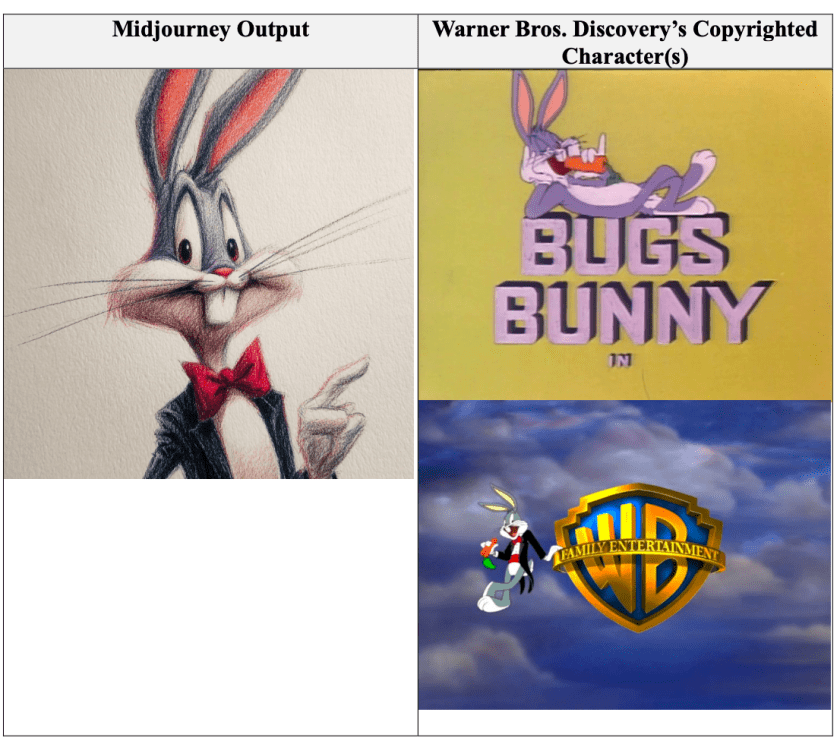
Illustration comparing a Midjourney-generated image of Bugs Bunny on the left with Warner Bros. copyrighted images of Bugs Bunny on the right, featuring different styles and settings.

Image: US District Court Filing

I confess to having been a lifetime fan of Bugs Bunny, that “Wascally Wabbit”, and not just because I worked for Time Warner at one point in my career. His insouciance, his ingenuity and his cultural achievements (have you seen Bugs perform opera or conduct a symphony orchestra?) are legend. Thus it was with some interest that I read the headline in my morning newspaper “Warner Bros. sues AI Company over Images of  Bugs Bunny and other characters”. It was based on a generic AP report that appeared in many journals across North America. The AI company in question is Midjourney. Hollywood Reporter has done a deeper dive comparing images produced with Midjourney’s AI program to copyrighted Warner Bros. (WB) images, drawn from the lawsuit submission. This is not the first confrontation between Hollywood and Midjourney. In June Disney and Universal brought a similar suit alleging that the AI company’s image generator produces near replicas of its copyrighted characters.

Just in case you forget what Bugs looks like, Warner Bros. (technically now known as Warner Bros. Discover) has a complete description in its lawsuit;

Many of the Looney Tunes characters are ubiquitous household names, and these characters have expressive conceptual and physical qualities that make them distinctive and immediately recognizable. Bugs Bunny, for example, is a playfully irreverent anthropomorphic gray and white rabbit, who has a star on the Hollywood Walk of Fame. Bugs Bunny has an overbite that showcases his two long front teeth, oversized feet with white fur, and is often depicted eating a carrot.

Does this description look anything like the image produced by Midjourney, as reproduced in the filing (see paragraphs 85 and 86), which I have pinched as the image for this blogpost. Scroll up or down to see the full range of characters at issue, ranging from Tweetie to Batman.

Midjourney’s response to the earlier lawsuit, and now to Warner Bros. is that they are not responsible for any copyright infringement that may occur. You see, it is the users of their service who are to blame. Not them. According to their court filing:

“The Midjourney platform is an instrument for user expression. It assists with the creation of images only at the direction of its users, guided by their instructions, in what is often an elaborate and time-consuming process of experimentation, iteration, and discovery.

Midjourney users are required by Midjourney’s Terms of Service to refrain from infringing the intellectual property rights of others, including Plaintiffs’ rights, Midjourney does not presuppose and cannot know whether any particular image is infringing absent notice from a copyright owner and information regarding how the image is used.”

Warner Bros. points out that Midjourney could easily control infringing outputs by (1) excluding WB content from training its AI system (2) rejecting prompts from users requesting WB characters and (3) using technical means to screen images. But instead, Midjourney has become a vending machine for WB content, selling a commercial service powered by AI that was developed using infringing copies of WB works and then allows users to reproduce or download infringing images or videos. These outputs directly compete with WB copyrighted content.

Midjourney’s defence strikes me as similar to arguments used by the manufacturers of guns. “Guns don’t kill people. People kill people.”  Except that there are a number of limitations on the kind of gun you can sell, and its capabilities. While the law varies from jurisdiction to jurisdiction, what is common are restrictions on selling automatic and semi-automatic weapons. The reasons are obvious. While there is a use for some kinds of guns (gun clubs, hunting etc.) there is no legitimate need for unlimited lethality. Not all gun purchasers (like AI software users) can be trusted so limitations are placed on what gun manufacturers are allowed to make available to the public. Similarly, while there are many uses for image-generating AI platforms, there are also legal limits to what is acceptable, such as when AI is used to create child porn. AI companies have agreed to set and enforce guardrails against this, and are clearly capable of doing so. Since, regrettably, not all users can be trusted, to simply to ask them to acknowledge and abide by Terms of Service is inadequate. So, if AI companies can stop some categories of use, they are equally capable of marketing a service that avoids copyright infringement. Enough of the “blame the user” nonsense. Design and market a service that conforms to the law.

Another good example of the “blame the user” excuse is META’s creation of “flirty chatbots” using virtual images of celebrities such as Taylor Swift, Scarlett Johanson, etc. According to Variety, quoting a report from Reuters who researched the issue, the celebrity AI chatbots  “routinely made sexual advances, often inviting a test user for meet-ups.” In some cases, when they were asked for “intimate pictures,” the chatbots “produced photorealstic images of their namesakes posing in bathtubs or dressed in lingerie with their legs spread.” Many of these chatbots, which clearly violate the right of publicity of the subjects, were user produced. But users could not produce these images, and cross the line into illegality, unless they were enabled to do so by the program produced by META. META claims that the production of such images violates its rules, which prohibit the direct impersonation of public figures. But of what use is a rule if it is not enforced?

If AI developers design products that are easily misused and then enable (even encourage) their users to do so, it is high time for them to accept responsibility. They are able to establish guardrails; they just don’t want to as it is easier to free ride, while attracting as many users as possible. Midjourney is a good case in point, but Warner Bros has just fired a shot across their bow. Just as Bugs did in Captain Hareblower.

© Hugh Stephens 2025. All Rights Reserved.

Confiscating Creator’s Rights: Australia’s Slippery Slope

A police officer in uniform is carefully holding a brown package marked with a copyright symbol.

Image: Author (via Dalle-E)

Confiscation is a strong word, but I can’t think of any more appropriate term to describe what has just happened in Australia regarding the copyright of film footage taken by two employees (Chris Delforce and Harley McDonald-Eckersall) of Farm Transparency International (FTI). FTI is an animal rights organization well known for its crusade against animal cruelty in Australia. The two illegally trespassed into the slaughterhouse facilities of Game Meats Company (GMC) and then installed pinhole cameras in the ceilings of the abattoirs. The resulting footage was to be used to further expose industry practices which FTI claims constitute animal abuse. It was sent to the Department of Agriculture, Food and Fisheries (DAFF) who forwarded the complaint to GMC, which triggered GMC’s lawsuit. It was also sent to Seven Network, who decided not to show it after the lawsuit was launched.

The Department (DAFF) declined to prosecute the company, although in court a GMC employee is reported as describing the alleged abuse as “a brief aberration … just a small glitch in a process”. The confrontation between FTI and the meat industry has been ongoing for a number of years, and the industry has employed various tactics to combat FTI’s use of film footage to expose slaughterhouse practices. Keeping the public’s eye away from how their lamb chop, hamburger or pork sausage got from farm to fork is one way of avoiding consumer pushback against the distasteful but necessary process of animal slaughtering. Such footage is not for the faint-hearted.

However, this blog post is not about the rights or wrongs of eating meat or animal slaughtering practices; it is about copyright. And, believe it or not, copyright is very relevant to this controversial topic.

Recall that copyright is established when an original work is created. There is no need for registration or validation, but the work must be fixed in some form (e.g. a book, image or film) and normally must have at least some element of creativity (although in Australia originality is not required for films). For films, holding copyright confers certain exclusive rights, such as the right to reproduce or make a copy, to have the film screened in public, and to communicate the film to the public through means such as broadcasting, streaming, or downloading. Once copyright is established, it lasts a long time (the life of the rights-holder(s) plus 70 years in Australia), and is impossible to renounce. Holders of copyright can issue various forms of Creative Commons licences authorizing use under various scenarios, but the copyright still exists. It is very “sticky”. In Australia, the copyright in films is normally held by the person who is the maker of the film, that is, the person who makes the arrangements for the film to be made. This could be the director, or the person who commissions the film. If a company commissions a film, the company could be the rights-holder. It could also be the person doing the filming, if it is a small-scale production and the person doing the filming is also the producer. The Australian Copyright Council has an excellent background paper outlining all the ins and outs of copyright ownership in films. In the case under discussion, the copyright owner was FTI. While the issue of who has copyright in a film can be complicated, one thing is very clear. The person being filmed does not own the copyright, any more than a person receiving a letter owns the copyright in that letter. It belongs to the author. But the Federal Court of Australia has just stood this principle on its head.

In August the full Federal Court upheld the appeal of Game Meats Company (GMC) against a lower court ruling. The lower court had concluded that while FTI had trespassed on GMC’s property (and was assessed significant damages for having done so), the filming that had taken place was not held in trust for the owner of the property, i.e. GMC. This somewhat convoluted wording meant that Game Meats did not own the copyright in the film and that the film was not made on its behalf. (This seems obvious since it was FTI doing the filming, but that was the wording of the decision). However, the Federal appeal court reversed this decision and awarded the copyright to GMC in the form of a “constructive trust”, to be maintained in force until such time as the copyright in the film was compulsorily assigned to it. As part of the decision, FTI was required to execute an assignment in writing of the copyright in the images and footage to Game Meats and permanently delete all copies of the images in its possession and control. In other words, FTI was required to turn over its copyright to the entity that it had filmed, thus ensuring that the new owner of the footage would ensure it never saw the light of day. In short, FTI’s copyright was confiscated.

As far as I am aware, this is the first time that the legal concept of “constructive trust” has ever been applied to a copyright case, in Australia or anywhere else. So, what is a constructive trust? There are many definitions, but here is one that seems to capture the essence quite well;

A constructive trust is imposed by law to remedy a situation in which someone has been unfairly deprived of property or wronged through misconduct such as fraud, misrepresentation, or a breach of fiduciary duty in relation to specific property or assets. This type of trust comes into existence to uphold equitable property interests, regardless of whether the parties intended to create a trust relationship.”

There are two key elements here, (1) there must have been some misconduct committed by the defendant and (2) restoration of “equity” demands that the property in question be transferred to the wronged party. It is often used in disputes over estates where one party argues they have been unjustly deprived of certain proceeds of the estate to which they had contributed for many years. It was not designed to deal with copyright disputes but that is how it has been used by Game Meats Company, now upheld by the full appeal court. This is an unfortunate precedent.

This case could lead to a very slippery slope regarding freedom of expression and freedom of the press. Hijacking copyright to stifle press coverage could easily result in unintended consequences. GMC, now the assignee of the copyright will, of course, not sanction any release of the footage. Any media outlet that does so could face severe legal consequences. Moreover, this decision sends a very threatening message to investigative journalists, photographers, film makers and others. Could the constructive trust ruling be expanded in future to impede researchers who were “virtually trespassing” by using drones or telephoto lenses? There are privacy and defamation laws to deal with this sort of situation, but what if the door is now open to seizing the copyright? What about surreptitious footage shot by documentary filmmakers or investigative TV reporters? The public interest demands that journalism be given some leeway to pursue investigations and shed light on contentious issues. It is self-evident that entities being investigated are not going to facilitate filming of their activities.

The Australian weekly, the Saturday Paper, quotes Macquarie University journalism professor, Peter Greste, who is also executive director of the Alliance for Journalists’ Freedom, saying the case “gives all sorts of subjects of media investigation an opportunity to threaten legal action and shut down otherwise important and legitimate journalistic investigations”. From a legal perspective, the appeal court’s ruling appears to be on shaky grounds. It is based on some non-binding opinion (obiter) in a 2001 case in which the Australian Broadcasting Corporation (ABC) successfully argued against an injunction sought by Lenah Game Meats, an opossum meat processer, that had sought to prevent ABC from showing footage the broadcaster had obtained from an anonymous source. ABC had subsequently learned its source had obtained the footage illegally. Apart from questionable legal precedence cited by the Federal Court in its current ruling, the decision itself constitutes a significant threat to responsible freedom of expression and freedom of the press at a time when both are under attack.

While privacy and prohibition against trespassing are important, there are other ways to deal with content obtained through illegal means such as legislation already used against FTI in New South Wales, the Surveillance Devices Act, or by seeking an injunction against publication because of “irreparable harm”. Undermining the Copyright Act and the fundamental principles of copyright is not the way to go. Australia has always had a strong tradition of journalistic freedom and a culture of encouraging creativity. The court’s FTI decision runs against that tradition and is a retrograde step. Let’s hope it is appealed–and subsequently overturned, reserving copyright law for the purposes for which it was intended.

© Hugh Stephens 2025. All Rights Reserved

Update: On December 4, 2025 the High Court of Australia granted leave for FTI to appeal the decision of the Federal Court of Australia.

So, You Want to Get in Touch with Echovita? Good Luck (But Please Don’t Phone Me)

Image Credit: Le Journal de Montréal

I first wrote about obituary piracy back in 2019, and then more recently (here and here) about the online obituary company, Echovita which, to be clear, does not engage in copyright infringement. This is because it manages to stay just within the law by taking information from obituaries on funeral home websites and posting rewrites based on the basic, non-copyrightable facts regarding the deceased, even though the family or funeral home has not granted permission for them to do so. While full obituaries describing a person’s life can be protected by copyright law, basic facts are not protectable. Echovita takes full advantage of this, frequently to the anguish of bereaved family members and the annoyance of funeral homes. Not only does Echovita post the rewritten obituaries without seeking permission from either the family or the funeral home (which is legal), they also not infrequently get basic facts wrong. This is likely explained by use of AI in reviewing and rewriting thousands of obituaries a day. Predeceased relatives have been recorded as mourning the deceased. Pets have been identified as friends of the departed. And since Echovita’s business model is to monetize the obituaries by selling memorial items such as flowers, tree plantings etc. on their obituary site, they cut into a revenue source of the funeral homes who host the “authorized” obituaries. To date, no jurisdiction has enacted any law prohibiting the practice of monetizing obituaries without the consent of the family. Whether there should be such a law is another matter.

On its website (FAQ), Echovita explains how an incorrect obituary can be removed or edited. However, the bereaved family needs to initiate the remedy by completing an online form. Apart from this contact sheet on its website, there appears to be no other way to get in direct contact with Echovita. No doubt they prefer it that way. It’s easier to filter complaints, and you don’t have to deal with irate family members phoning to complain about mistakes in an unauthorized obituary of a loved one. I am not sure what Echovita’s error rate is. It may be quite small but given that it scrapes obituaries from websites all over North America, even a small error rate could be significant in absolute terms. And if it is the obituary of your loved one that has been mangled, it is very significant, and hurtful. All I know is that since I wrote my most recent blog posting on Echovita in July, I have started to receive phone calls from distressed family members from various parts of the US. Since I don’t answer phone calls that I don’t recognize, they usually leave a voice message, often very irate and threatening legal action if a particular obituary is not taken down forthwith.

At first, I was puzzled as to why I was getting these calls, but I attribute it to AI. People who feel victimized by Echovita want to take action quickly and to vent. This is understandable. Simply filling out a request on a website to have an unauthorized obituary corrected or removed (three days is the apparent standard) is not as satisfying as speaking to someone right now. You won’t find Echovita’s phone number anywhere but if you do a deep enough internet search on the company, my previous blog postings on Echovita will come up and, I surmise, AI will produce my phone number in response to a request for a “phone number associated with Echovita”. When I get called like this, I phone back, express my condolences and explain that unfortunately they are shooting the messenger. The first question is always, “how can I get in direct touch with Echovita?”. Here is what I know.

The company is run by someone called Pascal (aka Paco) Leclerc. I know this from various press articles, such as this one a few years ago in Wired and more recently in the Toronto Star. I also know this because after my most recent blog posting on Echovita, (Echovita is Still Going Strong: The Sleazy (but Apparently Legal) Business of Monetizing Obituaries Without Consent) I received an email apparently from him as CEO of Echovita requesting removal of my “inaccurate and misleading” blog post. It went on to say that; “Your article contains statements and implications that are factually inaccurate, misleading, and potentially damaging to our reputation. Echovita operates fully within the law, follows industry norms, and provides a free, valuable service to families by making obituaries more accessible and offering optional remembrance tools.”

This was (part of) my response;

I publish a blog discussing copyright issues, often using current legal cases or media coverage to illustrate the topics under discussion, presenting my opinions on issues such as copyright piracy, use of copyrighted content by AI development companies and other copyright-related issues. My viewpoint is pro-creator and pro-copyright, as stated on the blog.

One topic on which I have written concerns piracy of obituaries, given that an obituary is usually a creative work that can be protected under copyright. In the case of Echovita, I have commented that Echovita’s business model of scraping obituary websites, extracting the basic unprotected facts concerning the death, and then republishing the basic information, is legal and avoids copyright infringement in contrast to the practices of another entity, Afterlife, that was found to have engaged in “obituary piracy”. I also noted that Echovita’s business practices are controversial and have upset many family members of the departed because the republished obituaries (more correctly, death notices), have been published without the consent or even in many cases the knowledge of those who may have originally published the obituary in a newspaper or on a mortuary website.

Because of the lack of consent or contact with the family, mistakes have been made in the death notices published by Echovita. While Echovita undertakes to correct any such mistakes, it is incumbent on the family to request the correction. I contrasted Echovita’s business with Legacy.com, which operates a similar website but does so on the basis of obituary content licensed from newspapers and with the consent of those placing the obituaries. Please indicate which parts of the above summary, or indeed information that I included in the blog post are inaccurate or misleading. I strive for accuracy and would be happy to correct any such misinformation on the blog.”

That was a couple of months ago. I have not heard back.

Echovita’s position is that it is providing a “service” to families (albeit one that they did not, in most instances, request). Its stated “mission” is to “make public information more easily accessible, free of charge”. While it has had plenty of complaints directed at it, one of Echovita’s responses is to encourage voluntary use of its site. For example, it advertises that users can add photos, personalize a text or authorize the original obituary for publication.

All for free! (whether you want it or not).

Here is an excerpt from one of its blurbs;

“Grief is universal and so is the need to remember. By centralizing obituaries online and making them easy to find and share, Echovita fills a critical gap between funeral homes, grieving communities, and the permanence of the internet. No family should lose a tribute because a newspaper shut down or because a paid notice couldn’t be afforded.”

Touching, n’est-ce pas? The problem is not the voluntary option. The problem (the moral problem, not the legal one) is the unauthorized republication and monetization of death notices of deceased family members without the consent, or in many cases, even knowledge of family members, compounded by making errors in republication. This business model is another offshoot of the internet where it costs very little to collect and digitally republish information, potentially reaching a market of millions to provide third party services on the platform. And it’s all perfectly legal.

But what if someone wants to actually talk to a real person at Echovita, say Paco Leclerc or one of his employees, to express some concerns?  Well, good luck to that.

According to the website Zoominfo.com, Echovita is headquartered in Quebec City, Canada, at 8967 1ère Ave, Quebec, Quebec, G1G 4C5, Canada. If you go to that address on Google Street View, a building with name Funerago on it appears. Funerago.com has a website (and a phone number). It is an online platform offering basic cremation services and is associated with another entity called Funera which provides somewhat more expensive cremation services. Funera is located at the same addresss. Testimonials on Funera’s site thank Paco Leclerc for his help and understanding. The Wired article back in 2021 that I referenced above mentions that Leclerc intended to invest in a new business called Funerago so there is clearly some connection between Funerago and Echovita, including a common business address. So, of course I called Funerago and asked to speak to someone, anyone, about Echovita. All the person who answered would say was that someone would call me back. I left my phone number.

If they call, I will have a contact number for Echovita, one that I would be happy to share. But it’s been a couple of weeks and I am still waiting. The silence is deafening. I don’t expect to be called anytime soon.

© Hugh Stephens, 2025. All Rights Reserved.

Does OpenAI (ChatGPT) Have a Presence in Canada? Should it be Subject to Canadian Law?

Based on Common Sense, the Answer Should be “Yes”

A hand holding a smartphone displaying the 'Chat GPT' logo in front of a Canadian flag backdrop.

Image: Shutterstock

Late last year a consortium of major Canadian media companies (including the Toronto Star, Globe and Mail, CBC-Radio Canada, Canadian Press, Metroland and PostMedia) sued OpenAI, founders and operators of ChatGPT (and Dalle E), for copyright infringement, seeking injunctive relief and damages. OpenAI moved to dismiss the case on jurisdictional grounds. The Ontario Superior Court is now reviewing that question. As the Globe and Mail reports, OpenAI is trying to argue that the Ontario court has no jurisdiction because the company has no physical presence in Canada. It is headquartered in San Francisco and registered in Delaware.

As I commented in an earlier blog posting on this issue, the fact that the US fair use doctrine does not apply in Canada, combined with the closed nature of fair dealing exceptions and the lack of a Text and Data Mining exception in Canadian law, could prove troublesome for OpenAI. However,  OpenAI would rather defend its case in California where it can resort to US “fair use” arguments, as it is doing in its defence against the copyright infringement and trademark dilution lawsuit brought against it by the New York Times. (The NYT case is being heard in the Southern District of New York). While the interpretation of whether fair use applies to unauthorized use of copyrighted materials for AI training is evolving in the US, and the outcome is far from certain, fair use and so-called “transformative use” have no applicability in Canada.

OpenAI claims that none of its corporate entities named in the suit conducts business in Ontario nor has a physical presence there. It also claims that the alleged conduct (web-crawling and copying) overwhelmingly takes place outside Canada. The lawyers for the plaintiffs concede that OpenAI’s servers are outside Canada but instead focus on other aspects of OpenAI’s conduct and presence. They note the websites of the media companies that were (and are) being crawled by OpenAI are hosted in Canada (which is one reason why the NYT suit is being heard in New York, because the content that OpenAI copied is located in New York City). Microsoft, which is a 49% owner of OpenAI, sells OpenAI’s products and services in Canada and its models are “reproduced and hosted” in a Microsoft data centre in Toronto. The suit alleges that the copyrighted content was copied not just once for AI training but is continuously accessed and reproduced through what is known as “Retrieval Augmented Generation” (RAG) whereby (according to the complaint) OpenAI’s models are “provided continuous access to an additional data set (the “RAG Data”), which is continually updated in response to user prompts.

There is no doubt that OpenAI operates in Canada, offering products to Canadian residents such as ChatGPT subscriptions and accepting payment in Canadian dollars, although it may not be incorporated or have a bricks-and-mortar office. In fact, its student discount offers are pitched specifically as being only for students in the US and Canada. If physical presence in a country is a requirement for the exercise of judicial jurisdiction, it makes me wonder how Elsevier and the American Chemical Society were able to sue Sci-Hub in the US and win substantial damages (which were never paid) given that Sci-Hub had and has no presence in the US. Would Russia or Kazakhstan, which is where its servers are believed to be located, have been the appropriate jurisdictions?

This is no doubt a complex legal question, and we will have to wait to see how the Court rules. In addition to noting the various forms in which OpenAI operates in Canada, the plaintiffs have pointed out that were the Court to surrender jurisdiction, this would amount to giving up the ability to regulate a large part of the digital economy and constitute an affront to Canadian sovereignty, an argument dismissed by OpenAI’s legal team as hyperbolic and sentimental. However—and although this is not based on any legal analysis, which I am not capable of providing– I have a hunch that the sovereignty argument will carry some weight.

In the past, Canadian courts have not shied away from asserting jurisdiction over cases involving Silicon Valley giants, which have been quick to seek transfer of court proceedings to California. I can think of several cases that fit into this category, notably the Equustek case in which the Supreme Court of British Columbia’s decision requiring  Google to de-index certain information from its global search results was upheld by the Supreme Court of Canada after Google had appealed the BC court’s ruling claiming Canada was applying its law extraterritorially. Another was a defamation case in BC where the plaintiff, a resident of both California and British Columbia, sued Twitter in BC for defamation for repeatedly allowing defamatory tweets despite being requested to remove them. Twitter wanted the case moved to California where it could hide behind the notorious Section 230 of the 1996 Communications Decency Act. This legislation has been interpreted by US courts to absolve digital platforms of responsibility for user content they host and disseminate. The BC court refused precisely because under US law the plaintiff would have had no cause of action because of the existence of Section 230. In another case Google tried to invoke the jurisdictional argument, as well as Section 230, in a Quebec defamation case. Google argued the Quebec court had no jurisdiction because its server was located in the US. That argument didn’t fly, nor did Google’s argument that it was protected by Section 230 because of the CUSMA/USMCA trade agreement.

None of these cases is an exact match for the OpenAI case, of course, but I somehow doubt if the Ontario Superior Court is going to let this one go. There have only been a couple of other AI/Copyright cases in Canada along similar lines, CANLII v Caseway AI, where both parties were Canadian entities, and several class action suits brought by authors in British Columbia including a suit against Nvidia by local author J.B. MacKinnon. As far as I am aware, no decision has been reached in any of these suits. New legislation to address unauthorized use of copyrighted content for AI training does not seem to be on the immediate horizon in Parliament so it is left to Canadian courts to establish some guidelines regarding Canadian law in this area. The Toronto Star et al. v OpenAI case would fit this bill perfectly.

© Hugh Stephens, 2025. All Rights Reserved.

When the End Does Not Justify the Means, Anthropic’s $1.5 Billion Lesson

“Fair Use” Does Not Justify Piracy

A hand-written note on a white paper that reads 'END ≠ MEANS'.

Image: Author

The stunning announcement on September 5 that AI company Anthropic had agreed to a USD$1.5 billion out-of-court settlement to settle a class-action lawsuit brought by a group of authors was ground breaking in terms of its size, and goes to disprove the old adage that “the end justifies the means”. It is still not clear if the “end” (i.e. using copyrighted content without authorization to train AI algorithms) is legal, although preliminary indications are that at least in the US this may be the case. However, even if what Anthropic and other AI companies have been doing is ultimately determined to be fair use under US law—which is by no means certain—downloading and storing pirated content is clearly not legal, even if it is to be used for a fair use purpose. In other words, the piracy stands alone and must be judged as such, separate from whatever ultimate use to which the pirated content may be put.

Ironically, in the end, Anthropic did not even use much of the pirated content it had collected for training its platform, Claude. It seems to have had second thoughts about using content from online pirate libraries such as LibGen (Library Genesis) and PiLiMi (Pirate Library Mirror) and instead went out and purchased single physical copies of many works, disassembling and then digitizing them page by page for its Central Library, after which it destroyed the hard copies. Why go to all this trouble? Why not just access a legal online library? That’s because when you access a digital work, you don’t actually purchase it. You purchase a licence to use it, and that licence comes with conditions, such as likely prohibiting use for AI training. Anthropic would have been exposing itself to additional legal risk by violating the terms of the licence, so instead of negotiating a training licence, they took the easy way out by downloading content from pirate sites LibGen and PiLiMi. Later, having second thoughts, they purchased physical copies of the works they wanted to ingest and then scanned them. But it was too late. The piracy had already occurred.

When the decision in the Bartz v Anthropic case was released this summer, I commented that the findings were a mixed bag for AI developers. A very expensive mixed bag, it turns out. In the Anthropic case, there were clearly some interim “wins” for the AI industry. Anthropic’s unauthorized use of the works of the plaintiffs (authors Andrea Bartz, Charles Graeber and Kirk Wallace Johnson, who filed a class action suit) was ruled by the judge (William Alsup) to be “exceedingly tranformative” thus tipping the scales to qualify as a fair use. In addition, he ruled that Anthropic’s unauthorized digitization of the purchased books to also be fair and not infringing. However, it was the downloading and storing of the pirated works that got Anthropic into hot water. Even though the intended use of the pirated works was to train Claude, a so-called transformative fair use, this did not excuse the piracy. While Alsup did not specifically rule that use of pirated materials invalidates a fair use determination (i.e. he ruled that the piracy and the AI training were separate acts), his ruling exposes a weak flank for the AI companies. For example, the US Copyright Office has stated that the knowing use of pirated or illegally accessed works as training data weighs against a fair-use defence. In short, the end does not justify the means.

The piracy finding was significant because Judge Alsup decreed that this element of the case would be sent to a jury to determine the extent of damages. (In Canada and the UK, judges rather than juries normally play this role). Given that under US law statutory damages start at $750 for each work infringed but can go up to $150,000 per work for willful infringement, Anthropic could have been on the hook for tens of billions of dollars in damages for the almost 500,000 works at issue. (Over 7 million works were inventoried by the pirate websites and downloaded by Anthropic but the limitations on who qualifies for the class action reduced the number of actionable works to just 7 percent of the total). As deep as its pockets are (Anthropic is backed by Amazon), if a jury awarded damages toward the higher end of the scale, the company could have been bankrupted.

Thus, Anthropic had lots of incentive to settle (including keeping the fair use findings unchallenged). As it stands, the $1.5 billion payout, while large in total, amounts only to about $3000 per infringed work, not the minimum but not really financially significant for the plaintiffs. This amount will probably have to be split between authors and publishers, with some of the funds covering costs, so no authors are going to be buying a new house on the proceeds. The real beneficiaries will be the law firms that represented them. The messy process of deciding who gets what that has led Judge Alsup to suspend the proposed settlement in its current form and require greater clarity as to how the payouts will be managed. The number of works eligible for payment is limited by the fact that to qualify they have to meet three criteria;

1) they were downloaded by Anthropic from LibGen or PiLiMi in August 2022

2) they have an ISBN or ASIN (Amazon Standard Identification Number) and, importantly,

 3) they were registered with the US Copyright Office (USCO) within five years of publication, and prior to either June 2021 or July 2022, (depending on the library at issue).

Any other works do not qualify. Registration with the USCO is not a requirement for copyright protection but in a peculiarity of US law, without registration a copyright holder cannot bring legal action in the US.

While the settlement has been welcomed in copyright circles, and could set a standard for settlement in other pending cases where pirated material has been downloaded for AI training by companies such as META and OpenAI, it doesn’t settle the overriding question of whether the unauthorized use of non-pirated materials for AI training is legal. With the settlement, the Anthropic case is closed, including with respect to the fair use findings. There will be no appeal, another benefit for Anthropic. However, there are still a number of other cases working their way through the US courts, so the question of whether unauthorized use of copyrighted content for AI training constitutes fair use is far from settled.

The Anthropic settlement, especially its size, has caught people’s attention. It may result in AI developers deciding it is better to resort to licensing solutions to access content rather than risking the uncertain results of litigation. On the other hand, payments like this could be one-offs, a speed bump for deep pocketed AI companies who will continue to trample on the rights of creators if they can get away with it. In the Anthropic case, while the company must destroy its pirated database, it is not required to “unlearn” the pirated content that it ingested. Moreover, even if this case leads to more payments to authors, which would be welcome, there are still many copyright-related conundra to be resolved. It should not be necessary to have to constantly resort to litigation to assert creator’s rights given that, as the Anthropic case shows, only a very limited number of rightsholders benefit from specific cases. Broad licensing solutions are required. This would also help address the problem of AI platforms producing outputs that bear close resemblance to, or compete with, the content on which they have been trained.

While Bartz v Anthropic is a decision that applies only to the US, and only to this one very specific circumstance, it will be studied closely elsewhere in countries that do not follow the unpredictable US process of determining fair use, for example in fair dealing countries like the UK, Canada, Australia, New Zealand and elsewhere, and in EU countries. In Canada, the unauthorized use of copyrighted works for training commercial AI models is a live issue. With the possible exception of research, unauthorized use such as that undertaken by Anthropic is unlikely to fall into any of the fair dealing categories (in Canada, they are education, research, private study, criticism, review, news reporting, parody and satire) nor is there a Text and Data Mining (TDM) exception in Canadian law. As Canada and other countries come to grips with the copyright/AI training dilemma, the principle of how content is accessed will surely be an important principle. Just as fair use (if indeed AI training is determined to be fair use) does not justify piracy in the US, licit access is required in Canada to exercise fair dealing user rights, including where TPM’s (technological protection measures, aka digital locks) are in place to protect that content.

Judge Alsup’s decision upholds the important principle that the end (if legal) does not justify the means (if illegal). This is a key takeaway from the Anthropic case, imperfect as the outcomes of that case were. Meanwhile the legal process of determining how and on what terms AI developers should have access to copyrighted content to train their algorithms continues.

© Hugh Stephens, 2025. All Rights Reserved.

Sci-Hub Blocked in India: Has the Last Domino Fallen for this Notorious Academic Pirate Site?

Sci-Hub Undermines both Paywall and Open Access Models

A stylized black bird holding a red key in its beak, against a starry background.

Image: Logopedia (CC-BY-SA Licence)

As reported by TorrentFreak, Sci-Hub, the notorious pirate site for scientific and academic journals, has been blocked in India by court order after a 5 year court process. Obstinacy and failure to appear or offer a defence on the part of Sci-Hub’s operator, Kazakhstan-based Alexandra Elbakyan, appear to have been factors in finally deciding the case. Although Sci-Hub has been blocked or banned in a number of countries, India was a holdout. Sci-Hub had been effective in mobilizing the “exploited Global South/knowledge should be free” argument to delay proceedings. Sci-Hub has accused the academic publishers, in this case Elsevier, Wiley and the American Chemical Society, of monopolizing knowledge and sealing it off behind paywalls that block access. In India, where the cost of western IP is a political issue (often played out in the patent domain in the area of pharmaceuticals, where India’s widespread production of generic drugs is controversial among western pharmaceutical companies), that argument has political legs. But in the end, it did not stop the court from putting an end to the delays and reaching a clear decision. Perhaps the last major domino has fallen.

Sci-Hub dates back to 2011 when it was founded by Elbakyan explicitly to do an end run on publishers of academic journals. Its motto, highlighted on its site, is “breaking academic paywalls since 2011”. What are Elbakyan’s motivations? They appears to be altruistic, i.e. making knowledge “free” as proclaimed on Sci-Hub’s website, although it is easy to be altruistic with someone else’s property. There doesn’t seem to be much of a business model behind Sci-Hub, with donations being the prime source of funding, a pipeline made more difficult when PayPal and Twitter agreed to block the platform. Justifying Sci-Hub’s piracy by arguing that it frees up academic and scientific knowledge is fed by academics who are unhappy with the academic publishing model. For example, this India-based academic argues that, as a right, researchers should have “complete, paywall-free access to every paper published everywhere.” In other words, all free, all the time. Publishers would argue that widespread access is already provided through university libraries to those who need it, although not every institution has access to all the key journals. However, it is always possible to contact the author directly and ask for a copy. But that is a hassle. It is far easier to go to Sci-Hub and download pirated articles.

The issue of access to academic and scientific journals is complex. Academic and scientific publication is essential for several reasons. A key one is to advance and share knowledge through accurate, peer-reviewed, properly edited, credible publications. Part of that process involves career advancement and development in academe; scholars and academics are often evaluated by their institutions based on the quality and sometimes quantity of adjudicated publications they author or co-author. Research without sharing the knowledge gained is essentially pointless. The issue is how best and most credibly to disseminate that knowledge.

There are lots of dodgy so-called academic journals that will publish anything, accurate or peer reviewed or not, simply on a pay-to-play basis. Frankly, no self-respecting academic would publish in such journals; it would undermine their reputation and credibility. Therefore, publication needs to be in a recognized and respected journal where there is a high academic barrier to entry. Those journals are generally published by a few major publishing houses, such as Elsevier, Wiley, Springer and Sage. Elsevier publishes almost 3000 journals, concentrating on science and health, Springer about the same but including social sciences and humanities, Wiley 1500 and Sage about 1000, with a focus on social sciences. Other institutions such as the Royal Society, American Chemical Society and various university presses also publish peer reviewed journals.

The normal model of a publisher paying an author a royalty for the right to publish a work is stood on its head in the academic world. In a sense, the publication is doing the author a favour by agreeing to publish, assuming the work meets editorial standards. At least, that is the way the publishers see it. The peer review process is unpaid work undertaken by other academics as part of their research commitments (although many academics are unhappy with this unpaid labour) while the publisher absorbs the costs of editing, publishing, archiving and distributing. (Sometime editors are senior academics who are not separately compensated for these services). In the digital world distribution and archiving is far less costly than in the pre-digital days of printing and distributing physical copies of journals, mostly to university libraries. Today, authors are not expected to pay for publication but also normally receive no compensation for granting the right to publish. The publisher recoups its costs, (and turns a profit) by charging for access to the journals. Most universities purchase bulk access for their students, but of course they cannot subscribe to every single journal. One time access is normally available through payment of anything from $20 or $30 to much more to get the paywall key.

This business model has been modified over time with the growth of the Open Access model and other means to provide content without going through a paywall. Under Open Access (OA) the article is published in the journal but not put behind the publisher’s paywall, i.e. it is disseminated without charge. Another is the pre-print process whereby authors can post a pre-proof copy of their paper on a preprint server. Preprints are copies of papers that can be posted prior to peer review and are freely available, typically with Creative Commons or similar licenses. Pre-prints were originally opposed by the publishers, but the arrival of open access mandates led to a sudden shift where publishers now risk having their journals abandoned by authors if they refuse to accept articles with posted preprints. Many new preprint servers, some “altruistically” funded by publishers, others funded by Foundations, have sprung up in response.

As for post-proof Open Access copies published in the journals, there are still costs to be covered so if the user is not going to pay for access, who covers the costs? Why, the author of course! (The cost would possibly be covered from whatever grant the author was using to research the topic, but often there is insufficient funding to cover these costs. Sometimes there is assistance provided by the author’s institution). Cost can vary significantly but are typically in the low thousands of dollars although it can cost over $12,000 to publish an Open Access article in Nature. The point is there are legitimate costs to be covered and somebody needs to pay, unless the author has uploaded a pre-print version. But that is not how Sci-Hub works. Peer-reviewed, published works are hijacked and placed in Sci-Hub’s repository through various means such as illicit sharing of passwords, leaked credentials from students or faculty who have legitimate access through their institutional libraries, or apparently through more nefarious means such as phishing. Police in the UK reported that 42 UK universities had been “hacked” by Sci-Hub by tricking students into revealing their log in credentials.

For the academic and scientific publishers, Sci-Hub is a growing problem and so they have taken action, as in the recent case of India. In 2015 Sci-Hub was sued in the US by both Elsevier and the American Chemical Society (ACS). Elsevier won a $15 million judgement; ACS was awarded $4.8 million. Sci-Hub was not represented in court and despite the judgements, continues to operate despite losing its domain. Not surprisingly, the damages were not paid. In the UK, the publishers took a different approach, successfully obtaining site blocking orders, an approach also taken in a number of EU member states, including France, Germany and  Sweden. But India was the big test, given significant support in India for Sci-Hub and the sensitive “decolonialization of knowledge” argument. An “inconvenient truth” regarding this argument, however, is that, according to a 2022 study published in Nature (sorry, paywalled) the country with the second largest number of users of Sci-Hub, after China, is the United States, followed by France, Brazil, India, Indonesia and Germany. The widespread use of VPNs also hides where many users reside.

Why do students in developed countries use Sci-Hub? It is sometimes–perhaps often–quicker and easier than going through an institutional library, where they may have to be physically present or have updated and valid credentials. Piracy is often the course of least resistance for the user, although it comes with costs and risks, such as malware, whether it is pirating academic journals or streaming content. It is for this reason, among others, that many academic institutions warn their students against using Sci-Hub. Sci-Hub has been accused of obtaining and potentially misusing all sorts of other personal information, such as email addresses and social insurance numbers, obtained through using “borrowed” library access credentials.

It has also been accused of undermining the legal Open Access movement. Counter-intuitively, I think Sci-Hub’s role initially likely provided impetus to expand Open Access. As an academic friend put it, while policy makers were trying to figure out how to share the keys to the library, Sci-Hub had broken in through the window and was giving away the books in the back alley. Finding legal ways to minimize the negative impacts of paywalls helped energize Open Access, but now that it is well established, resorting to Sci-Hub for documents weakens the case for Open Access options. As this university library notes;

The OA movement is a way to transform the research dissemination in a healthy and safe way for the long term without putting users and institutions at risk. If as researchers we are unsatisfied with the current limitations of academic publishing, then the solution is to push for change in how we disseminate our work that don’t necessitate responses like Sci-Hub.”

Now the “Indian domino” has fallen, with a blocking order issued by the Delhi High Court, will this stop Sci-Hub? Not likely, which means there will continue to be a need for regular pushback by the publishers, along with continued work on improving legal open access. Otherwise, the established and essential system of academic and scientific publishing will be undermined by Sci-Hub’s piracy. No-one benefits from that outcome.

While the motivation for academics to get paid for the content they produce is generally not as intense as with other authors (by “authors”, I include artists, photographers, musicians, etc)–because most academics and scientists already get compensated by their employing institutions for the research and writing that goes into an academic publication–they still need compensation. That compensation comes in the form of being able to publish in recognized, academically respected journals. As with any discussion of piracy, the reality is that when free-riding begins to overtake the legitimate dissemination of content, the content creation and distribution model is undermined. By taking various legal means to disable Sci-Hub, the publishers are of course protecting their business model–but they are also protecting the future production and distribution of quality, credible and verifiable knowledge, including content distributed through Open Access models.

© Hugh Stephens, 2025. All Rights Reserved.

Policy Overboard! US Trade Talks Stabilized…For Now.

What’s the Next Policy to Walk the Plank? (The Canadian Content Industries Are Uneasy.)

A hand-drawn illustration of a boat labeled 'TRADE TALKS' with a small figure falling overboard next to the word 'POLICY'. The background features simple waves.

Image: Author

It used to be that when concessions were made during trade negotiations, they were announced as part of a final, balanced deal. That appears to be no longer the case, at least with respect to the dragged out Canada-US trade talks that are supposed to address the unilateral imposition of US tariffs on a range of Canadian products, such as steel, aluminum and copper along with many products manufactured from these commodities, and other Canadian products that do not qualify for CUSMA/USMCA tariff-free treatment. Last week, Prime Minister Mark Carney announced that effective September 1 Canada would lift retaliatory tariffs against a range US products that it had imposed back in March when the US imposed steep “fentanyl” tariffs on Canadian products. Since then, the US has confirmed that products falling under the CUSMA/USMCA Free Trade Agreement will be exempt (for now) from the 35% tariffs that the Trump Administration has imposed on non-CUSMA compliant goods. The tariffs that Canada is lifting cover only CUSMA/USMCA compliant goods, thus matching US policy.

Maybe this is a sensible and timely move to preserve the existing but tenuous CUSMA/USMCA zero tariff treatment enjoyed by qualified Canadian products. The fact that US compliance with a carefully negotiated trilateral treaty, personally signed by Donald Trump back in 2016, is considered tenuous speaks to the US President’s respect for international obligations, or rather lack of. If he doesn’t like what the US has agreed to through negotiations, he simply ignores treaty obligations by finding some specious excuse (like the accusations of Canada being a centre for fentanyl smuggling into the US) to renege on signed and Congressionally-ratified commitments. This process, by the way, is just a warmup for the upcoming renewal negotiations for CUSMA/USMCA in 2026. Trump already has Canada, and many other trading partners, on the back foot with his incessant imposition of new trade barriers on fabricated grounds. Soon he will be saying that imports of Canadian maple syrup are a security threat to the United States.

So far Canada has managed to weather the worst of the storm thanks, in part, to the existing CUSMA treaty. Negotiations with Washington to reset the relationship have been underway for some time but famously missed the August 1 deadline that Carney tried to pry out of Trump at the Kananaskis, Alberta, G7 summit earlier this year. As part of these negotiations, Canada has already made two significant concessions, one to dramatically increase defence spending immediately (probably a good idea for a host of reasons, but designed nonetheless to mollify the President), the other to withdraw its Digital Service Tax (DST) legislation. This latter move was required by the Trump Administration as a pre-condition for resuming the trade talks it had unilaterally suspended when Canada announced it was proceeding with its DST.

On the DST, while the US has dragged its feet on finding a multilateral solution to the problem of giant digital businesses engaging in tax avoidance through tax forum shopping, Canada compounded the problem by playing its hand badly. While there is plenty of justification for imposing a tax (DST) on the digital giants based on the level of revenue they generate in a given jurisdiction (since they manipulate their tax accounting to ensure that profits accrue only in offshore low tax regimes like Ireland), to actually implement a unilateral tax in the middle of trade negotiations was asking for trouble. Instead of putting the tax on pause and using it as a bargaining chip, the introduction of the DST–despite warnings of consequences–was a poorly timed move and led, almost overnight, to a hasty retreat and a humiliating climbdown on Canada’s part. And now we have the repeal of retaliatory tariffs that were instituted as part of the “elbows up” response to the unilateral imposition of US tariffs earlier this year. All just to keep the negotiations going. The only benefit Canada has received is a verbal assurance from Trump that lifting the tariffs will “kickstart” the negotiations. Not exactly a bankable document.

Trump’s strategy is to pick off one concession after another in return for just keeping the talks going. So far, he has been successful.  If you impose a DST, we’ll walk! Remove your retaliatory tariffs (remember, it was the US that started the tariff war, thus explaining why Canadian tariffs are “retaliatory”) or the negotiations will go nowhere. What’s next? Canadians have every right to worry. Trump smells weakness, and serial capitulations only encourage him. On the other hand, are there any good options?

The goal clearly must be to protect Canadian jobs. Maybe a little water in the wine at the right time is the way to do this, since the old model of how trade negotiations used to work is no longer on the table. Traditionally negotiating an agreement, a balance of concessions and advantages, was resorted to by smaller economic powers in order to have some guarantees of security and access to larger markets. The larger powers respected what they had negotiated as a means of promoting a more open trading system, to the benefit of all, while winning access for key sectors of their own. Trump has upended all that, using any excuse he can think of to renege on US obligations and impose unilateral tariffs, even if this is likely illegal and a usurpation of the role of Congress.

The end result will be the proof of whether Carney’s policies, which some equate with appeasement, are working. Using hockey analogies, which Carney employed so effectively in the election campaign, (Carney played on both the Harvard and Oxford varsity ice-hockey teams; it is not known whether his opponent, Pierre Polievre, can even skate) we have moved beyond “elbows up” defensive moves to focus instead on scoring goals. But if Trump continues to control the puck, neither elbows up or elbows down will have made much difference. One wonders where Carney will draw the line and how much longer the US can continue to slice the Canadian salami (before it’s all gone).

One can argue that lifting retaliatory tariffs is not a bad idea since they have hurt many Canadian businesses by increasing costs on the imported US goods they rely on (although there were many special exemptions created through duty remission orders). Canadian consumers have also taken a hit. On the flip side, while the Canadian tariffs hurt and caught the attention of some US exporters, the economic pressure was not sufficient to deter the Trump Administration. Over the longer term, Trump’s import tariffs are going to seriously damage the US economy, but Canada and Carney don’t have the luxury of waiting for that to happen. Nonetheless, unilateral concessions are a slippery slope. What’s the next Canadian policy at risk of being pushed overboard?

The content industries in Canada are concerned they might be the next ones to walk the plank. It’s no secret that some large US companies are not happy with Canadian cultural policies such as the Online News Act and the Online Streaming Act. In fact, the whole idea of an exemption from free trade agreement obligations for Canadian cultural industries has long been unpopular in the US although accepted as the part of the balance of give and take that was necessary to reach a mutually beneficial agreement. The “cultural exemption” was embedded in the first Canada-US bilateral agreement in 1987 and has been carried over to both NAFTA and the CUSMA/USMCA. However, the “Art of the Deal” style of negotiating does not put much stock in mutually beneficial win/win outcomes, instead viewing negotiations as a zero-sum game. With Trump generally holding the better cards owing to several decades of economic integration of the Canadian and US economies as a result of the bilateral FTA, NAFTA and CUSMA, Carney is playing against the odds. What is the ultimate price of a deal that Canadians can live with?

The unilateral concessions to date have led to some domestic unease and criticism, but if Carney scores a winning goal, or even achieves a tie, no doubt all will be forgiven. In the meantime, the cultural sector in Canada (and no doubt the supply management industry, especially dairy) are nervously watching the process of the on-again, off-again bilateral trade negotiations, hoping they won’t find themselves the next ones made to walk the plank just to keep the negotiating process going.

© Hugh Stephens, 2025. All Rights Reserved.

It’s the Pot Calling the Kettle Black: US State Dept Human Rights Reports Criticizes Freedom of the Press in Canada

A kettle labeled 'CDA' next to a pot labeled 'US' over an open flame, surrounded by smoke in a natural outdoor setting.
Image: Shutterstock (AI assist)

Earlier this month the US State Department released its annual report on Human Rights in over 190 countries. As usual, there was a country report on Canada. What was less usual was the report’s negative focus criticizing the state of press freedoms in Canada. It seems that as press freedom has declined in the US under Trump 2.0, the MAGA interpretation of how other countries should conduct themselves has ramped up. If there was ever a case of “the pot calling the kettle black”, this is it.

The US Government, through its various departments, issues a number of annual reports, most of them mandated by Congress. Many of them, such as the National Trade Estimates Report on Foreign Trade Barriers or the Special 301 Report on intellectual property (IP), both issued by the Office of the US Trade Representative, are commentaries on the practices of other countries. While these reports can be useful in highlighting trade-distorting measures or areas of weak IP enforcement or legislation, no-one could accuse the US Government of consistency between the practices it identifies and comments on, and many of the practices that the United States itself follows. One good example is in the area of copyright law, where the annual Special 301 Report takes various trading partners of the US to task for numerous transgressions and/or loopholes in copyright protection. But as I pointed out in a blog last year (The USTR “Watch List” Designation You Will Never See), the US hardly has clean hands when it comes to some key copyright issues, such as an unwillingness or inability to institute a site-blocking regime to fight offshore streaming piracy, something that more than 40 other countries have managed to do, and the inadequacy of US law in protecting performance rights of US and non-US artists for music played on terrestrial radio stations, among other issues. The fact that the US is the leading source of online piracy globally with 13.5 billion visits to piracy sites annually does not seem to be enough to get a US site-blocking regime over the goal line in Congress.

The same is true in spades for the trade sector with the advent of the Trump Administration and its practice of unilaterally, arbitrarily and seemingly randomly setting import tariffs (Brazil 50%, Canada 35%, Mexico 30%, China 30%–for now, EU 15%, Japan 15%, Australia 10%, etc,) in defiance of just about every international trade agreement the US has ever signed.

The most recent example of this phenomenon of “say one thing but do another” is the US State Department’s Report on Human Rights in Canada particularly with respect to Section 2 and its hypocritical criticisms of Canada’s “Freedom of the Press”.  A particular bugbear for the State Department is the Online News Act (ONA), legislation that came into force in 2023, based on similar legislation in Australia. (Note that the State Department’s report on Australian human rights does not even mention the similar Australian legislation as an issue). The objective of the ONA, to quote the Canada Gazette, is to seek “to capture the largest and most prominent digital platforms that operate in the markets that have a strategic advantage over news businesses” in order to introduce “a new legislative and regulatory framework that ensures fair revenue sharing between digital platforms and news businesses”. Certain market criteria were applied to scope in the targetted platforms (annual global revenue exceeding $1 billion, must operate a search engine or social media market, minimum 20 million average monthly unique visitors in Canada). As a result, only two entities were subject to the legislation, Google and Meta (Facebook, Instagram). As noted, the ONA mirrored similar legislation passed in Australia a couple of years before. It was also very similar to legislation introduced, but not passed, in the US Congress, (the Journalism Competition and Preservation Act) and to legislation enacted in California. Basically, it required the large digital platforms to pay for their use of news content, content that the platforms used to attract viewers and thus sell ads.

It would be fair to say that the results of the ONA in Canada were mixed. After much uncertainty, threats and lobbying, Google carved out an exemption for itself by agreeing to contribute (CAD) $100 million annually to a fund to support Canadian journalism (while eliminating contributions it was already making to some chosen journalistic enterprises). META took an alternate route by supposedly exempting itself from the reach of the legislation by blocking all coverage from Canadian news sources, claiming that it derived no commercial benefit from having news coverage on Facebook or Instagram. This seems to reflect a global decision by the company to refuse to acknowledge any value from–or willingness to pay for–news content. META’s earlier deals in Australia are not being renewed. Australia is not amused and is considering various courses of action.  

The funding from Google was welcomed by Canadian media outlets, many of them small. As in the US, most news media enterprises in Canada, whether print, digital or broadcast, are struggling as digital platforms have taken over the ad markets that previously supported news media and news journalism. Consumers have gone online for news yet are reluctant to pay for it. The Google funding, plus taxpayer-funded Local Journalism Initiative Funds and tax credits allocated to “Qualified Canadian Journalism Organizations” (QCJO), have helped prevent more areas of the country from becoming news deserts. According to CBC, eligible media outlets employing a qualified journalist will receive between approximately $14,000 and $17,000 annually per journalist from the Google funding, with smaller and digital outlets being on the higher end of the scale. You would think that these efforts to preserve independent journalism would be considered a good thing and might even be applauded by the US State Department in its report on Canadian press freedoms. You would be wrong.

The State Department’s most current (2024) criticism of Freedom of the Press in Canada contains four essential points;

  1. The Government of Canada used a variety of mechanisms to fund public and private sector media in the country.
  2. The Online News Act empowered the CRTC to set mandatory guidelines between digital platforms and news businesses.
  3. The Federal Court upheld the government’s decision to deny tax credits to an “independent news organization” (Rebel News–not specifically named in the State Department report) because it failed to meet the program’s criteria as a qualified journalism organization.
  4. The “Changing Narratives Fund” component of the Local Journalism Initiative, designed to support “diverse communities” (defined as including Indigenous, Black, racialized, ethno-religious minority, people with disabilities and 2SLGBTQI+ communities) discriminated against journalists who fell outside these “favored” categories. 

Let’s look at these allegations in turn. The Government of Canada, as is the case with many governments including, until recently, the US Government (which fully or partially funded media organizations including National Public Broadcasting, PBS, and Voice of America), provides various support measures for Canadian media and publishing, such as the Canadian Periodical Fund, the Local Journalism Initiative (LJI) and the Journalism Tax Credit. To ensure that only bona fide organizations qualify for the tax credit, there are transparent criteria to become a Qualified Canadian Journalism Organization (QCJO). An independent advisory board composed of journalism experts drawn from current and retired faculty members from post-secondary journalism schools across Canada, as well as some in the journalism industry, makes recommendations as to who qualifies . As for the LJI, it is also adjudicated by an independent panel of experts.

With respect to government support programs, the State Department alleges that “News organizations faced direct and indirect pressure to conform their political speech in order to gain or maintain access to these funds, leading to self-censorship”. How did they reach that conclusion. Who knows? Not the slightest evidence is put forward to support this dubious proposition.

As for the Online News Act, the report states that “The law empowered the Canadian Radio-Television and Telecommunications Commission to set mandatory bargaining guidelines between platforms and news businesses and to otherwise enforce and set regulatory guidance for the act, including codes of conduct and eligibility of news businesses to participate, powers which could be used to discriminate against political speech or disfavored independent media outlets.” Huh? The only funding that emerged from the ONA was Google’s $100 million. The CRTC has no role in its distribution. It is administered by a non-profit organization, the Canadian Journalism Collective, established for this purpose by a group of independent publishers and broadcasters, and selected by Google to manage distribution of the funds. As for META, which stonewalled the ONA process and eventually picked up its ball and went home, blocking distribution of Canadian news on its platforms to avoid paying a nickel to support news gathering in Canada, the State Department manages to blame Canada for the resulting news blackout, which it equates with “censorship”;

Rather than participate in government-mandated bargaining, some American digital platforms announced that they would no longer make news content available to Canadian users, leading to substantial censorship of news content including local news content.

This is a quibble, but censorship is defined by the Oxford Dictionary as “suppression or prohibition of any parts of books, films, news etc that are considered obscene, politically unacceptable or a threat to security“. What META did by blocking all Canadian news was certainly unacceptable but it definitely wasn’t censorship.

As for the State Department championing Rebel News (an alt-right website often compared to Breitbart News in the US) in the website’s attempt to qualify for the journalism tax credit, is the US State Department implying that the Canadian court system does not support freedom of the press? These are the facts. Rebel News appealed the denial of QCJO status to the Federal Court. It lost for good reasons. The Federal Court upheld the decision of the Canada Revenue Agency to deny the outlet’s application for QCJO tax credits because it failed to meet the key criteria of producing original news content. On a review of 483 articles published by Rebel News, less than one percent was deemed original, the rest being either opinion or republished material. (These are the very same tax credits that earlier in the Report were criticized for leading to self censorship of news organizations, so according to the State Department, it’s bad if you take them and it’s bad if you can’t get them.).

As for the Changing Narratives Fund, it is an additional $10 million (i.e. new money) in funding over 3 years provided to the Local Journalism Initiative. It is hard to understand how that undermines press freedom in Canada.

Let’s look at the equivalent State Department Report on Canadian human rights in 2023, which had this to say about press freedoms;

“An independent media, an effective judiciary, and a functioning democratic political system combined to promote freedom of expression, including for media members. Independent media were active and expressed a wide variety of views without restriction”.

Gee, how could it all go so wrong in just a year? The tax credits and local journalism funding have been around for quite a while. The ONA brought in around $100 million in new funding to journalism. There is room for valid criticism of the role of the press and press freedoms in Canada (the RCMP have been pretty heavy-handed with journalists at protest sites for example) but what really changed was the arrival of the MAGA crowd in Washington.

But if the criticisms of Canada’s press freedoms reek of the Trump Administration’s domestic US agenda, it is the hypocrisy of attacking the freedom of the press in Canada that really sticks in my throat given the current declining state of press freedoms in the US. Apart from the fact that– according to the Reporters Without Borders’ Press Freedom Index— the US places 57th out of 180 countries (Canada ranks 21, UK 20, New Zealand 16, Australia 29), there is plenty of evidence that press freedoms in the US are on a steep decline, despite the courage of some US media outlets in fighting back. I personally don’t give the Press Freedom Index that much credibility (it strains credulity to place the US below Panama, Moldova, North Macedonia and a few others), but it is more difficult to dismiss the views of the New York-based Committee to Protect Journalists who report that 100 days into Donald Trump’s administration, press freedoms in the US are no longer “a given”. The Committee’s Special Report, “Alarm bells: Trump’s first 100 days ramp up fear for the press, democracy”, states clearly that;

The first 100 days of the Trump administration have been marked by a flurry of executive actions that have created a chilling effect and have the potential to curtail media freedoms. These measures threaten the availability of independent, fact-based news for vast swaths of America’s population.”

Trump’s $20 billion lawsuit against CBS, cravenly settled by Paramount, is one prominent example. There are many others. The White House banned Associated Press reporters from the press pool after the outlet refused to follow an executive order renaming the Gulf of Mexico the Gulf of America. The Wall Street Journal was banned from the press pool covering Trump’s recent trip to Scotland over its coverage of the Jeffrey Epstein affair, which Trump didn’t like. As Donald Trump has weaponized the US government against any elements of the US media he doesn’t like, at any given moment in time, the US reputation as the “gold standard” for press freedom and investigative reporting is dropping like a stone. Now it appears that the US State Department has been enlisted to do the Administration’s dirty work, and to peddle its view of how the world should be run, through its Human Rights Report.

I don’t really blame the authors of the report. If they hadn’t already been fired for not being doctrinally correct, they were just doing what they were told to do—push the Trump agenda by whatever means available. In picking on freedom of the press in Canada, they come across as particularly hypocritical and biased, undermining whatever reputational impact the State Department’s Report on Human Rights used to have.

If this is not a case of the pot calling the kettle black, (with very little substantiating evidence to back up the accusation) then I don’t know what is. Maybe it’s just a lot of hypocritical hot air.

© Hugh Stephens, 2025. All Rights Reserved

“Just the facts, Ma’am”: Facts and Copyright

Historical scene depicting a gathering in a church, showcasing a group of people, many in period costumes, attentively listening as a military officer reads a document. The setting features wooden benches and large windows, suggesting an atmosphere of important decision-making.

Painting by C.W. Jeffreys, Public Domain via Wikimedia Commons

Resurrecting this 1950s-era Joe Friday (played by Jack Webb) quote from the TV series Dragnet may date me but it is a classic. The request seems so simple.  Just the facts, and nothing but the facts. Facts are integral to interpretation of copyright law because “the facts” cannot be copyright protected. As almost everyone knows–but it bears repeating–copyright does not protect ideas or facts, only original expressions of ideas (and expressions that may be based on facts). Thus, Van Gogh’s painting of a vase of flowers could be copyright protected, but anyone can paint their own version of flowers in a vase. Winston Churchill wrote several copyrighted volumes about his interpretation of what happened in the Second World War, but the circumstances and facts of that conflict are open to anyone to write about. I was thinking about history and facts this summer when my wife and I visited one of Canada’s National Historic Sites, Grand Pré in Nova Scotia, site of the “Acadian Expulsion”. (known in French as Le Grand Dérangement).

The “facts” are probably generally if imprecisely known to many, especially in Canada and the US. The reasons why it happened, also part of the narrative, are less definitive. Here are the essential facts. In 1755, the British governor of Nova Scotia, Charles Lawrence, ordered the removal of some 6,000 Acadians settled in the areas of the Fundy marshes, close to present day Wolfville, NS. It was a brutal event; the settlers’ houses were torched, livestock killed, families often separated. The Acadians were widely scattered, with many being settled in the New England colonies and later in Britain and France. They were not, contrary to popular belief, deported to Louisiana, but many of those who eventually ended up in France were recruited by the Kingdom of Spain to settle in Louisiana, at that time under Spanish control. Spain wanted reliable Catholic settlers for colonization purposes. This is the foundation of the Cajun (Cadian) people of Louisiana. Some members of the Acadian diaspora eventually found their way back to what are now Canada’s Maritime provinces. Their return was permitted after 1764 following the defeat of France in North America and the fall of Québec. They settled largely on the north shore of what is now New Brunswick since New England Planters from the Thirteen Colonies had taken up much of their original lands. This part of New Brunswick has become an Acadian stronghold, and a strong sense of Acadian nationality and pride has developed over the years. Today it is common to see Acadian flags flying, and the Acadian star adorning houses in areas where Acadians reside.

The resurgence of Acadian awareness and pride can, ironically, be traced to a 19th century American poet, Henry Wadsworth Longfellow, who in 1847 published the opus “Evangeline”. This was a poetic work of fiction based loosely on the Acadian Expulsion (or Upheaval, as it is sometimes called), centred around a deported Acadian heroine, Evangeline, who for years engaged in a fruitless search for her deported betrothed, Gabriel, only to find him in Pennsylvania on his deathbed many years later, afflicted by the plague. As a work of fiction, Longfellow’s work was of course copyrighted. The poem was his expression of what had happened to the Acadians. Given its date of publication, its copyright protection has long since lapsed, and it has been in the public domain for many years. But behind Longfellow’s epic poem, and a few other early works written about the Acadians, (offering various interpretations and perspectives), there are “the facts” explaining what actually happened, and why. But what did actually happen? What are the bare facts?

You would think it would be relatively straightforward to recount the factual story but recall this all happened 250 years ago. The most public display of “the facts” is at the Grand Pré exhibition hall, run by Parks Canada. And this is where it becomes somewhat difficult to get to the unvarnished truth, “just the facts”.

The site is a place of pilgrimage for Acadians, part of their national story. People come to visit the Evangeline Chapel built in 1924 when the site was first established as a memorial. But one must not forget the Mic’maw people who populated the area before the Acadians arrived, and after they left. They are still around, still active and very vocal. And then there are the New England settlers who were brought in to take over the lands of the Acadians and establish a “loyal”, non-Catholic presence. Many of the current residents of rural areas of Nova Scotia are direct descendants of what is known as the New England Plantation. In addition, there is the interpretation of the positions of the then British and French governments, and the role they played, and the responsibility they bore. The display panels at the Grand Pré site, in English and French, do a good job of trying to manage the interpretation of the facts in a way that meets contemporary needs, or at least will offend the least possible number of people!

While we were at Grand Pré there was an historical re-enactment. An actor dressed up as an Acadian told us about the shock of the expulsion, being separated from her children, and so on  but then in an aside made it very plain that the New England settlers who arrived a year or two after the Acadians had been forcibly removed were not to blame for the expulsion. In fact, when it came to explaining the reasons for the expulsion, there were several different options to choose from in the interactive displays. It was clear that the Acadians were expelled for refusing to take the oath of allegiance to Britain, which was the governing power in Nova Scotia since the area had been ceded to them by the French in 1713 in the Treaty of Utrecht. That treaty still left the French in possession of Québec and what today is called Cape Breton Island, where they established the fortress of Louisbourg. Those French fortresses were perceived to pose a threat to the English settlements further south, including Rhode Island, Massachusetts, and Connecticut. Between the French and the English settlements lay Acadia, governed by Britain but populated largely by French speaking settlers whose loyalty was, at best, dubious. Some had actively aided French expeditions sent south to penetrate the area, although others had remained neutral.  Was it unreasonable for the British to be concerned about what in later years would be called a “Fifth Column” in their midst? Was it unreasonable to pressure the Acadians to pledge loyalty to Britain, which some did but most resisted? I guess it depends on your point of view and the judgement of history.

But what about the Acadians? Why didn’t they accept their fate and realize they had been abandoned by France? Perhaps they had hopes that the outcome of Utrecht would be eventually reversed (since Britain and France seemed to go to war with each other every 10 years or so). Or was it because they were concerned their Catholic faith would be in jeopardy, given that Britain would not guarantee this? Another theory has it that the Acadians, who had a close but not completely satisfactory relationship with the powerful Mik’maw, were afraid that they would be subject to attack if the Mik’maw thought the Acadians were accommodating the British. There were no doubt many reasons for their refusal.

The Mik’maw also play a role. They were originally dispossessed by the Acadians, but had been converted to Catholicism, and thus there was a certain bond between the two groups. Apparently intermarriage was not infrequent. The Mik’maw fiercely resisted the British for a number of years to the point that Governor Edward Cornwallis offered a bounty for Mik’maw scalps. This has put Cornwallis, who founded Halifax and who is considered the father of Nova Scotia, in bad odour in today’s climate of reconciliation. (Edward was the uncle of Charles Cornwallis who surrendered British forces to George Washington in 1783). Cornwallis issued his proclamation after the Mik’maw had attacked and killed settlers. Today that would be called defending your land. Who is right? What are the “facts”?

You won’t find “just the facts” in Longfellow’s poem, or even definitively in the Parks Canada panels at Grand Pré describing the events of the day. As I noted, great effort has been made to present all views and, presumably, to let visitors decide for themselves as to what led to the Expulsion. This interpretation of the “facts” by Parks Canada historians, who have to answer to all segments of public opinion, could certainly be copyrighted as one expression of what happened. I am not aware that copyright has been asserted although it is possible that the interpretive panels and content are under Crown copyright. That would be appropriate as the “balanced and blended” interpretation of the reasons for what happened to the Acadians between 1755-1764, and why, is still only one version. Joe Friday didn’t realize what a complicated question he was asking when he uttered that famous expression, “Just the facts, ma’am”.

© Hugh Stephens 2025. All Rights Reserved.