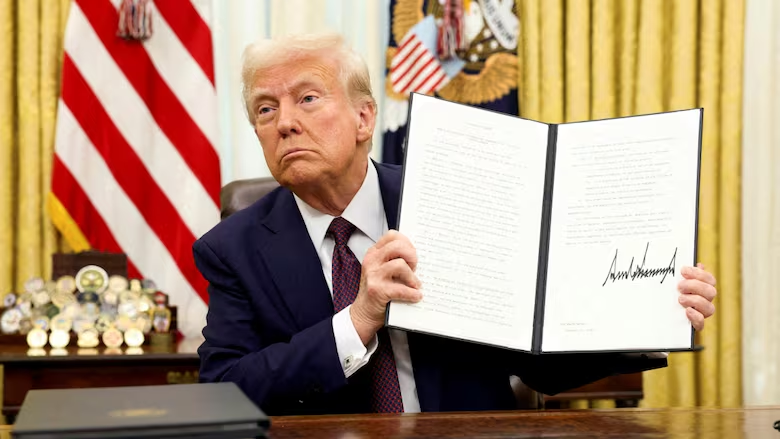
Donald Trump’s Tariff Threats: Their Potential Impact on Canada’s Cultural Industries

Image: Shutterstock.com

With a general election in Canada now set for April 28, attention will be focussed south of the border to see what Donald Trump says and does next. Apart from his tiresome and insulting trope about Canada becoming the 51st US state, how best to deal with the economic fallout from the imposition of unilateral US tariffs on Canadian exports to the US will be the big election issue. Indeed, the drumbeat of tariff threats emanating from self-proclaimed “Tariff Man” is becoming overwhelming, both in terms of tariffs already applied, but also regarding potential future tariffs. As we have already seen, the uncertainty and almost daily changes, (government by tweet), are roiling markets and undermining investor confidence. With respect to Canada there have been repeated threats of what is to come while some tariffs, such as those on steel and aluminum that were applied globally, are already in force. Then there are the threatened 25% tariffs on all Canadian (and Mexican) imports, except for energy products which will be taxed at a 10% level, imposing additional costs on US consumers. (The example of potash, an essential product needed by American farmers is an interesting case study. It is basically only available from Canada, unless you import it from Russia, Belarus or China. The US does produce a small amount but 85% of US potash consumption comes from Canada. So much for President Trump’s mantra that Canada has nothing the US needs. When US farmers squealed loudly, the duties on potash were suddenly lowered from 25% to 10% and then suspended completely under an exemption for all products covered by CUSMA).

The 25% tariffs designed to hinder the export of automobiles and car parts (amongst other products) manufactured in Canada from being shipped to the US —a measure which incidentally contravenes the terms of the US-Canada-Mexico Agreement (USMCA/CUSMA)—are temporarily on suspension given the representations made by US auto manufacturers who had to explain to the White House how integrated North American supply chains work, but any products not covered by USMCA/CUSMA are still subject to the 25% tariff. The pretext for this violation of a ratified trilateral trade agreement is supposedly the “national emergency” created by the flow of fentanyl and illegal immigrants from Mexico and Canada. The only problem with this rationale is that, in the case of Canada,  there is a greater flow of illegals from the US to Canada than vice versa, and the seizures of fentanyl at the northern border by US officials in 2024 totalled less than 20 kilos, less than one percent of the amount seized on the southern border. Thirteen grams (that’s less than half an ounce) were seized in January. This year, US border officials have caught more people smuggling eggs from Canada into the US (where the price of eggs has shot up owing to avian influenza in US poultry flocks) than fentanyl. But the facts appear irrelevant to the Trump Administration; what is important is to create a pretext to violate the USMCA.

That pretext was used to trigger the International Emergency Economic Powers Act (IEEPA). This legislation allows the President “to deal with any unusual and extraordinary threat, which has its source in whole or substantial part outside the United States, to the national security, foreign policy, or economy of the United States”. It was first enacted in 1977 and is designed to deal with acts of terrorism or other threats to the security of the United States. It confers wide, albeit temporary, powers on the Executive Branch and has been used in situations like the Iran hostage crisis in 1979, the Soviet invasion of Afghanistan and to deal with various identified terrorist groups. Using it to punish Canada because under 20 kg (43 lbs). of fentanyl were seized in the course of a year at the Canada-US border is clearly an abuse of the intent of the Act. Notwithstanding, that is what Trump used to impose USMCA noncompliant tariffs on Canada.

The temporary suspension of the 25% tariffs on Canadian (and Mexican) imports will apparently end on April 2, when Trump plans to impose reciprocal tariffs on a global basis. How these will be calculated is anyone’s guess. The President has indicated that in addition to whatever tariff irritant he can find, he might also include other measures in US calculations that in his view discriminate against US goods and services. Thus, while most US products enter Canada tariff free (with the notable and unfortunate exception of most dairy products, which are subject to Canada’s outdated supply management system), Trump could take aim at other policies he doesn’t like. For example, while many US banks operate in Canada, none of them are full-service retail banks allowed to take deposits (but nor are they required to have the same capital requirements). Then there is the fact that Canada, like the EU, imposes a value-added tax (VAT) on most products (basic foodstuffs being the primary exception), called the GST (Goods and Services Tax). This is another potential target even though it is applied without discrimination to US, Canadian or products from any other country. Likewise, longstanding measures that provide protection and subsidies for Canadian cultural industries, like broadcasting (AV and music) content quotas or more recent mandatory financial contributions to Canadian content funds, along with funding obligations to support local journalism, could potentially become targets.

Would Google try to reopen the commitments it finally made to support Canadian journalism in order to avoid designation under the Online News Act? Will the mandatory “contributions” to Canadian content creation that the CRTC has imposed on foreign streamers become an issue? A prominent US trade association, the Computer and Communications Industry Association (CCIA), went so far as to claim that ”the CRTC’s structure of mandatory contributions contravenes Canada’s commitments to the United States under CUSMA”. While I think that claim is doubtful, if the Trump Administration regards the CUSMA as just a piece of paper to be ignored at will, US industries should think twice about using it as a lever against Canada. In any event, in my view the best approach is to continue to stress the value of cooperation and mutual benefit, as Canada has been trying to do by explaining to the Trump Administration why tariffs are self-defeating. In terms of AV production, the contribution that US content producers make to the Canadian production industry is significant even if there are disagreements about the extent to which US production in Canada helps or hinders creation and distribution of Canadian content.

It is important to note that all countries impose investment or trade restrictions of one sort or another, and the US is no exception. These restrictions are weighed in terms of the balance of reciprocal benefits when trade agreements are negotiated, including the current USMCA/CUSMA signed by Trump himself in his first term. But if you are not inclined to respect the commitments you have made, and intend to ignore carefully negotiated and signed treaties, then any domestic measure can become a target. Uncertainty as to what could happen next is a major concern. Two Canadian cultural industries that are keeping their heads down and hoping for the best are art dealers and book publishing.

Earlier this month, the Globe and Mail reported that art dealers and galleries are facing slowdowns in the face of the uncertainty brought about by the Trump tariff threats. Books, art and other informational materials were granted an exemption when Trump first imposed the tariffs on Canada, using the excuse of fentanyl trafficking. Buried within the legislation used to suspend USMCA/CUSMA obligations, (the IEEPA referred to in paragraph 3 above) is a provision that creates certain exceptions, amongst which is “any information or informational materials, including but not limited to, publications, films, posters, phonograph records, photographs, microfilms, microfiche, tapes, compact disks, CD ROMs, artworks, and news wire feeds”, unless controlled by some other authority. (Section 1702 (b)(3)). While US Customs noted the exception when publishing its Notice of Implementation, the on-again/off-again tariff implementation has created anxiety and uncertainty, not least of which is the possibility that any random Customs officer can hold up a shipment based on an individual (mis)interpretation of the regulations. Compounding the issue is the announcement by Canada of 25% retaliatory tariffs that include, among other things (the targets of the retaliation are wide covering everything from toilet paper to drones), “Paintings, drawings and pastels, executed entirely by hand”.

Book publishers are also exempted under the IEEPA and are keeping their heads down, as noted by another article in the Globe. Many Canadian publishers do not ship much to the US but some do, including companies that are exclusively printers rather than full service publishers. In the case of Friesens Corp, a printer in Manitoba, the bulk of their business is from US customers. However, now a new threat has risen for Canada’s independent book sellers. Books have been included on Canada’s retaliation list, and if books from the US are subjected to a 25% retaliatory tariff, the cost will be passed on to bookstores, and ultimately consumers. Independent bookstores already work on very thin margins and an additional charge will likely affect sales. Harm to Canadian business and consumers is the flipside of punishing US exporters, just as harm to US consumers will result from US tariffs on imports. Surely it would be best to leave a cultural product like books out of the trade war.

What happens next with regard to tariffs on exports to the US, from Canada or elsewhere, seems to depend on Donald Trump’s mood of the day. The expected announcement of “reciprocal tariffs” on April 2 will create further uncertainty and likely retaliation, further feeding the spiralling trade war. The fact that import tariffs are levied on the importer and are largely passed on to consumers seems not to have registered with the Trump Administration. They can certainly raise revenues, but if the end goal is to impede imports so that all production is reshored to the US, then presumably the revenue windfall (largely ultimately paid for by US consumers) will ultimately disappear. To depend on tariff revenues to fund more tax cuts in the US is ultimately a self-defeating strategy. In the meantime, the US economy will have suffered the impact of increased prices on all imported goods.

The Trump tariffs have had the effect of causing maximum disruption and chaos, and if that was the goal, then Donald Trump has succeeded. In the meantime, Canadians have until April 28 to figure out which political party and leader is best equipped to help navigate the treacherous waters ahead. Whatever happens, copyright and cultural industries are unlikely to escape getting wet.

© Hugh Stephens, 2025. All Rights Reserved.

This post has been updated to include reference to potential Canadian retaliatory tariffs on US book imports and the impact this will have on independent bookshops in Canada.

Donald Trump’s Punitive Tariffs on Canada: A Personal Commentary

Image: CBC

This blog post is an “extra”. It is tangentially copyright-related (after all, this is supposed to be a copyright blog) but I will admit it’s essentially a non-copyright personal opinion piece. I was incentivized to write it as a result of various conversations I have had with friends and colleagues during this past weekend about the impact and rationale behind Donald Trump’s punitive tariffs on Canada.

Do President Trump’s 25% tariffs on all imports from Canada (except for oil and gas which will be tariffed at 10%) have anything to do with copyright? The short answer is “probably not”, although judging from the vindictiveness of the President toward Canada, as well as an apparent inability to understand how international business is actually conducted, I wouldn’t rule out him finding some excuse to make life difficult for US studios that produce films in Canada, or for Canada to retaliate against US content providers as it desperately searches for a way to get the message through to anyone south of the border who may have Trump’s ear. In either case this would be a mistake. Hollywood is an unlikely source of influence on the President, although Silicon Valley might be a more likely prospect. Both Canada and the US film and TV industry have benefited from having the option of producing in Canada. It’s called win/win, a formula that seems alien to the current President.

So, there could be (but hopefully not) an impact on copyright industries from the fallout from the economic war Trump has declared on Canada, and the inevitable retaliation. (Canada’s initial retaliation list focussed primarily on foodstuffs, appliances and clothing, not affecting copyright industries). Economically, retaliation is a bad idea, inflicting pain on your trading partner but also causing a degree of self-harm. However, in the world of trade negotiations, it is inevitable and frankly is the only thing that Canada can do other than to turn the other cheek and say, “Hit me again”.

However, beyond the world of copyright that I usually write about lies another world, the world of international trade and security, a space in which alliances, cooperation, and mutual respect among trading partners are important. It is what is happening in this world that I want to talk about briefly today, from a personal perspective.

The announcement of the Trump tariffs on Canada has to be just about the most short-sighted policy announcement imaginable. As the Wall Street Journal put it, this is the “dumbest trade war in history”. Not only that, it is a blatant violation of US trade and treaty obligations under the USMCA/CUSMA. What is driving Trump to punish Canada, other than personal spite, is hard to fathom.

Forty years ago, Canada embarked on the path of economic cooperation and integration with the United States through the negotiation of the Canada-US Free Trade Agreement, overcoming decades of suspicion and various failed attempts to establish Canadian manufacturing in a small market behind high protective tariff walls. I was involved in a minor way, buried in the trade bureaucracy of the Department of Foreign Affairs and International Trade, and later the Trade Negotiations Office. It was a big roll of the dice for Canada, giving up quite a bit of economic sovereignty in exchange for agreed rules on market access. Both sides negotiated hard, but at the eleventh hour finally got to “yes”. It was a big step forward, promising greater prosperity on both sides of the border. We believed that when the US made commitments, it would respect them. Silly us.

There were economic advantages for Canada to develop an integrated market with the United States, but there were also important advantages for the US and US business. Production could be specialized where it was most economically and geographically advantageous to do so, supply chains could be integrated, tariffs would be (mostly) eliminated and the border would not impede business. Within the agreed rules, people and goods could move freely. US auto companies in particular, (Ford, GM and (then) Chrysler), were particular beneficiaries, but so were consumers in both countries. The rules around this grand bargain were ratified in the form of a treaty, later expanded to include Mexico. The objective was to minimize disruptions and where disagreements occurred, to settle them through a fair and impartial dispute settlement process in a timely way. This process was renewed under the USMCA/CUSMA, signed by Donald Trump in 2018. What Trump is doing now is effectively tearing up the commitments he made and which have been respected since the late 1980s, through both Republican and Democratic administrations.

The legal excuse being put forward for this trade war is the “national emergency” of fentanyl and illegal migrants. The USMCA does have provision for a national security override, Article 32.2.1.(b) which says;

Nothing in this Agreement shall be construed to..preclude a Party from applying measures that it considers necessary for the…protection of its own essential security interests.”

By invoking fentanyl and migration as “essential security interests” to justify his actions, Donald Trump is seeking to manufacture a pretext–at least insofar as Canada is concerned–allowing him to renege on US trade commitments enshrined in a Congressionally-ratified treaty that he signed. If there is a crisis, the problem does not lie with Canada. Last year exactly 19.5 kg of fentanyl (43 lbs) was seized at the Canadian border, less than 1% of the total seized at the Mexican border (21,148 lbs). In terms of illegal migration, US Customs and Border Patrol apprehended just under 24,000 illegal migrants coming into the US from Canada (Canada apprehended a greater number trying to sneak into Canada from the US, so the flow of illegals from Canada to the US was actually below zero). By contrast, on the Mexican border, about 1.5 million migrants were arrested by US authorities. Again, the Canadian border “problem” was about 1% of the total of migrants on the southern border. (I am not trying to trash Mexico but simply demonstrate how the rationale put forward to impose the tariffs on both countries is wildly disproportionate when it comes to Canada). How can Trump with a straight face use this “national emergency” as an excuse to try to cripple the economy of a friendly neighbour, an ally, and the largest customer for manufactured US goods globally? (Canada is the top export market for 34 states). Because he can, I guess.

It is apparent that facts have not been allowed to get in the way of what appears to be a personal vendetta. In fact, it appears that Trump is convinced in his own mind that Canada should not exist as a nation. His repetitive and insulting trolling of Prime Minister Trudeau as “Governor” Trudeau and the belief that Canada should become the 51st state is both tiresome and insulting. (Parenthetically, if Canadians ever agreed to become part of the US, why should Canadians settle for just two Senators? After all, the Province of Ontario has a larger population than 46 of the 50 US states, not to mention that Canada is the second largest country on the planet geographically). In reluctantly announcing retaliatory tariffs, which will hurt American workers and consumers, Justin Trudeau made a plea to Americans, recalling the famous words of John F. Kennedy;

“Geography has made us neighbours, history has made us friends, economics has made us partners and necessity has made us allies.”

These wise words are worth recalling. It is estimated that the tariffs, if sustained, will tip Canada into recession, increase the unemployment rate, shave several points off GDP and lead to a further drop in the Canadian dollar. As Ontario Premier Doug Ford put it, “he’s coming after our families and our jobs”. There will be negative impact on the US economy as well, but the unanswered question is “why would you want to deliberately destabilize your friend and ally, best customer and neighbour?”. Is it not in the interests of the US to have a prosperous, reliable, stable and friendly neighbour on its northern border? I would have thought so.

The current situation causes me both great sadness and repressed anger. Sadness because, like many Canadians, I have spent considerable time in the US and in the company of Americans. I grew up not too far from the border like many Canadians, so US television was part of my mispent youth. I attended grad school in the US. I have taken a number of holidays in various parts of the US. During my years on many foreign postings in Canada’s foreign service, I worked with and cooperated closely with my US colleagues in similarly located American embassies. Later I worked for a US company and had, and still have, many American friends and former colleagues. I have never detected any animosity toward Canada or Canadians. Thus I simply cannot believe that when he was elected, Donald Trump was given a mandate to go after Canada. But that is what he has done.

As I said at the beginning of this post, there is not much here related to copyright–but I needed to get this off my chest. I hope that saner heads will prevail, but much damage has already been done in Canada to the goodwill and trust that has long existed between Canadians and Americans. I wish it were otherwise. Maybe one day it will be again.

© Hugh Stephens, 2025.

Just before posting this, news reports indicated that President Trump had agreed to pause the imposition of tariffs on Canadian goods for 30 days after speaking with Prime Minister Trudeau. They were to have gone into effect tomorrow (February 4). Earlier he did the same for Mexico. While a temporary reprieve, this really doesn’t change much.

Fair Dealing, Passwords and Technological Protection Measures (TPMs) in Canada: Federal Court Confirms Fair Dealing Does Not Trump TPMs (Digital Lock Rules)

Image: Shutterstock.com

Anyone who has been following this case, Blacklock’s Reporter v Attorney General of Canada, might be scratching their heads about now, saying, “Wait a minute, didn’t I just read the exact opposite somewhere?”. Yes, if you were reading Michael Geist’s blog, that is precisely what you read. On June 1, Dr. Geist jumped in with both feet with his blog “Huge Win for Copyright User Rights in Canada: Federal Court Rules Digital Lock Rules Do Not Trump Fair Dealing”. That is one interpretation of the outcome of this case but, IMHO, there is one heck of a lot of spin and some wishful thinking in that headline. In fact, if you were to listen to the breathless self-congratulatory podcast on Prof. Geist’s blog featuring the lawyers who represented CIPPIC, the “Samuelson-Glushko Canadian Internet Policy and Public Interest Clinic” at the University of Ottawa (of which Dr. Geist was a founder) in their intervention, you would think that Canadian copyright law had suddenly been turned on its head by this decision.

While there has been a lot of commentary from both sides of the copyright divide on this case, I think some additional perspective is needed. Apart from the “huge win” Geist school of thought (picked up by a number of blogs from law firms), there have been comments that this marks the end of password protection in Canada as well as statements claiming that this decision puts Canada in violation of the CUSMA/USMCA. Although there were indeed controversial aspects of the decision relating to passwords and circumvention, it did not invalidate the role of access control TPMs, nor did it violate the CUSMA (which requires remedies be taken against circumvention without authority), nor did it give a blank cheque to password sharing. Let’s dig a bit deeper.  

First, we could start with my headline above stating that “Fair dealing does not trump TPMs.” This is admittedly a bit of counter spin but is just as accurate as the headline in Michael Geist’s blog. The Court’s decision does not allow or condone circumvention (i.e. the “trumping” or “overriding”) of a TPM, even if the purpose of the circumvention is to engage in a fair dealing activity. That is because the Court ruled there was no circumvention given the circumstances of the case. As the judge noted,

In the case at bar, there is no circumvention of a TPM simply because the password was not circumvented: it was properly obtained and used for a legitimate purpose.” (Para 120)

We may disagree with the conclusion that there was no circumvention, but it is important to note that the Court did not sanction circumvention.

First, a quick clarification of what a TPM is. A TPM (Technological Protection Measure), sometimes called a “digital lock” is defined in the Copyright Act, s. 41, as;

any effective technology, device or component that, in the ordinary course of its operation, (a) controls access to a work, to a performer’s performance fixed in a sound recording or to a sound recording and whose use is authorized by the copyright owner; or (b) restricts the doing – with respect to a work, to a performer’s performance fixed in a sound recording or to a sound recording – of any act [which only the copyright owner has the right to do or authorize].

The ”or” is important, since this distinguishes between two types of TPM, those that control access to a work (Part a of Section 41), aka “access controls” (which is what we are concerned with in this case), and those that control reproduction or other copyright related activities related to a work (Part b). aka “copy controls”.

Access controls provide the gateway that allows business models to function in the digital environment. You cannot access a work protected by copyright unless you are given the “key”, normally by paying for a subscription. (This is where paywalls and passwords come into the picture). Copy controls (Part b of Section 41) protect a copyright owner’s rights with respect to how the work is used. Those rights include the right to reproduce and distribute the work, but these rights are subject to fair dealing, as are copy controls in both Canada and the US, (fair use in the US case). It is only the circumvention of access controls that is prohibited by law. The Blacklock case was about access controls. (Often copy controls are bundled with access controls, in which case the access control protection prevails).

Because a copy cannot be made for fair dealing purposes unless access is licitly obtained (i.e by not circumventing access controls), it seems reasonable to state, as I have done, that fair dealing does not trump TPMs/digital locks.  Content has to be accessed legally in order for fair dealing rights to be exercised. A TPM may be part of that legal access. If a TPM has to be circumvented in order to exercise a fair dealing purpose, that is offside Section 41.1 (1) of the Canadian Copyright Act. The Blacklock’s case does not change this.

The Court was very precise in its language stating that the fair dealing rights of the users, in this case employees of Parks Canada, could be exercised because they had licit access to the content through a licitly obtained password. In other words, there was no hacking, bypassing or decryption of a TPM in order to obtain access to and then subsequently use the content on the basis of fair dealing. At the same time, the Court refrained from ruling on whether or not a password was a TPM. More on this later.

This reaffirmation of protection afforded to a TPM will no doubt disappoint Dr. Geist and others who in the past have argued that it should be legal to bypass a TPM in order to assert fair dealing rights. He has claimed there is a self-described “fair dealing gap” that stops users from accessing content to exercise fair dealing. He has advocated for a “long overdue fair dealing exception for the digital lock rules” and has also called for establishing an exception “to allow for circumvention of a TPM for any lawful purpose”.

There are a few circumstances when it is legal to break a TPM. These are specified in the Copyright Act and include such things as law enforcement and national security; reverse engineering for software compatibility; encryption research; verification as to whether a TPM permits the collection or communication of personal information; security testing of computer systems; accessibility for disabled persons; temporary recordings made by broadcasters for technical reasons; and unlocking cell phones. Fair dealing is not among them.

To grant a legal exception to allow users to bypass a TPM in order to access content for a fair dealing purpose, such as research, would gut the ability of creators to protect content and operate a business model in the digital age. While third parties can use content in accordance with the law, including fair dealing purposes, access must be gained legally. This is just as true in the digital age as it was in the analog world. As one of the lawyers on the Geist podcast himself said, you can’t throw a brick through the window of a bookstore and grab a book just to exercise your fair dealing rights. Nor can you hack a TPM that controls access to a work, whether or not your ultimate purpose is to conduct research. The Blacklock case did not change this. I explained all this in a blog I wrote several years ago (Why Can’t I Legally Pick ‘Digital Locks’ to exercise my Fair Dealing Rights?)

But what about passwords and paywalls? Aren’t they access control TPMs? I would have thought so, and that is what Blacklock’s contended, but it seems that in terms of jurisprudence this may be unclear. A password is certainly a common means to control access, to open the door to protected content once payment or some other form of authorization is given, and is often an integral feature of a TPM. The Attorney General of Canada (AGC), representing Parks Canada, asserted that a password is not a TPM (and thus the use of a password does not constitute circumvention), and asked the Court to so affirm. It did not do so. In the absence of any evidence or expert testimony as to what a TPM is, the Court declined to address the issue. To quote from the decision, (Para 111)

“…the issue raised clearly lacks any evidence of a technical nature…There is no evidence either of what a “password” is and what it was in this case: thus, there was no expert evidence led by either party on what, in this case, constitutes the TPM.”

The Court then went on to a discussion of paywalls and whether a paywall was a TPM, or merely a means of enforcing a TPM. The end result was uncertainty regarding how a TPM (which you will recall is any effective technology, device or component that controls access to a work) is to be defined. The Court also focussed on the word “effective” to dismiss Blacklock’s argument that s. 41 was intended to empower owners to protect their works with any technological tool at their disposal, yet “effective” has been interpreted in CUSMA to simply mean that it cannot be accidentally bypassed. (Article 20.66 FN 72).

Another loose end is the meaning of circumvention. Password sharing, apparently, is not circumvention according to the Court.

Key takeaways:

  1. The absence of expert testimony as to what constitutes a TPM was not helpful to Blacklock’s case. The judge admitted that a password could arguably constitute a TPM (Para 133) but in this case there was a paucity of evidence to allow that determination.
  2. The fact that the password was obtained licitly was also not helpful to Blacklock’s. The password was not circumvented (defined as descrambled, decrypted, or otherwise avoided, bypassed, removed, deactivated or impaired). A subscription had been paid for, and a password provided, albeit shared within the organization-but for a fair dealing purpose.
  3. The terms and conditions under which the subscription was purchased were ambiguous. This case dates back more than a decade. Memories are not precise. No exact replication of the Blacklock’s website at the time the subscription was purchased (2013) is available, having vanished into internet history. Testimony as to what it contained was contradictory and inconclusive. The terms of use were contradictory, allowing circulation of Blacklock’s content for personal and non-commercial use, but then referring to bulk subscriptions. Moreover, the terms and conditions did not require explicit acknowledgement by the user, opening it to claims that the terms may not have been read in full or understood. In short, there were a number of unfortunate loopholes that weakened the case. To use a cricket analogy, the Blacklock’s case was played on a regrettably weak wicket.
  4. The use of the content was, in my view, consistent with fair dealing. It constituted non-commercial research. Of that there can be little doubt. It met the fair dealing test.

All of these elements created a perfect storm of conditions that undermined Blacklock’s case, although the Court specifically rejected the AGC’s low-blow allegation of entrapment and deception by Blacklock’s.

Going forward, the issue of whether a password or paywall is a TPM needs to be clarified. If it is, does unauthorized sharing of a password constitute circumvention? The circumstances of the sharing will certainly be relevant. As the Court stated (Para 125),

how the password was obtained is significant as this may prevent a user from invoking the fair dealing provisions of the Act. Obtaining content by descrambling a signal or decrypting a communication may render invoking fair dealing very difficult to establish successfully.”

Properly drafted terms and conditions can provide protection against unauthorized sharing of passwords, avoiding a weakness faced by Blacklock’s in this case. The Court also went on record to note that its decision was decided on the evidence presented in this case alone and is not to become a reference at large.

It is legitimate for Blacklock’s to feel cheated by the Court’s ruling that there was no circumvention of a TPM in this case, and I can sympathize with their frustration. At the same time, it is important to note that the Court did not legitimize the circumvention of a TPM for fair dealing purposes. The law remains that a fair dealing purpose does not legitimize the circumvention of a TPM, (or the breaking of a digital lock if you will).

Commentators and analysts are free to take what they wish from any case, emphasizing this or that aspect. Michael Geist and CIPPIC have provided their interpretation, or spin. Now you have an alternate perspective. While the outcome is not what Blacklock’s hoped for, bypassing or circumventing a TPM in the name of fair dealing has not been legitimized. In other words, “Fair Dealing Does Not Trump a TPM”.

© Hugh Stephens, 2024. All Rights Reserved

The CRTC and Online Streaming: Money Now; Details Later

Photo: Author

The first shoe has dropped for foreign online music and video streamers in Canada, at least those generating more than $25 million a year in “contribution revenues” from the Canadian market. On June 4, the Canadian Radio-television and Telecommunications Commission (CRTC) announced it will be imposing “base contributions” of 5 percent of annual Canadian contribution revenues on streamers such as Netflix, Spotify, Amazon Prime, Disney + etc. as part of the implementation of the Online Streaming Act passed last year. (Canadian streamers associated with a Canadian broadcast entity, i.e. Crave, are exempt). The Act brings online streaming services under the regulatory purview of the broadcast regulator. The “base contributions” are to begin in the 2024-25 broadcast year, beginning September 1 of this year, and are expected to generate in the range of CAD$200 million annually. According to the Minister for Canadian Heritage, Pascale St. Onge, the levy is about “fairness in the system” and will be good for the streamers because it will create more content that will “most likely” go back on their platforms. So why are they not happy? (And they are not).

They are not happy because this is just the first shoe to drop, and while they now know the cost of this shoe, they don’t know what the other shoes are going to cost, what exactly those shoes will look like, or indeed whether they will be allowed to try them on. Because, you see, the rules about who can access the Funds that their money will be going into, and on what terms, have not yet been determined. Key decisions regarding the definition of Canadian content and who can own or control Canadian content (through holding the copyright) are a couple of years down the road. With those decisions could come other requirements, such as allocating a percentage of revenues to production of local content on top of the current “base contribution” to existing Funds, discoverability obligations, and possibly others.

With regard to the top-up of existing funding mechanisms, just about anybody who is anyone in film, TV or music will be lining up to get a share of the $200 million pie. The list includes (and I am not kidding) no less than 11 identified recipients named by the CRTC;  the Canadian Media Fund, the Independent Local News Fund, the Black Screen Office Fund, Certified Independent Production Funds supporting OLMC (Official Language Minority Communities), the Indigenous Screen Office Fund, FACTOR and Musicaction, a new temporary fund supporting local news production by commercial radio stations outside designated market, the Canadian Starmaker Fund and Fonds RadioStar, the Community Radio Fund of Canada, direct expenditures targeting the development of Canadian and Indigenous content and, last (and least, in terms of percentage of the funding from audio online undertakings), the Indigenous Music Office. Is anyone missing? What about the Punjabi Weather Network or the Lawn Bowling Broadcast Fund? This is micro-management gone wild.

The 5% contribution funding is divided up into various slivers, some larger than others, by the Solomons at the CRTC. As for the Minister’s optimistic belief that those making the contribution will “most likely” benefit from the content produced, I struggle to see how Netflix or Disney+ will get much out of the Independent Local News Fund (which is currently funded by Canadian cable platforms) or Francophone productions in British Columbia or Alberta. The argument, no doubt, is that this is the price for participating in the Canadian broadcast ecosystem, that now includes online streaming undertakings. Music streamers, on the other hand, will probably benefit from the development of more Canadian talent.

As a consumer of music and audio-visual content, I am also a participant in the broadcast ecosystem and already pay in various ways, through income and sales taxes, and streaming and cable (yes, I am still one of them) subscription fees. I have a hunch I am about to pay more. For several years now the AV streaming services have been on a spending spree in an attempt to grab market share. Profitability came second, but that is rapidly changing as the market matures. And that means subscription fees are going up. (Netflix is killing off the basic subscription I have had for a number of years and given me the choice of a slight price reduction if I put up with ads, or else face a roughly 50% increase in monthly subscription fees. I am still dithering). And this was before the CRTC dropped its latest bombshell. If the CTRC is going to take 5% or more of revenues, simple math tells you there are only a couple of ways to make that up, cut costs or raise prices. “Costs of doing business” inevitably get recovered from customers. If the price of supporting a viable content industry in Canada was limited to a 5% increase in my monthly subscriptions, I would gladly pay but I doubt that my contribution will be limited to 5%.

Ironically, the issue of whether the CRTC should regulate streamers was postponed for years in Canada because of aversion of what was referred to at the time as the “Netflix tax”. No-one knew for sure what that meant; it could have meant imposing sales taxes on a Netflix subscription (which has since been done), or it could have meant a levy on Netflix (which was the first streaming service to enter Canada) to fund Canadian content. But while people weren’t clear on what a Netflix tax was, they knew they didn’t like it. It became a symbol of piling yet one more nuisance fee onto consumers (“carbon tax” anyone”?) and while a small fee on a streaming subscription was unlikely to send anyone to the poor house, politicians from all parties outdid themselves by swearing to avoid any form of Netflix or internet tax.

Serendipitously, I have just finished reading Howard Law’s new book, “Canada vs California-How Ottawa Took on Netflix and the Streaming Giants”, a fascinating deep dive on Bill C-11, which became the Online Streaming Act, and its unsuccessful predecessor Bill C-10. (For those who don’t know, Howard also publishes a weekly blog, MediaPolicy.ca, another essential read for anyone interested in the Canadian media scene). Law devotes an early chapter to “No Netflix Tax 1999-2019” and then goes on to take the reader through the painful teething pains of Bills C-10 and C-11. The term “Netflix tax” has fallen out of use these days but the end result of the imposition of the CRTC “base contribution” on foreign streamers is really no different from an indirect tax.

Alternatively, if the streamers do not fund this new “base contribution” by raising prices to consumers, they will likely compensate for it by spending less elsewhere, i.e. on Canadian production, the very objective for imposing the contribution in the first place. According to MPA-Canada, in 2021-22 “foreign investment in production” (FIIP, a metric for international participation in the film and television production industry in Canada) contributed $875 million to production of Canadian content, about 13% of total financing for Canadian-owned content productions. (This is in addition to the much larger Foreign Location Shooting spend on US productions made in Canada). By comparison, the Canadian Media Fund contributed only 7% of total financing for Canadian productions. The foreign contribution to Canadian production was not far off the $1.09 billion spent by Canadian broadcasters on in-house production. A similar scenario exists in Australia, where the government is also exploring various options to require foreign streaming services to fund local production. Yet the streamers are currently the leading source of production funding for Australian adult drama. In Australia, streaming services invest more in this drama than public, commercial and subscription broadcasters combined, despite having no legal obligation to do so.

What does the US government think of the CRTC’s announcement? That will depend on how hard the foreign streamers push the US Administration to intervene, and right now it is not clear what they will do. Part of the issue is those other dangling shoes. The outcome might not be all that bad for the streamers if they are given fair access to the content they will be required to fund. After all, they need to spend on content to fill their pipeline. But the terms of what payback they will get from their required investments are not clear. A lot will depend on what amount of spend the Commission imposes on foreign streamers for production of Canadian content (Cancon), and how Cancon is defined.

Right now, the Canadian content definition is a complicated formula, set by different funding and regulatory bodies, as I outlined in a blog a couple of years ago,  (see “Unravelling the Complexities of the Canadian Content (Cancon) Conundrum”) and as Law outlines in his book. The core is the infamous points system, based on the nationality of key players in the production, plus amount of local spending. In addition, one of the current conditions for a production to be considered Canadian—and thus qualify for tax credits (funding)–is that the copyright and catalogue rights must be held by a Canadian (normally the producer) for a minimum of 25 years. However, the CRTC does not impose a copyright requirement when defining Cancon for broadcast quota purposes. Will this continue when the Commission finally gets around to addressing this issue? That shoe is still hanging there.

If the Cancon definition is tweaked in such a way that the foreign streamers are required to spend a set percentage of local revenues on Canadian content, but at the same time are excluded from being able to acquire such production (i.e. restricted to licensing content they have already invested in), this will be a problem. It is one thing to apply strings when a producer is applying for tax credits (AKA a subsidy). It is quite another to be required to fund production but be excluded from recouping a return on that investment in a way that makes most sense for the funder. With the Cancon definition shoe still dangling, trying to enlist the US Administration to bring pressure on Canada right now may not be the best strategy. Not that this has stopped some of the usual suspects, like the National Foreign Trade Council and the US Chamber of Commerce from weighing in. Their comments are no doubt a marker for future reference if needed. CUSMA/USMCA obligations need to be kept front and centre.

As I noted in an article last year, (“Could or Would the US Retaliate Against the Online Streaming Act (C-11) Now That it is Law?”),the CRTC must be mindful that foreign streamers who contribute to Canadian productions need to be able to access, acquire and distribute them on an equal footing with Canadian streamers, who face no such limitations”. The CUSMA/USMCA trade agreement requires that cross-border digital services be dealt with on a national treatment basis, i.e. accorded no less favourable treatment than Canadian streaming services. The current proviso that exempts Canadian streaming services associated with a Canadian broadcaster from the 5% levy on revenues is not an auspicious start, but we will have to wait to see what happens.

Regarding the link between Cancon and copyright ownership, I know there are people in the industry in Canada whom I respect who argue this is very important to maintain cultural sovereignty. They feel strongly that it is essential for Canadians to hold the copyright in productions to avoid becoming just service producers. They have a point, although there are other considerations that need to be borne in mind. A Canadian producer should be able to hold the copyright (and assume the risk that the production may not be a big earner in future) if they wish, or else assign it, take the money and move on to the next project without the government putting its thumb on the scale of commercial negotiations. And it is not unreasonable for those who provide the funding and invest in a project to be allowed to negotiate commercially on how the asset is exploited.

The CRTC’s June 4 announcement can be considered a down payment or perhaps a first shot across the bow, depending on how you want to look at it. We are in for months, if not years, of more consultations. The CRTC’s own announcements project consultations into 2026, well past the next election. There will be several more shoes to drop, and the political landscape could well change. In the meantime, the streamers will have to start paying into a mixed bag of Funds as directed by the CRTC. As for those all-important details about the regulatory framework, they will come later.

© Hugh Stephens 2024. All Rights Reserved.